Visit Rome: 30 Must-See and Must-Do Attractions
Visiting Rome means diving into the heart of 3,000 years of history, where every alleyway, every square, and every monument tells the story of the grandeur of the Italian capital. The Eternal City captivates visitors with its iconic landmarks, from the Colosseum to the Pantheon, including St. Peter’s Basilica and magnificent Baroque fountains such as the Trevi Fountain. Blending antiquity, the Renaissance, and the Baroque, Rome also offers outstanding museums, such as the Borghese Gallery, the Capitoline Museums, and the Vatican Museums, where art and history meet at every step.
But Rome is not only about monuments: its lively neighborhoods, its sumptuous parks such as Villa Borghese and Villa Doria Pamphilj, and its panoramic hills like the Janiculum invite visitors to stroll and enjoy the city in a different way. Food lovers will discover authentic Roman cuisine, with must-try dishes such as carbonara, cacio e pepe, saltimbocca alla romana, and delicious supplì or carciofi artichokes, symbols of the capital’s rich culinary heritage.
For those who wish to extend their discovery, many excursions around Rome are possible: Ostia Antica, an ancient port city, or Tivoli, with its magnificent Villas of Hadrian and d’Este, offer a journey through time and exceptional landscapes. Whether you are passionate about history, art, nature, or gastronomy, visiting Rome remains a unique experience that combines heritage, culture, and the Italian art of living.
Discover Rome’s must-see highlights with our scavenger hunt in Rome, a mix between an escape game and a cultural tour.
Monuments & Historical Heritage – Rome
The Colosseum
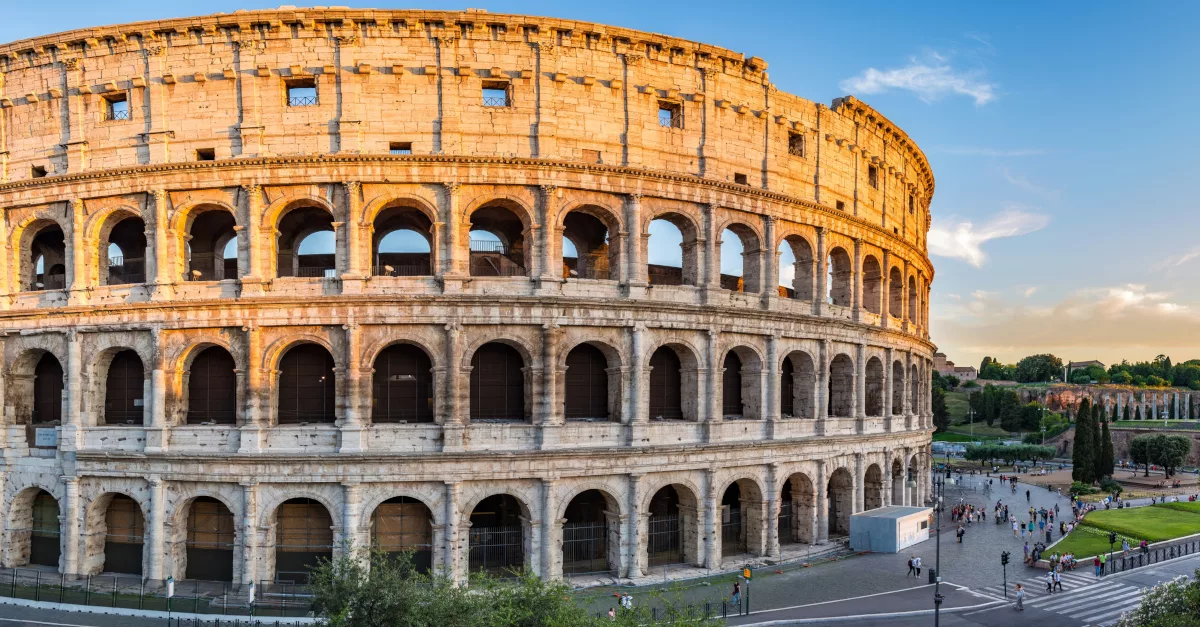
The Colosseum, or Flavian Amphitheatre, is a massive oval amphitheatre located in the heart of Rome.
Its construction began between 70 and 72 AD under Emperor Vespasian and was completed in 80 under Titus. Originally, it was called the Amphitheatrum Flavium, in reference to the Flavian dynasty.
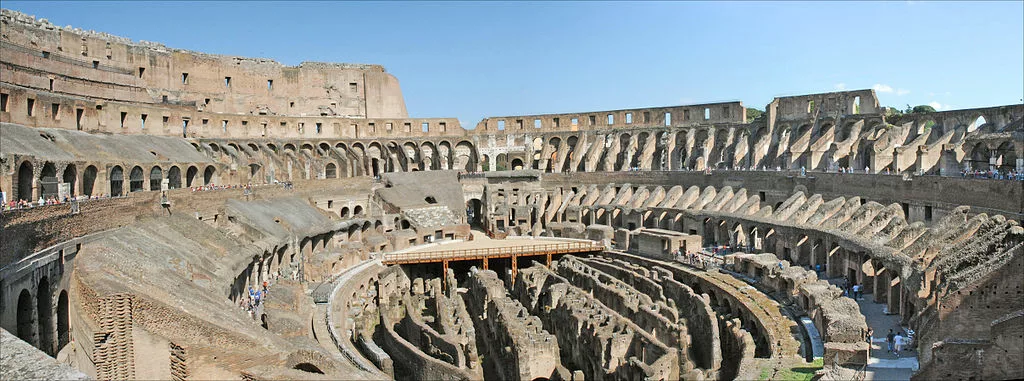
It could accommodate between 50,000 and 70,000 spectators for gladiator fights, wild animal hunts, or reenactments of battles. Its elliptical shape, approximately 189 m long and 156 m wide, was designed to optimize visibility and crowd circulation.
The Colosseum featured a velarium, a retractable awning supported by masts and ropes to protect spectators from the sun.
Beneath the arena was an underground network (the hypogeum) that allowed for the spectacular entrance of gladiators and animals. After the fall of the Roman Empire, the Colosseum was heavily looted: its stones were reused for other constructions in Rome.
Several earthquakes (notably in 1349) damaged the structure, explaining its partially ruined state today.
The Roman Forum
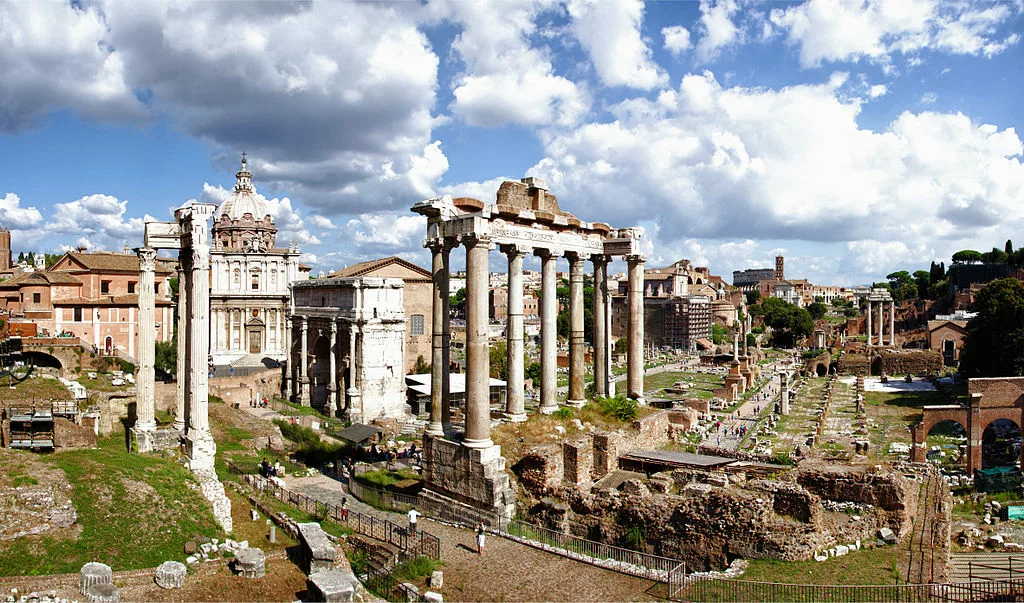
The Roman Forum (Forum Romanum) is a vast archaeological site located between the Palatine, Capitoline, and Quirinal hills in Rome. In Antiquity, it was the nerve center of Rome’s political, religious, judicial, and commercial life.
Originally, the Forum valley was marshy; it was drained thanks to the construction of the Cloaca Maxima, one of the very first Roman sewer systems.
During the Republic, the Forum hosted political institutions such as the Curia (the Senate), as well as commercial porticoes and judicial basilicas. In the Imperial era, prestigious monuments were erected there: the Temple of Vespasian and Titus, the Arch of Septimius Severus, the Basilica of Maxentius, among others.
The Arch of Titus, built around the year 81, commemorates Titus’s victory in Jerusalem and still gives the Forum a monumental appearance today.
The Column of Phocas, erected in 608, is the last monument built in the Forum; it bears the name of the Byzantine Emperor Phocas.
After the fall of the Roman Empire, the Forum gradually fell into oblivion; it was buried, looted, and used as a stone quarry.
Today, the Roman Forum is part of a major archaeological circuit that also includes the Colosseum and the Palatine Hill, attracting millions of visitors.
The Pantheon
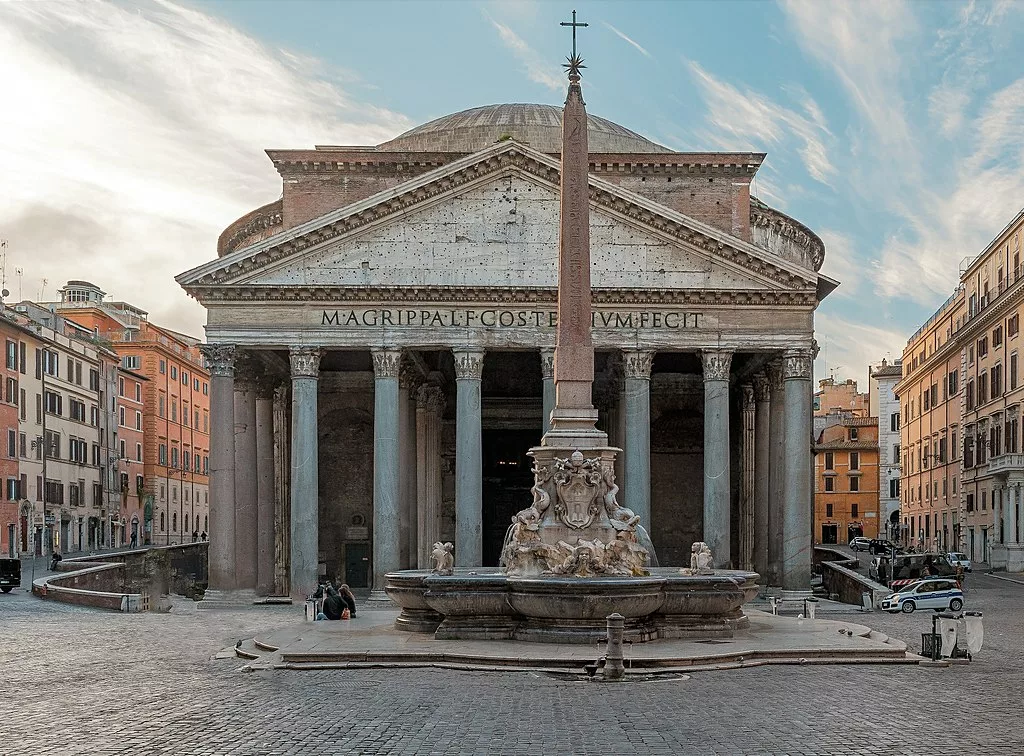
The Pantheon of Rome is an ancient building located on Piazza della Rotonda, built to honor all the gods.
The original building was constructed by Marcus Agrippa between 27 BC and 25 BC, as indicated by the inscription on the pediment: “M. AGRIPPA L. F. COS TERTIUM FECIT”.
The current Pantheon was rebuilt between 118 and 125 AD under Emperor Hadrian, after several fires.
Its dome, with a diameter of 43.30 meters, is a masterpiece of engineering: its interior height equals this diameter, creating a perfect sphere. At the top of the dome is an oculus measuring 9 meters in diameter, which lets in light from the sky and symbolizes the connection with the universe.
The entrance portico is composed of 16 monolithic columns made of granite imported from Egypt, reinforcing the monument’s grandeur. The Pantheon is today a Christian church, consecrated under the name Saint Mary of the Martyrs since the 7th century, which has contributed to its excellent preservation.
It houses the tombs of illustrious figures such as Raphael, as well as Italian kings like Victor Emmanuel II and Umberto I.
Discover the secrets hidden in the columns and the pediment in our scavenger hunt on the must-see highlights of Rome.
The Trevi Fountain
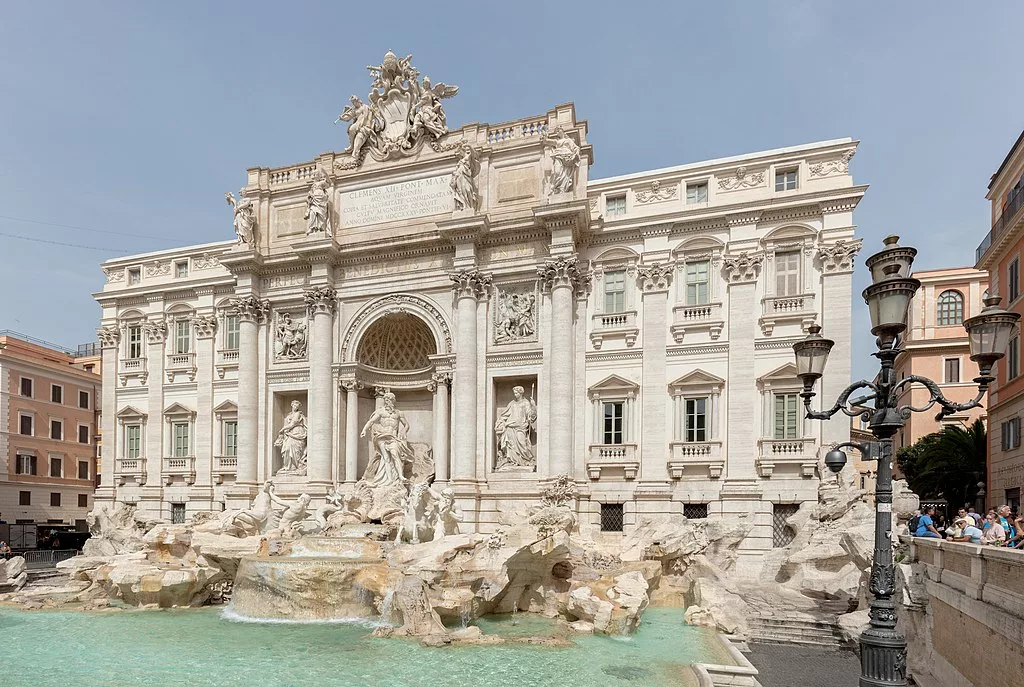
The Trevi Fountain (Fontana di Trevi) is one of Rome’s most famous Baroque monuments. It was designed by the architect Nicola Salvi, and construction began in 1732. After Salvi’s death in 1751, the project was continued by Giuseppe Pannini, who completed the fountain in 1762.
It measures approximately 26.3 meters high and 49.15 meters wide, making it the largest Baroque fountain in the city. The fountain is built against the façade of Palazzo Poli, giving it a majestic structure inspired by a triumphal arch.
At the center, the statue of Oceanus (Neptune) stands on a shell-shaped chariot, pulled by two sea horses guided by tritons. On either side of Oceanus, two other sculpted figures represent Abundance and Salubrity.
The name “Trevi” is believed to come from the three streets (tre vie) that converge on the square where the fountain is built.
The water that feeds the fountain comes from the ancient Aqua Virgo aqueduct, built in 19 BC. According to tradition, throwing a coin into the fountain over your shoulder ensures a return to Rome.
Discover the meaning of the statues of this fountain in our scavenger hunt in Rome.
St. Peter’s Basilica in the Vatican
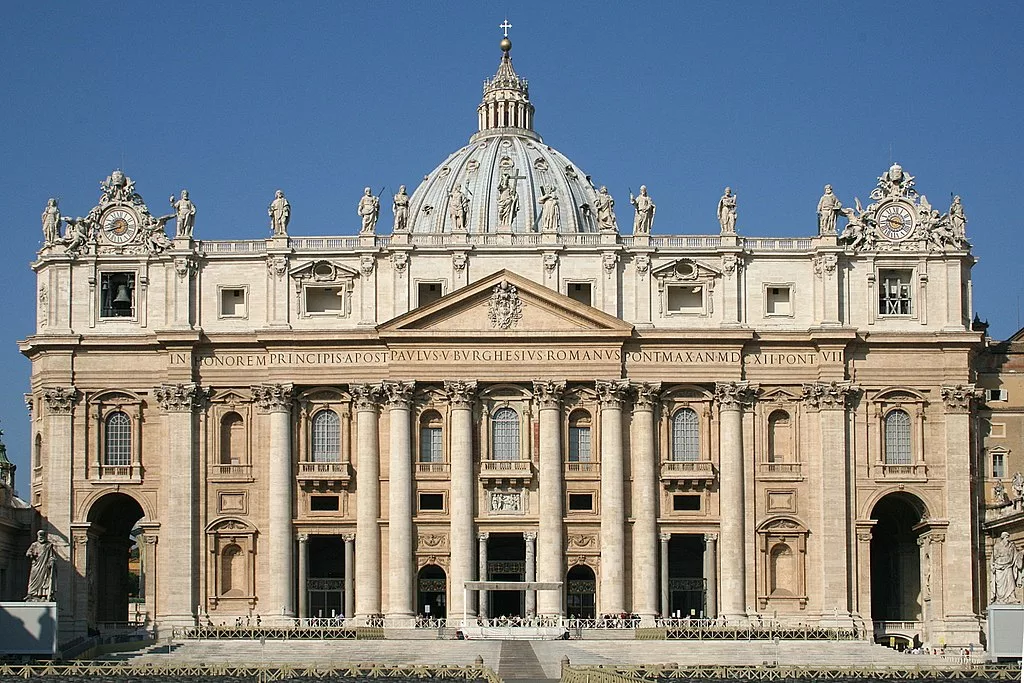
St. Peter’s Basilica, or Basilica Papale di San Pietro in Vaticano, is the principal place of worship of Catholicism and is located in Vatican City. Its current construction began on April 18, 1506, under Pope Julius II and was completed in 1626.
Among the most famous architects who took part in its construction are Bramante, Michelangelo, Maderno, and Bernini.
The basilica features an architectural style blending the Renaissance and the Baroque, particularly visible in its monumental façade and dome. Beneath the main altar lies the tomb of Saint Peter, one of the founding apostles, whom Christian tradition considers one of the first popes.
Visitors can explore the Vatican Grottoes beneath the basilica: a complex of chapels and tombs, some of which date back to the former Constantinian basilica.
Inside, the basilica contains 45 altars and 11 chapels, each decorated with remarkable works of art.
St. Peter’s Square, in front of the basilica, was designed by Bernini: its semicircular colonnades symbolize the maternal arms of the Church.
Castel Sant’Angelo
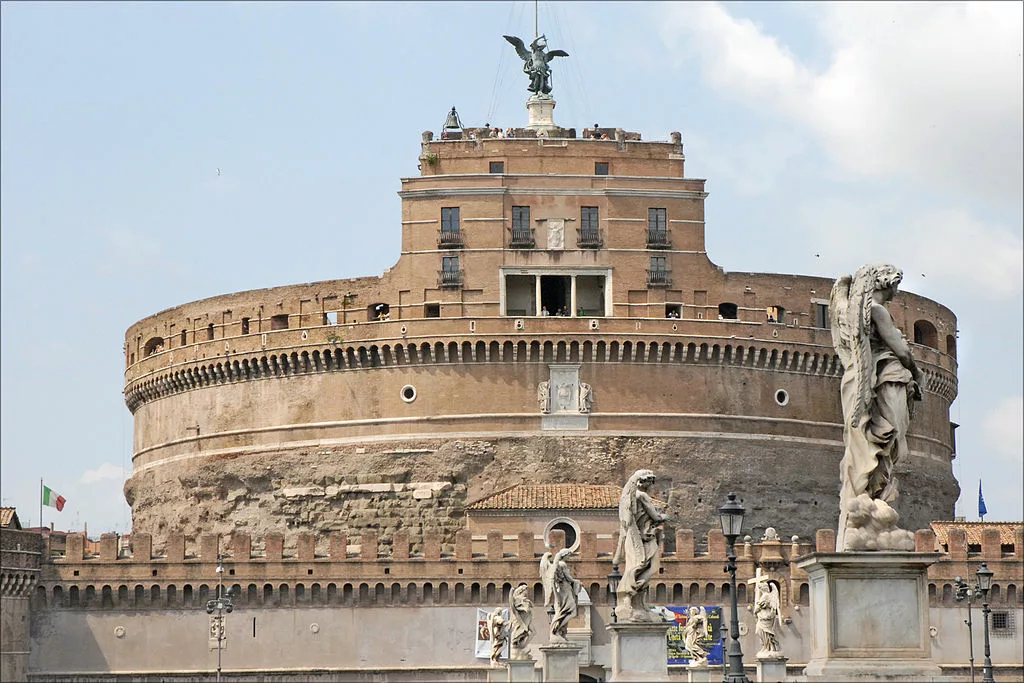
Castel Sant’Angelo is an iconic monument located on the right bank of the Tiber, not far from the Vatican.
Originally, it was the Mausoleum of Emperor Hadrian, built between 123 and 135 AD to house his ashes and those of his family.
Later, it was transformed into a military fortress, notably with the addition of bastions under Emperor Aurelian. Since 1277, the castle has been connected to the Vatican by a fortified passage known as the Passetto di Borgo, which served as an escape route for popes.
The name “Sant’Angelo” comes from a legendary apparition of the Archangel Michael in 590: according to tradition, he lowered his sword as a sign of the end of an epidemic. At the top of the castle stands a statue of the Archangel Michael, created in 1753 by Peter Anton von Verschaffelt, replacing several earlier versions.
During the Renaissance, several popes transformed the castle into a palace; Paul III had richly decorated apartments installed there.
The monument has five levels: they include ancient remains, medieval halls, prison cells, papal apartments, and panoramic terraces.
Today, the castle houses the National Museum of Castel Sant’Angelo, with collections of weapons, paintings, and historical objects, and offers an exceptional viewpoint over Rome from its terrace.
The Baths of Caracalla
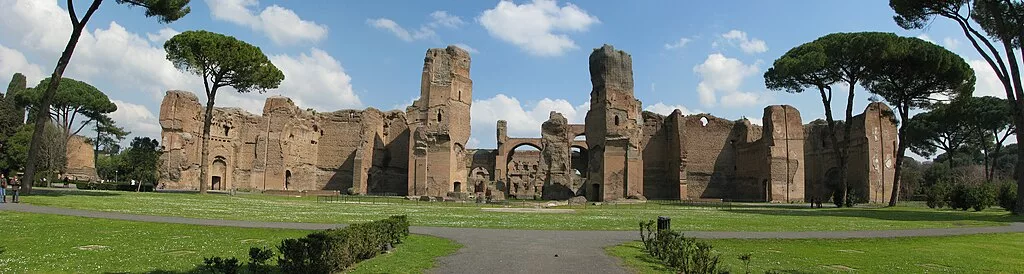
The Baths of Caracalla (Thermae Antoninianae) were built between 212 and 216 AD under Emperor Caracalla.
They were one of the largest and most luxurious bath complexes of ancient Rome, covering an area of approximately 11 hectares. According to historians’ estimates, the site could accommodate up to 1,600 bathers at the same time.
The baths were supplied with water via a special branch of the Aqua Marcia aqueduct, known as the Aqua Antoniniana.
The complex included several rooms: a caldarium (hot bath), a tepidarium (warm bath), a frigidarium (cold bath), and a large swimming pool (natatio).
Excavations have revealed numerous works of art: statues (such as the Farnese Hercules), mosaics, frescoes, and more.
There was also a mithraeum, an underground sanctuary dedicated to the cult of Mithras, discovered in the galleries of the baths.
These baths remained in use until the 6th century; they were abandoned after the aqueducts were destroyed by the Goths in 537. Today, the ruins are among the most impressive in Rome, with some sections of walls still reaching 30 meters in height.
The site is also used today for cultural purposes: concerts and opera performances are sometimes held there, in a highly evocative historical setting.
The Via Condotti
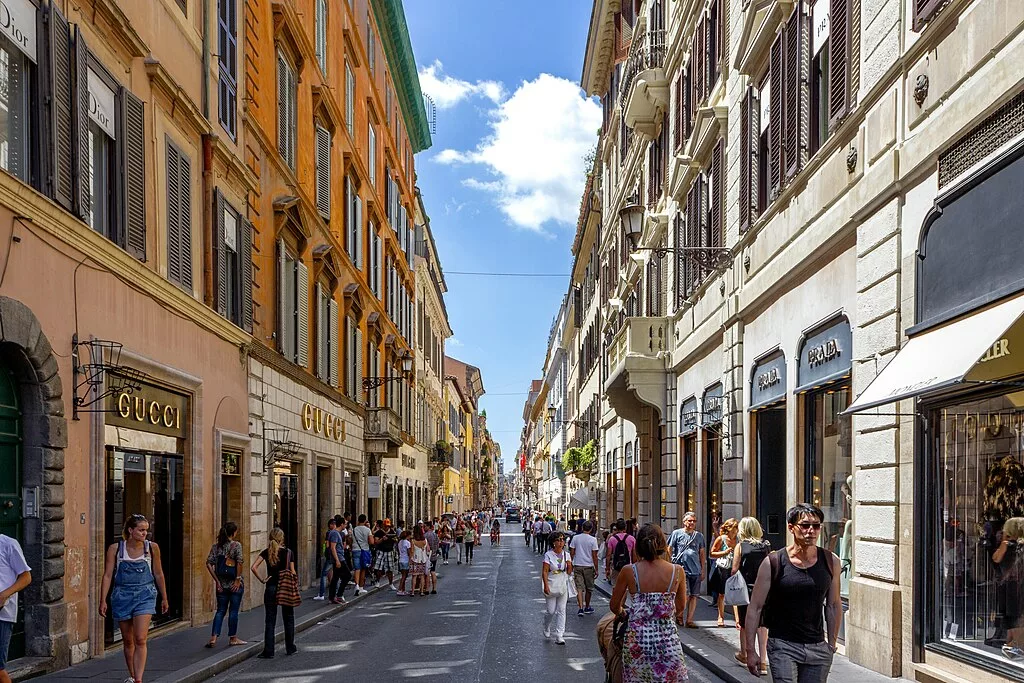
Via Condotti (or Via dei Condotti) is Rome’s most prestigious shopping street.
It begins at the foot of the Spanish Steps (Piazza di Spagna) and connects this square to Via del Corso.
Its name, “Condotti,” comes from the channels (or conduits) that, in Roman times, carried water to the Baths of Agrippa.
Today, Via Condotti is a major hub for luxury shopping: it is home to designer boutiques such as Gucci, Prada, Dior, Valentino, Hermès, Louis Vuitton, Bulgari, and many others. The street is part of the Roman “Tridente,” an urban triangle formed with Via del Corso and other shopping streets, highly popular with stylish tourists.
It is also home to a historic café: the Antico Caffè Greco, opened in 1760, which has welcomed figures such as Goethe, Byron, Keats, and Liszt.
The buildings on both sides of the street feature elegant Baroque architecture, enhancing the chic atmosphere of this thoroughfare.
Obelisco di Montecitorio
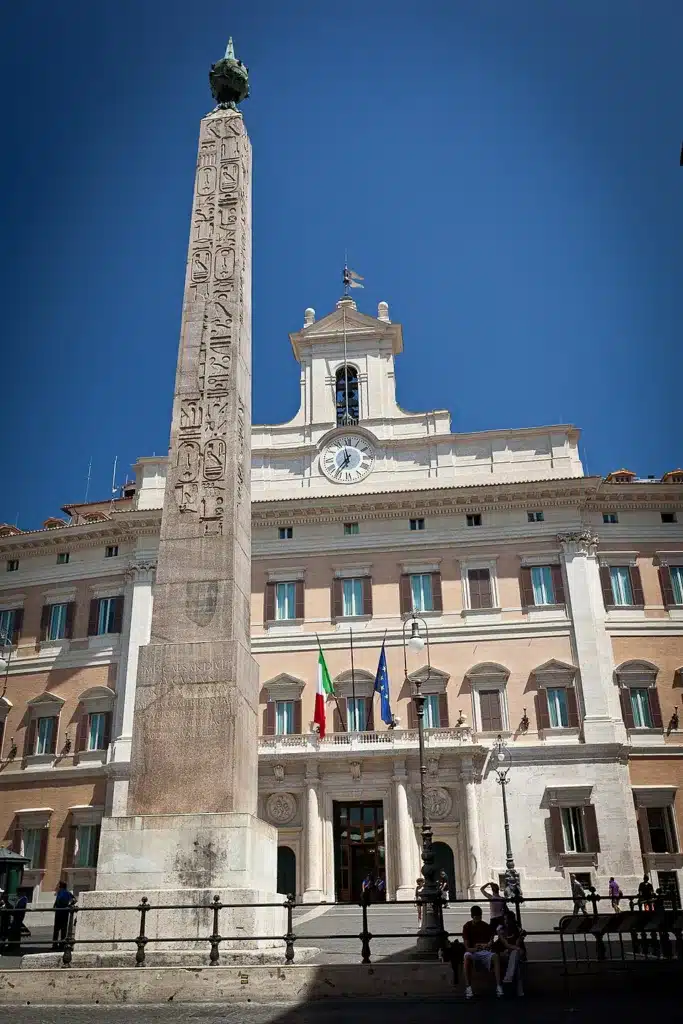
The Obelisco di Montecitorio is an ancient obelisk made of red Egyptian granite from Heliopolis, erected during the reign of Pharaoh Psammetichus II (around 595–589 BC). It was transported to Rome in 10 BC by Emperor Augustus, who used it as the gnomon (pointer) of a vast monumental sundial (the Horologium Augusti) on the Campus Martius.
The obelisk stands 21.79 meters high, and approximately 33.97 meters including the base and the sphere topped by a globe. The monument bears Egyptian hieroglyphic inscriptions celebrating Pharaoh Psammetichus II, making it a valuable direct testimony of ancient Egypt.
Having fallen and broken into several fragments between the 9th and 11th centuries, it was rediscovered in 1748 and restored by Pope Pius VI, then re-erected on Piazza Montecitorio between 1789 and 1792 under the direction of architect Giovanni Antinori. Today, the obelisk stands in front of Palazzo Montecitorio, seat of the Italian Chamber of Deputies, and is a major symbol of Rome’s ancient heritage.
Discover the secrets of the hieroglyphs on this obelisk through our scavenger hunt in Rome.
The Monument to Victor Emmanuel II (Altare della Patria)
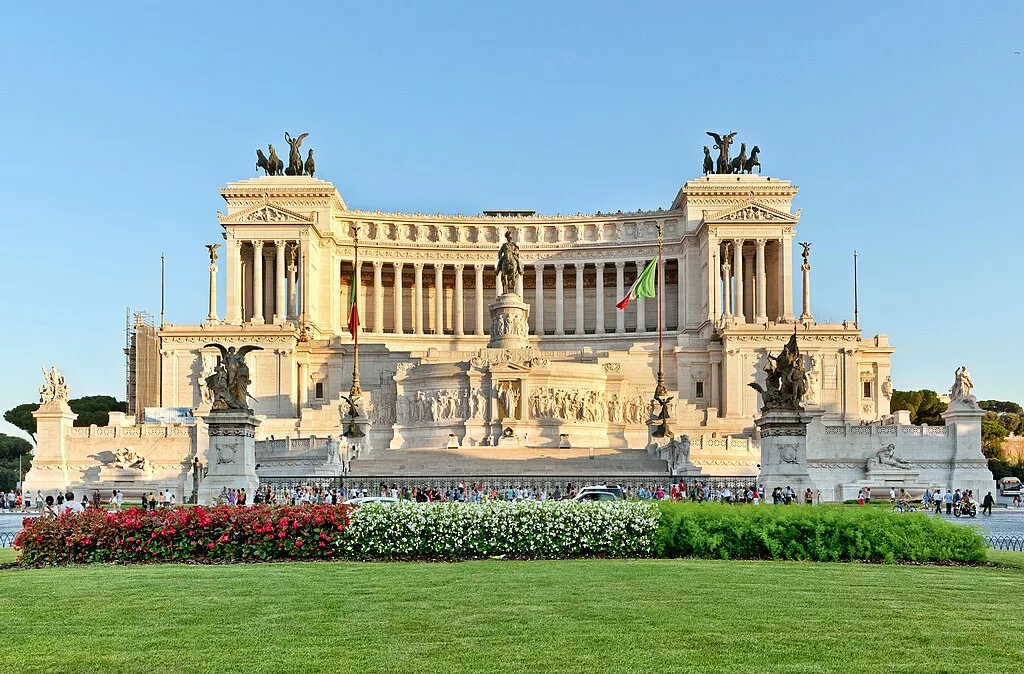
The Monument to Victor Emmanuel II, also known as the Vittoriano or Altare della Patria, is a massive structure located between Piazza Venezia and the Capitoline Hill. It was designed by architect Giuseppe Sacconi and built between 1885 and 1911.
The monument celebrates the unification of Italy and pays tribute to Victor Emmanuel II, the first king of the unified Kingdom of Italy.
It is made of white marble quarried in Botticino, in the province of Brescia, giving it a very distinctive brilliance. At the center stands an equestrian statue of Victor Emmanuel II, sculpted by Enrico Chiaradia, approximately 12 meters high.
The monument is adorned with two quadrigas (four-horse chariots) topped with allegories: the Unity of the Fatherland and Liberty, sculpted respectively by Carlo Fontana and Paolo Bartolini.
At the base lies the Altar of the Fatherland, which houses the Tomb of the Unknown Soldier, a symbol of remembrance for Italian soldiers who died in wars.
Inside the Vittoriano is the Central Museum of the Risorgimento, which traces the history of Italian unification.
The Catacombs of Rome
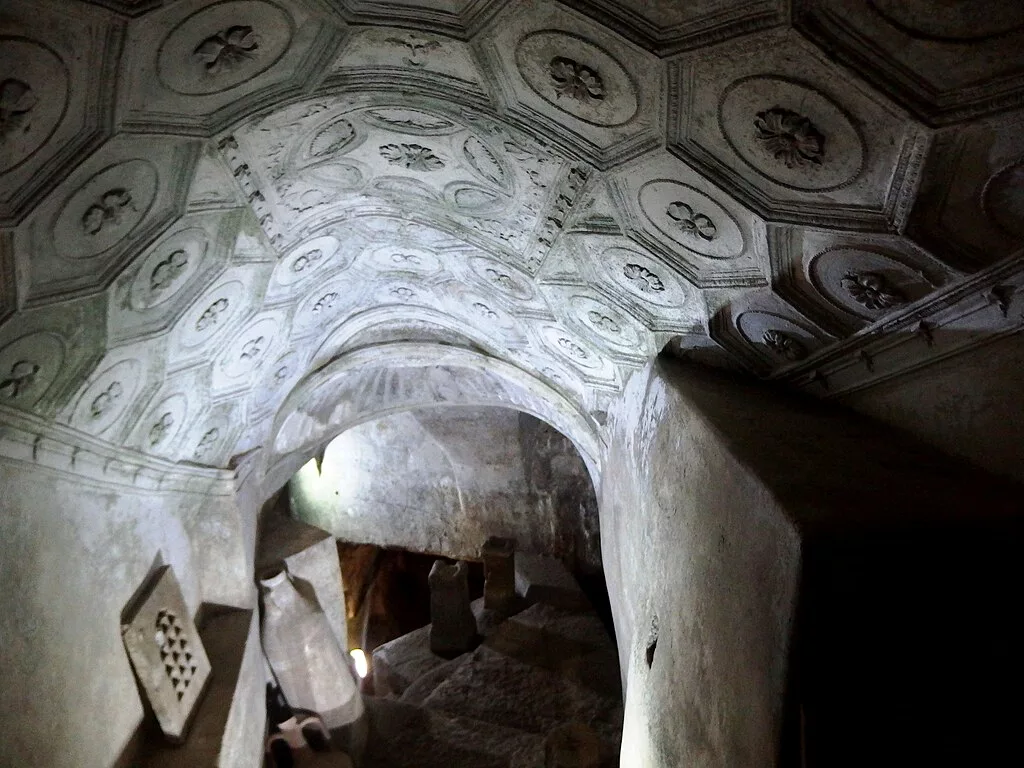
The Catacombs of Rome are a vast underground network of Christian cemeteries, made up of more than sixty catacombs forming hundreds of kilometers of galleries.
These galleries were initially dug as quarries or former sand pits, before being transformed into funerary hypogea.
The first Christian catacombs date back to the 2nd century, when Christian communities wished to bury their dead “near the martyrs” (burial ad sanctos). Roman law forbade burials within the city walls; the catacombs were therefore dug on the outskirts to comply with this rule.
Some catacombs, such as those of Saint Callixtus, have several levels of galleries—up to five stories—and descend deep underground. The Catacombs of Saint Callixtus, one of the most important Christian cemeteries, extend for nearly 20 km of galleries and contain the tombs of 16 popes.
The catacombs were not used solely as burial places: they also became sites of pilgrimage, especially after the legalization of Christianity by Constantine’s Edict in 313.
Today, some of these catacombs are open to the public: for example, the Catacombs of Saint Sebastian, Saint Callixtus, Priscilla, Domitilla, or Saint Agnes.
Piazza Navona
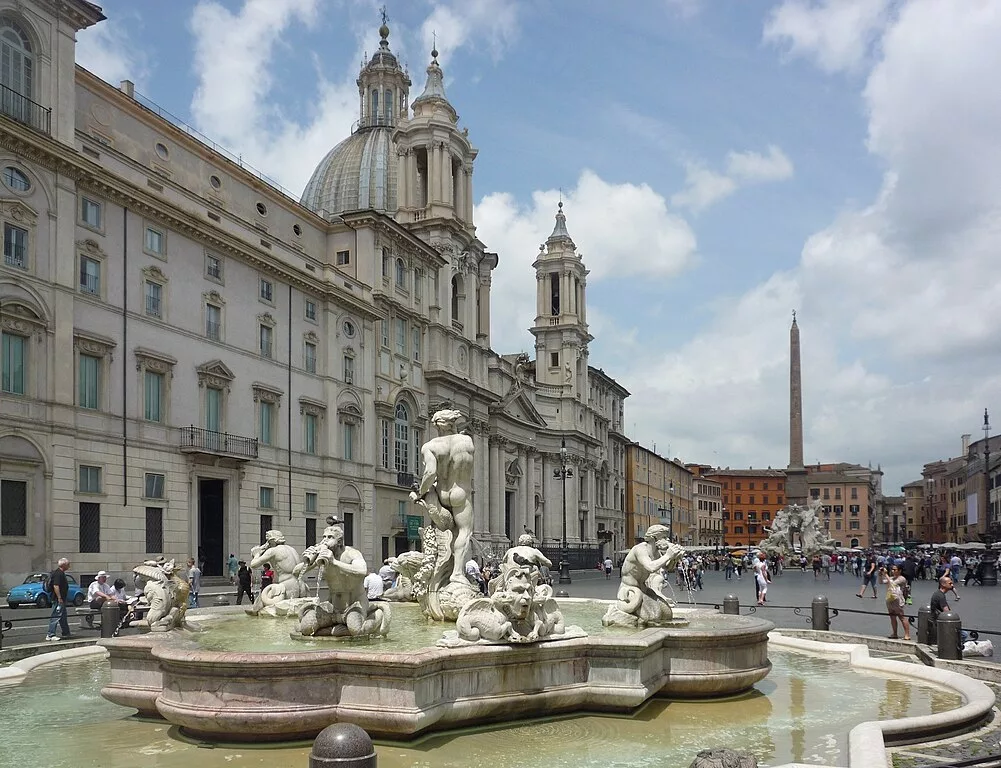
The Piazza Navona is an iconic square in Rome, known for its lively atmosphere, café terraces, and street artists.
It is built on the site of the ancient Stadium of Domitian, dating back to the 1st century, and retains its characteristic oval shape.
In the 17th century, under Pope Innocent X, the square was transformed into a masterpiece of Baroque art with spectacular fountains.
The Fontana dei Quattro Fiumi (Fountain of the Four Rivers), sculpted by Gian Lorenzo Bernini in 1651, stands at the center of the square, topped by an obelisk. The four rivers represented—the Nile, the Ganges, the Danube, and the Río de la Plata—symbolize the four continents known at the time.
At one end of the piazza stands the Fontana del Moro, designed by Giacomo della Porta and enhanced by Bernini. At the other end, visitors can admire the Fountain of Neptune, another fine example of Baroque art.
In the past, every weekend in August, the square was flooded to create a “lake,” a water festival organized by the Pamphili family; this tradition lasted until the 19th century.
Church of Sant’Ignazio di Loyola
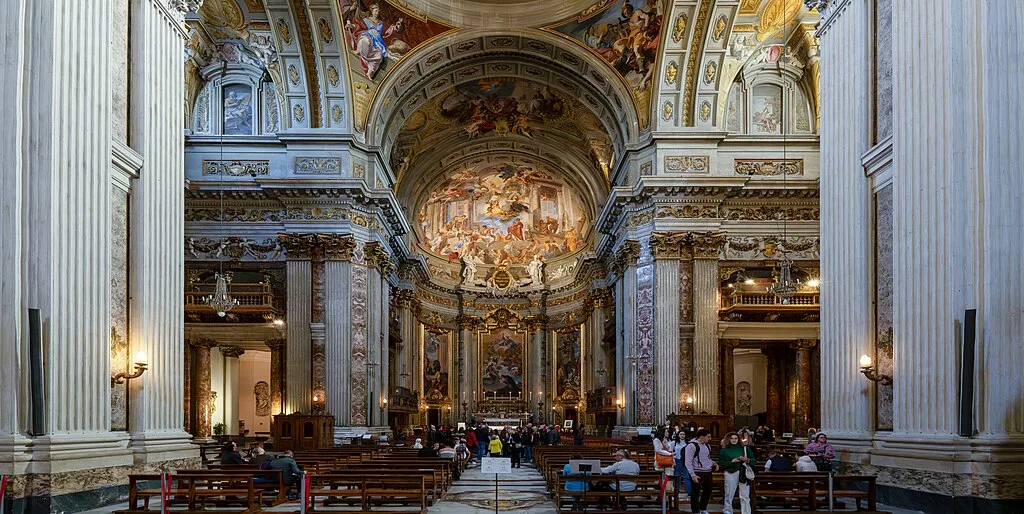
The Church of Sant’Ignazio di Loyola is located on Piazza Sant’Ignazio, in the historic center of Rome. It was built starting in 1626 at the initiative of Cardinal Ludovico Ludovisi, nephew of Pope Gregory XV.
The ceiling of the nave is adorned with an impressive trompe-l’œil fresco painted by the Jesuit artist Andrea Pozzo, depicting the “Entry of Saint Ignatius into Paradise.”
There is no real dome: Pozzo painted a false “dome” in perspective to create the illusion of a cupola.
Column of Marcus Aurelius
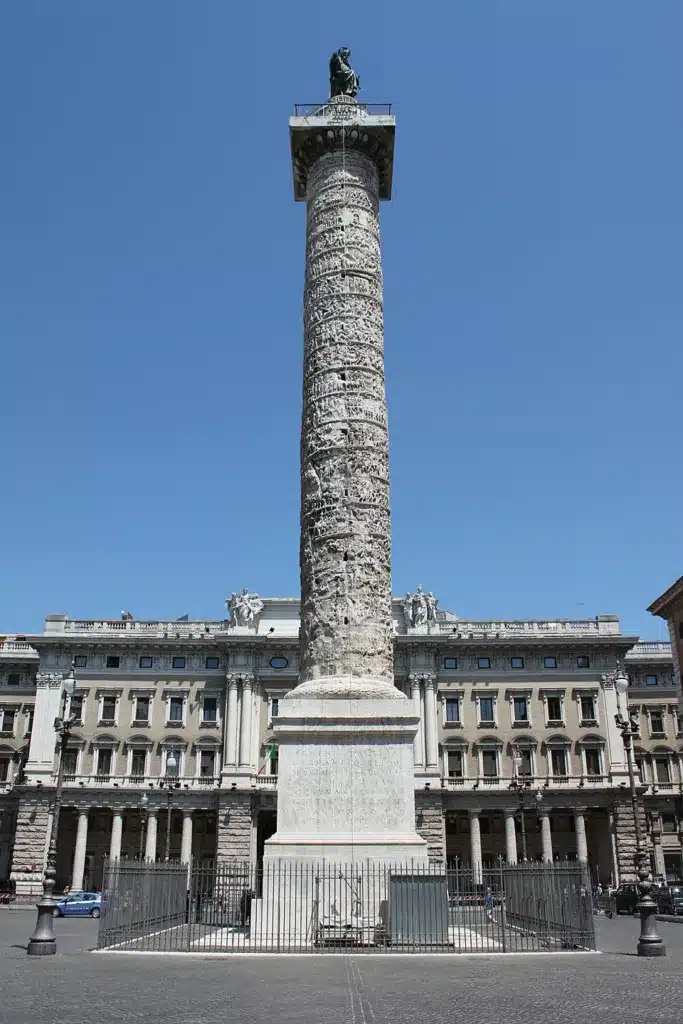
The Column of Marcus Aurelius is a Roman victory column located in the center of Piazza Colonna in Rome, Italy, erected in honor of Emperor Marcus Aurelius. It was built between 180 and 193 AD, probably after the emperor’s death, to celebrate his victories during the Marcomannic Wars against Germanic and Sarmatian tribes.
The column is inspired by Trajan’s Column: it is made of marble blocks with a spiral frieze sculpted in relief depicting the military campaigns of Marcus Aurelius. The spiral wraps around the shaft and shows scenes of battles, marches, and military activities, forming a visual narrative of his campaigns.
It stands about 30 meters high (around 100 Roman feet) without the base, which adds several more meters to its total height. In 1589, Pope Sixtus V had the column restored and replaced the original statue of the emperor at the top with a statue of Saint Paul, which still stands there today.
Inside, the column is hollow and contains a spiral staircase, once used to access an observation platform but now closed to the public.
Discover the secrets of the reliefs on this column through our route covering the must-see highlights of Rome.
Temple of Hadrian
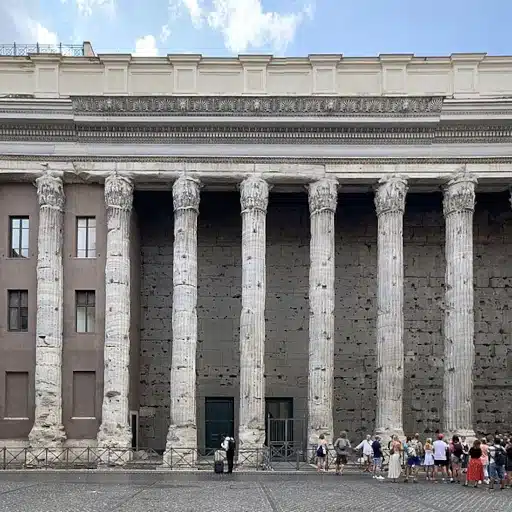
The Temple of Hadrian is an ancient Roman temple located on Piazza di Pietra in the center of Rome, dedicated to Emperor Hadrian, who was deified after his death. Construction of the temple may have begun under Hadrian himself but was completed around 145 AD by his successor, Antoninus Pius.
Originally, the temple featured a complete colonnade with Corinthian columns. Today, eleven columns on the northern side are still visible, incorporated into a later building. In the 17th century, the remains of the temple were integrated by architect Carlo Fontana into the Palazzo della Dogana di Terra, which today houses, among other institutions, the Rome Chamber of Commerce.
The surviving columns, approximately 15 meters high, rest on a podium several meters tall and form the remaining façade of the temple. Decorative reliefs depicting Roman provinces and other architectural motifs once adorned the interior and base of the temple; some of these reliefs are now preserved in museums.
Discover how many columns this temple originally had and uncover its secrets through our Rome scavenger hunt.
Palazzo Colonna – Galleria Colonna
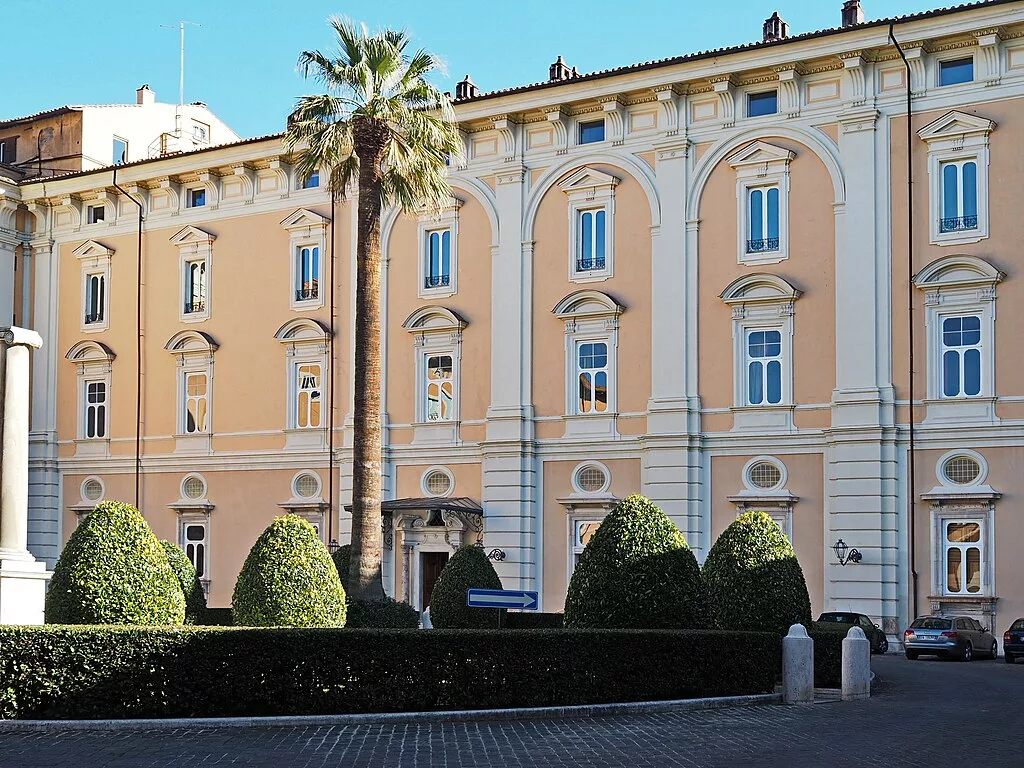
Palazzo Colonna is a vast palatial complex located in the heart of Rome, at the base of the Quirinal Hill, near the church of Santi Apostoli.
It has belonged to the Colonna family for more than twenty generations, making it one of the oldest private palaces in Rome. Part of the palace is built over the ruins of an ancient Roman Serapeum, reflecting the site’s long continuity.
The origins of the palace date back to the 13th century, when it served as a family fortress; according to tradition, Dante is even said to have stayed there during a visit to Rome.
During the 17th and 18th centuries, the palace was transformed into a Baroque residence. The palace’s private garden—accessible from the gallery—extends over the area of an ancient Roman temple dedicated to Serapis.
The Galleria Colonna, about 76 meters long, houses an exceptional art collection, including paintings by Carracci, Guido Reni, Tintoretto, Bronzino, Veronese, and many others. The palace’s salons feature frescoes celebrating, among other events, the role of Marcantonio II Colonna at the Battle of Lepanto in 1571. The Palazzo Colonna is open to visitors.
Sciarra Gallery
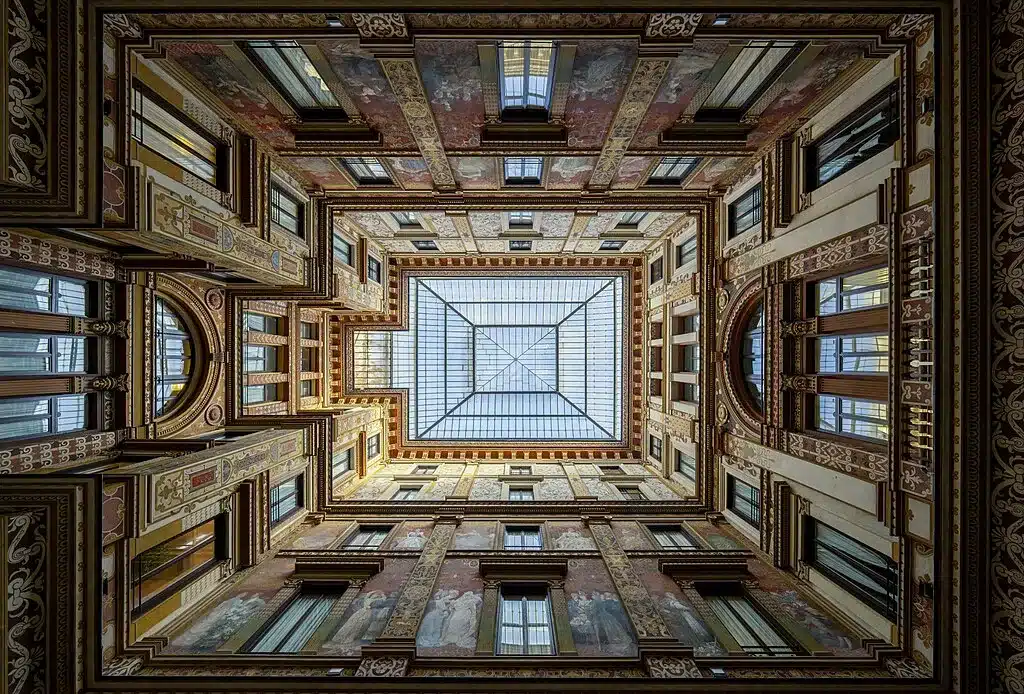
The Sciarra Gallery is a richly decorated covered passageway located in the center of Rome, between Via Marco Minghetti and Piazza dell’Oratorio, near the famous Trevi Fountain. It was created between 1885 and 1888 as a courtyard within the Palazzo of the Sciarra Colonna family, and later transformed into a pedestrian passage covered by an iron-and-glass roof.
The architectural project blends and restores different styles and was entrusted to architect Giulio De Angelis, influenced by English Art Nouveau (Liberty). The wall frescoes decorating the gallery were painted by Giuseppe Cellini and depict allegories of feminine virtues such as modesty, strength, fidelity, and patience.
The decorations also include scenes of 19th-century bourgeois life—such as gardening, dining, and music—as well as literary references, including a presumed portrait of Gabriele d’Annunzio. Originally part of the Palazzo Sciarra Colonna, the gallery reflects the prestige of the Sciarra family at the end of the 19th century.
Discover the secrets of the frescoes painted in this passage through our route covering the must-see highlights of Rome.
Museums to See in Rome
Capitoline Museums
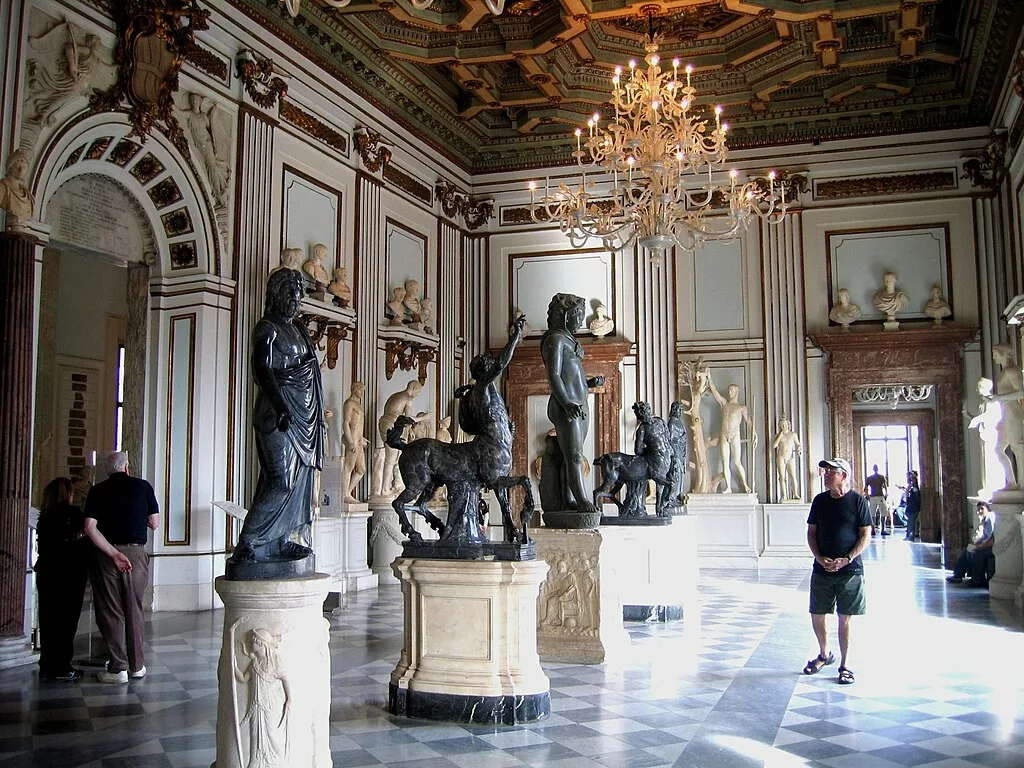
The Capitoline Museums (Musei Capitolini) are a group of art and archaeological museums located on the Capitoline Hill in Rome.
The core of their collection dates back to 1471, when Pope Sixtus IV donated a group of bronze statues to the Roman people, including the famous Capitoline Wolf.
The museums are mainly housed in two historic buildings: the Palazzo dei Conservatori and the Palazzo Nuovo, which face each other on Piazza del Campidoglio, designed by Michelangelo.
Visitors can admire famous ancient Roman sculptures here, such as the equestrian statue of Marcus Aurelius, the “Dying Gaul,” and many others.
The Capitoline Pinacoteca, located on the second floor of the Palazzo dei Conservatori, displays Renaissance and Baroque paintings, notably from the Sacchetti and Pio collections. One iconic work is the statue of Cupid and Psyche, a Roman marble copy of a Hellenistic original, donated by Pope Benedict XIV.
The museum also includes the Apartments of the Conservators, decorated with frescoes recounting the history of Rome through the centuries.
Borghese Gallery
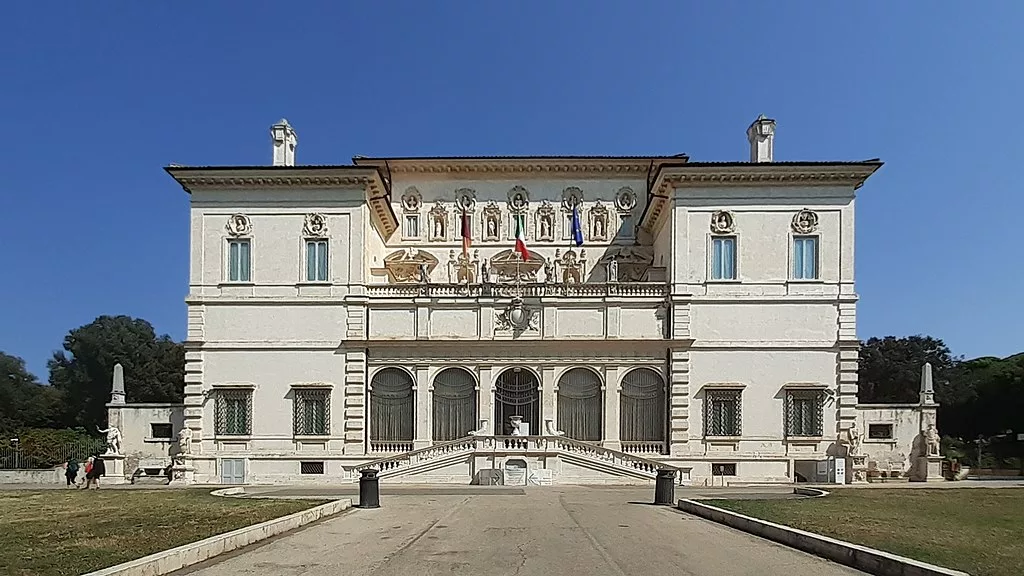
The Borghese Gallery is an art museum housed in the Villa Borghese, on the Pincian Hill in Rome.
The collection was mainly assembled in the 17th century by Cardinal Scipione Borghese, nephew of Pope Paul V and a great patron of the arts. The villa housing the gallery was built between 1613 and 1616 to designs by Flaminio Ponzio, and later completed by Giovanni Vasanzio after Ponzio’s death.
In 1902, the Italian state acquired the villa and the Borghese collection, transforming the complex into a public museum.
The gallery comprises twenty rooms richly decorated with frescoes, stucco, and marble, spread over two floors. Highlights include paintings by Caravaggio (such as David with the Head of Goliath) and works by Raphael, Titian, Correggio, and others. The sculptures are equally remarkable, with masterpieces by Gian Lorenzo Bernini such as Apollo and Daphne and The Rape of Proserpina.
National Roman Museum
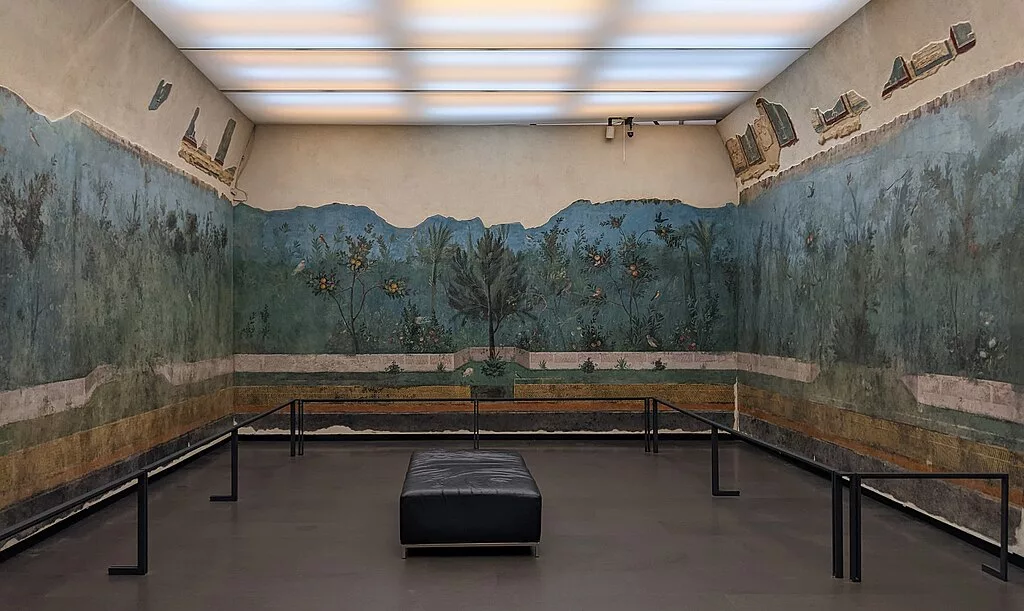
The National Roman Museum (Museo Nazionale Romano) is a large archaeological museum spread across four distinct sites in Rome: the Baths of Diocletian, Palazzo Massimo, Palazzo Altemps, and the Crypta Balbi.
The museum was founded in 1889, during a period marked by numerous archaeological discoveries shaping the understanding of ancient Rome.
The Baths of Diocletian site houses the epigraphic section, along with major ancient remains displayed within the monumental halls of the baths.
The Palazzo Massimo alle Terme presents masterpieces of Roman sculpture: portraits, sarcophagi, mosaics, frescoes, and bronzes. In the basement of Palazzo Massimo is the numismatic collection, featuring over half a million items—coins, medals, and jewelry—illustrating Rome’s economic history.
The Palazzo Altemps, another site of the museum, houses high-quality ancient sculptures from the collections of Roman Renaissance nobility.
The Crypta Balbi allows visitors to understand the urban evolution of Rome, presenting a place of social and archaeological history with ruins and reconstructions of medieval buildings.
Vatican Museums
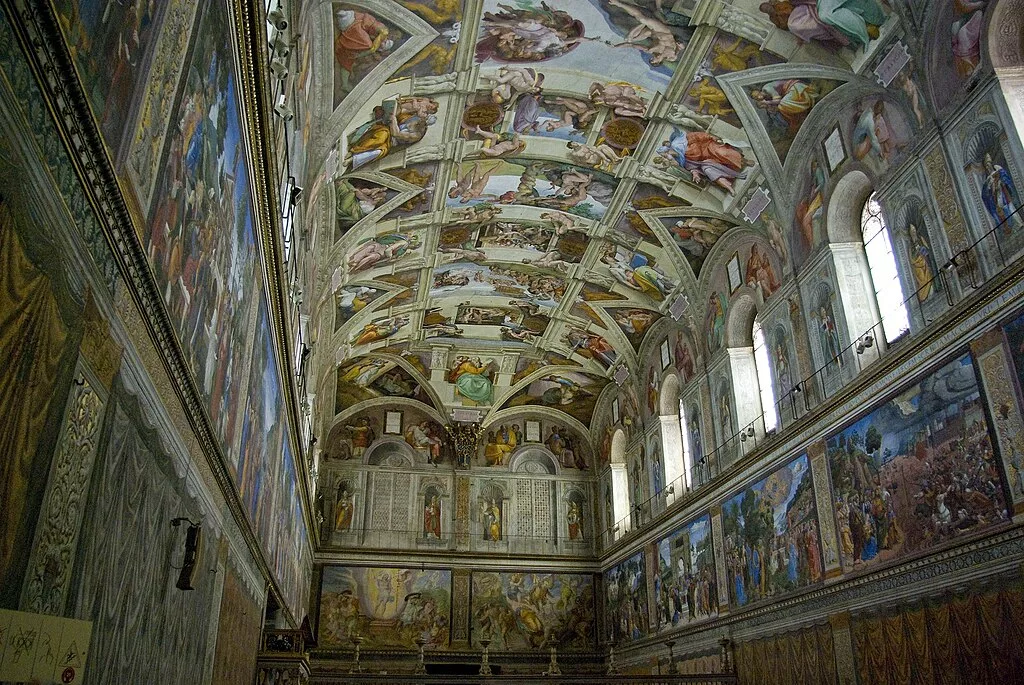
The Vatican Museums (Musei Vaticani) are a group of public museums located within Vatican City, founded in the early 16th century by Pope Julius II.
They house approximately 70,000 works of art, of which around 20,000 are on display across more than 24 galleries.
The Pio-Clementine Museum, one of the oldest, displays major ancient sculptures such as the Laocoön group and the Apollo Belvedere.
The Vatican Pinacoteca, inaugurated in 1932, exhibits paintings by Raphael, Leonardo da Vinci, Caravaggio, Giotto, and many others.
The Raphael Rooms are a series of rooms decorated by Raphael and his pupils; they are part of the museum route.
The Sistine Chapel, famous for its ceiling painted by Michelangelo, is the highlight of a visit to the museums.
The Gregorian Egyptian Museum exhibits mummies, papyri, and artifacts from ancient Egyptian civilization.
The Ethnological Museum “Anima Mundi” (formerly the Missionary Museum) gathers artworks and objects from cultures around the world, related to the Catholic mission.
The Vatican Philatelic and Numismatic Museum displays stamps and coins issued by the Vatican State since its creation, offering a unique insight into its history.
Parks, Gardens & Walks – Rome
1. Villa Borghese
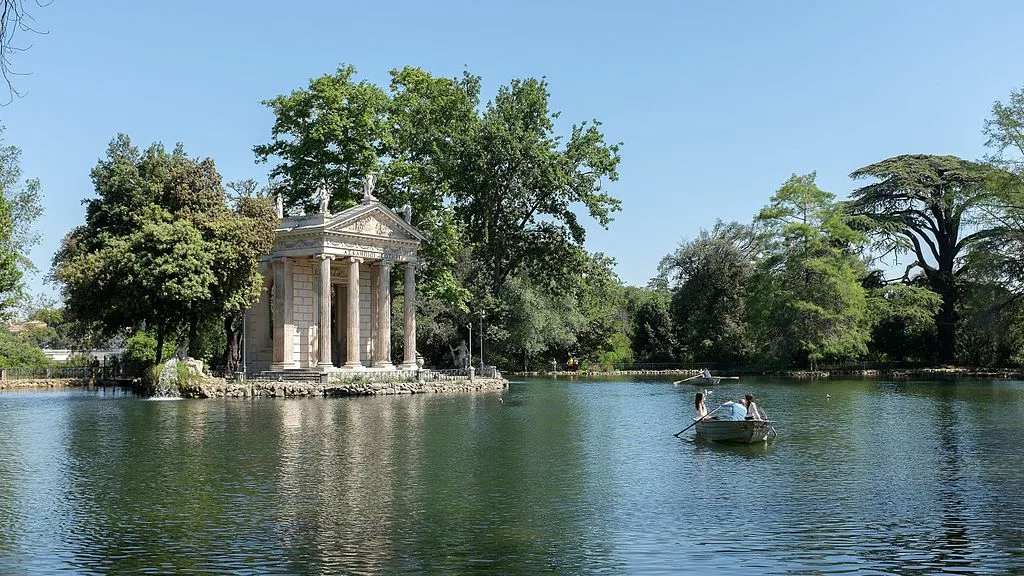
Villa Borghese is a large public park of 80 hectares situated on the Pincian Hill, in the heart of Rome. The garden began to be developed in the early 17th century by Cardinal Scipione Borghese to transform a former vineyard into a magnificent park.
Architect Flaminio Ponzio, later assisted by Giovanni Vasanzio, designed the avenues, fountains, and groves to create a space that is both natural and artistic. In the 18th century, architect Luigi Canina redesigned parts of the park in an “English” style, incorporating exotic plants and gentle perspectives.
Notable spots in the garden include a small lake (Giardino del Lago) with a neoclassical temple dedicated to Aesculapius, which can be admired from a boat.
The park features fountains, monuments, and numerous sculptures—an open-air museum blending nature with Baroque and Neoclassical art.
The Pincio Terrace, overlooking the park, offers spectacular panoramic views of Rome, especially impressive at sunset.
The park also houses the Bioparco, Rome’s zoological garden, one of the oldest in Europe, located within the gardens.
2. Janiculum (Gianicolo)
The Janiculum (Gianicolo in Italian) is a hill on the right bank of the Tiber, west of Rome’s historic center. Although it is very elevated, the Janiculum is not one of the traditional “seven hills” of Rome, as it lies outside the ancient Servian walls.
From the Janiculum lookout, visitors enjoy one of the most beautiful panoramic views of Rome: domes, bell towers, roofs, and monuments unfold before the eyes.
The hill also has a strong historical role: it was the site of the heroic defense of the Roman Republic in 1849, led by Garibaldi against French troops. At the summit stands an equestrian statue of Giuseppe Garibaldi, created by Emilio Gallori in 1895, honoring this hero of the Risorgimento.
Approximately 84 marble busts line the promenade, representing Italian patriots who fought for unity or the Republic. A cannon located under the terrace fires a blank shot daily at noon, a tradition established to synchronize the clocks of Rome’s churches.
The Fountain of Acqua Paola, a large Baroque marble fountain, is located on the Janiculum; it celebrates the completion of the aqueduct that supplies it.
3. Via Appia Antica
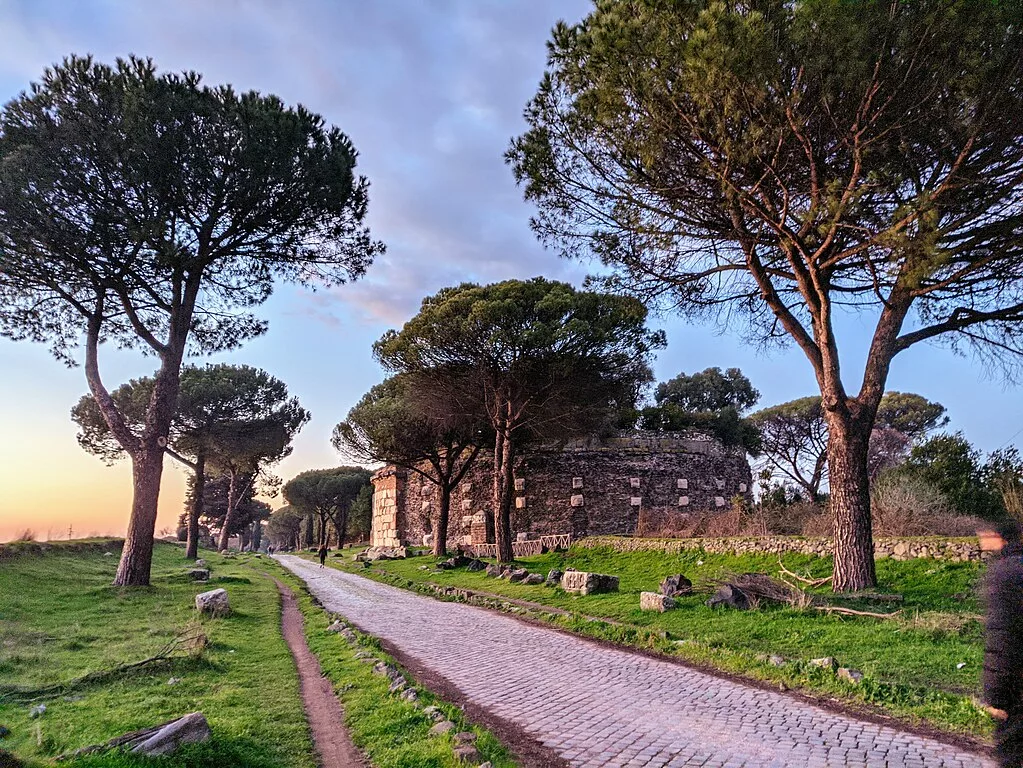
The Via Appia Antica, often called the “Regina Viarum” (Queen of Roads), is one of the oldest and most prestigious Roman roads. It was initially constructed in 312 BC by Appius Claudius Caecus to connect Rome to Capua.
Later, the road was extended to Brindisi, making it a strategic route for trade and military movements toward the East.
The Appian Way was paved with basalt stones, which explains why some sections remain intact today.
It was about 4.1 meters wide, allowing two chariots to pass, and featured earthen sidewalks on the sides.
Today, Via Appia Antica is part of a protected archaeological park, the Parco dell’Appia Antica, covering approximately 3,400 hectares. Along the road, visitors can see many funerary monuments: mausoleums (such as that of Cecilia Metella), catacombs (Saint Domitilla, Saint Sebastian), and remains of Roman villas.
The Circus of Maxentius, one of the most spectacular sites on the Via Appia, testifies to imperial architectural grandeur.
4. Villa Doria Pamphilj
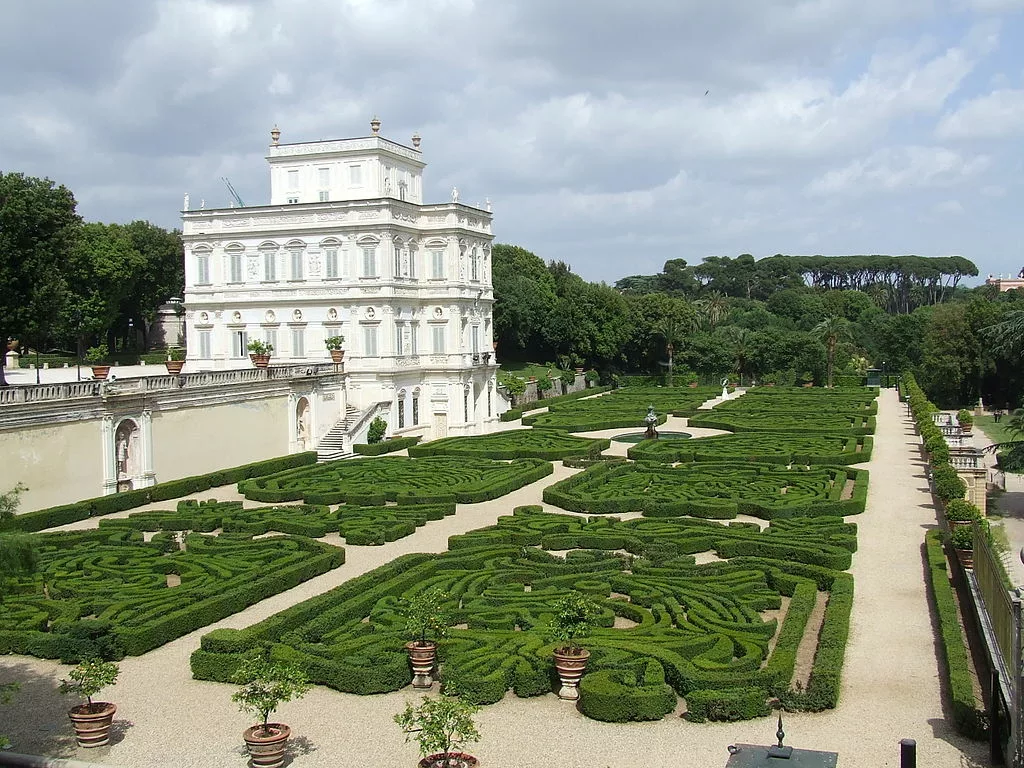
Villa Doria Pamphilj is a vast urban park of 184 hectares, making it one of the largest green spaces in Rome. The park originally belonged to the noble Pamphilj family, who began developing the estate in the 17th century.
The Casino del Bel Respiro, a Baroque gem within the park, was designed by Alessandro Algardi and Giovanni Francesco Grimaldi in the 1640s–1650s for Camillo Pamphilj.
The park is divided into three sections: the “pars urbana” with the palace and gardens, the “pars fructuaria” (pine forest), and the “pars rustica” (agricultural land). It contains Roman remains, including an ancient necropolis; frescoes from the columbarium have been studied, with some now displayed in Palazzo Massimo.
The park features several remarkable fountains: Fountain of Venus, Fountain of Cupid, Fountain of the Lily, Cascade Fountain, and more. A peaceful lake at the center provides an ideal setting for relaxation, walking, and enjoying nature.
The park was partially expropriated in the 20th century: the Italian state acquired the Casino, and the municipality of Rome gradually purchased the rest, opening the park to the public in 1972.
Roman Cuisine
Spaghetti alla Carbonara
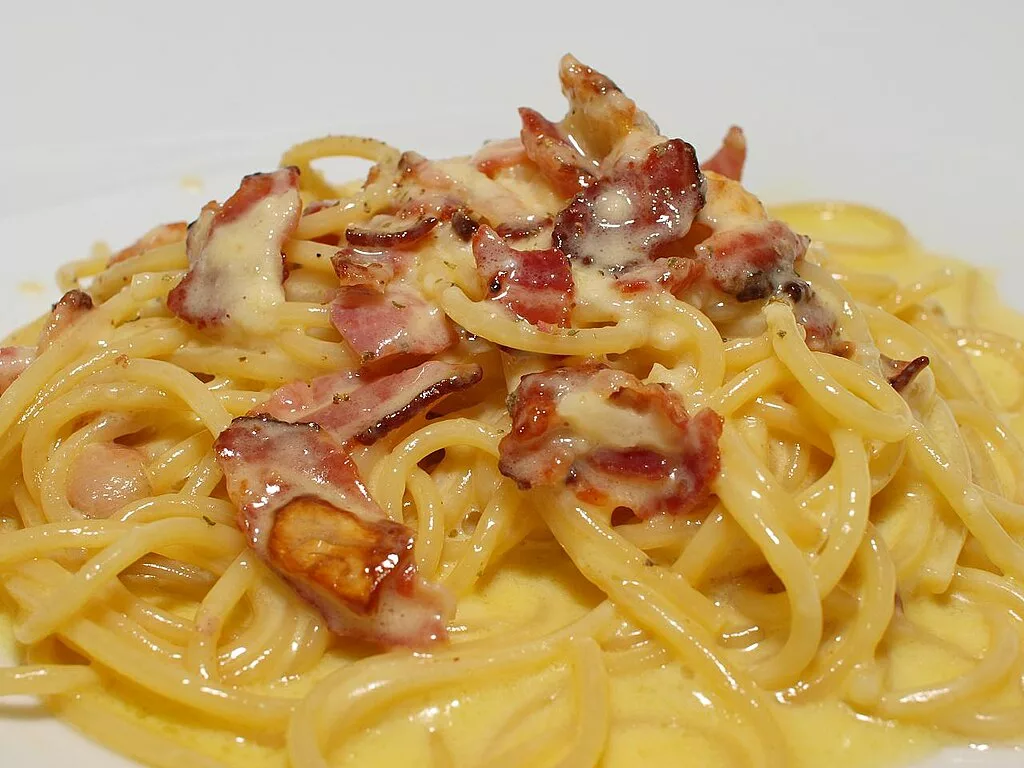
Carbonara is traditionally made with guanciale, eggs, pecorino romano, and black pepper, without any cream. The heat of the pasta cooks the eggs, creating a creamy and rich sauce.
Cacio e Pepe
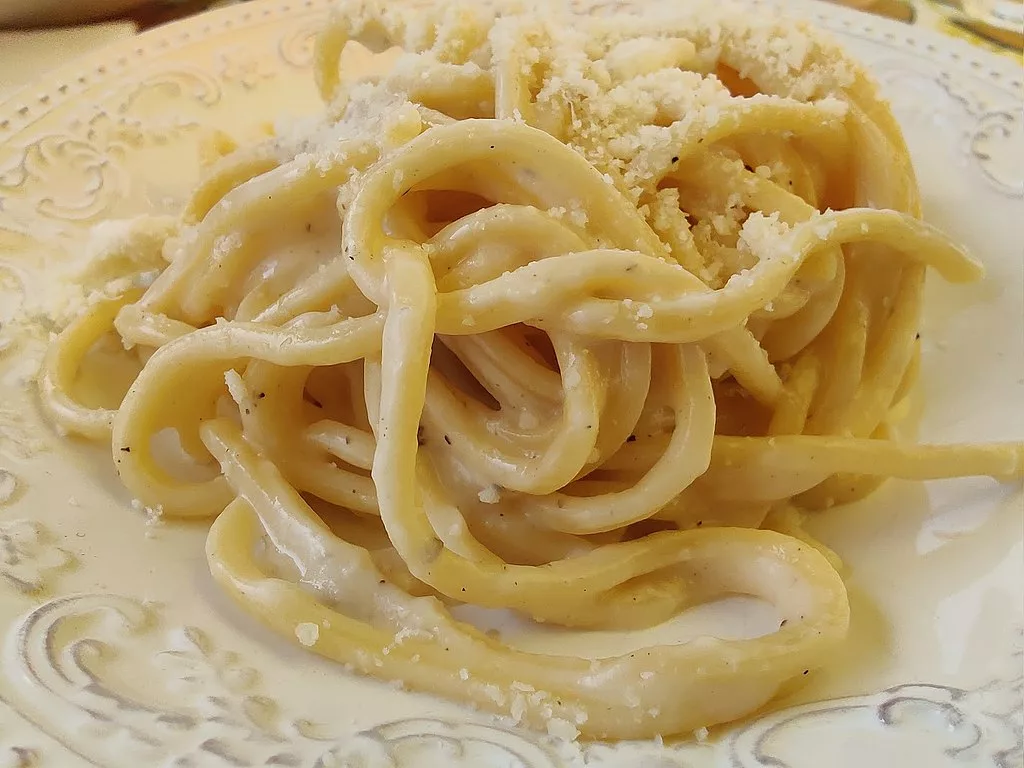
The name literally means “cheese and pepper,” which is exactly what this iconic dish contains.
The pasta is coated in melted pecorino romano and generously seasoned with freshly ground black pepper. Cacio e pepe is often served with spaghetti or tonnarelli, traditional local pasta.
Saltimbocca alla Romana
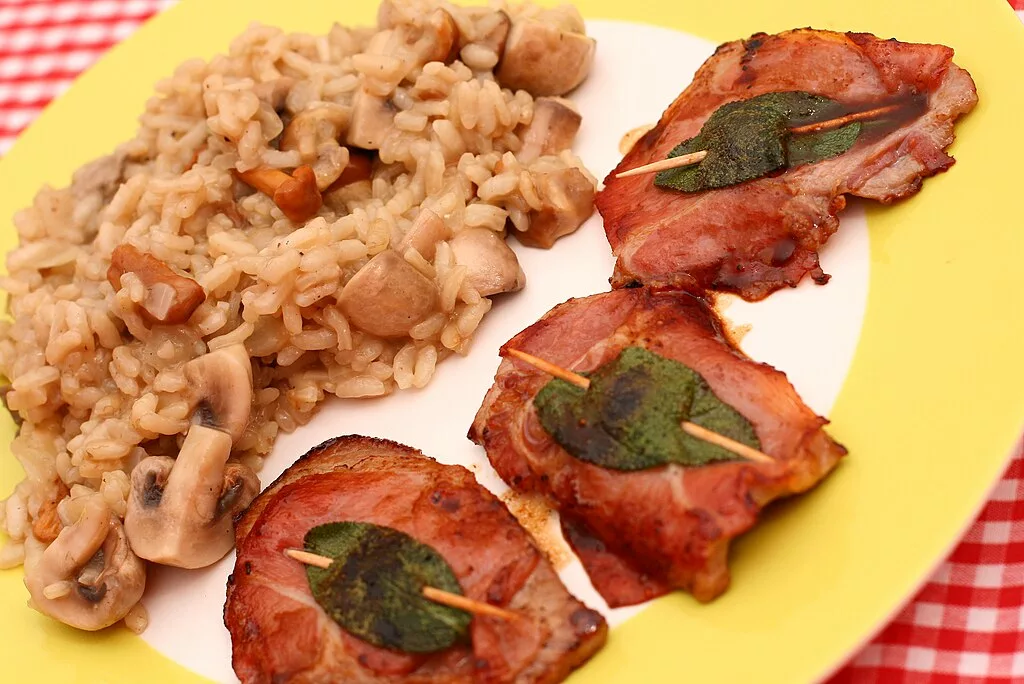
Saltimbocca alla Romana is a veal cutlet topped with prosciutto and sage leaves. It is usually quickly pan-fried with white wine, giving it a delicate and aromatic flavor.
The name means “jumps in the mouth,” referring to the tenderness and intense taste of the dish.
Supplì
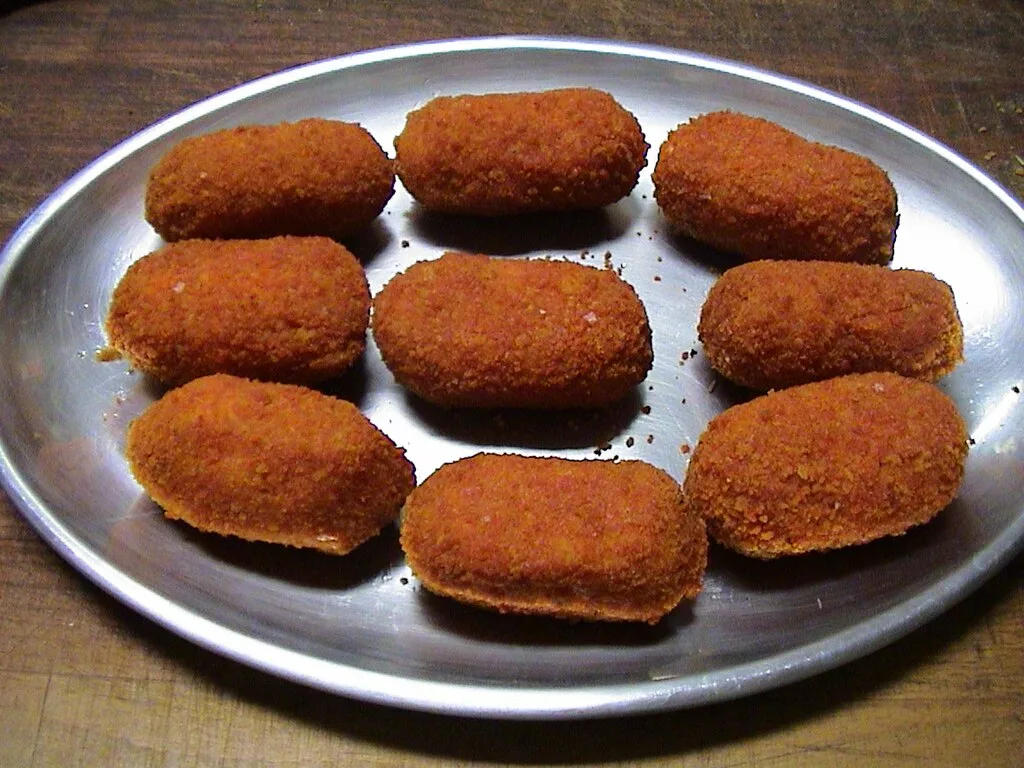
Supplì are fried rice croquettes, often filled with melting mozzarella. They are crispy on the outside and soft inside, perfect as a snack or antipasto.
Traditionally, supplì were served as street food during local festivals and events.
Artichokes (Carciofi)
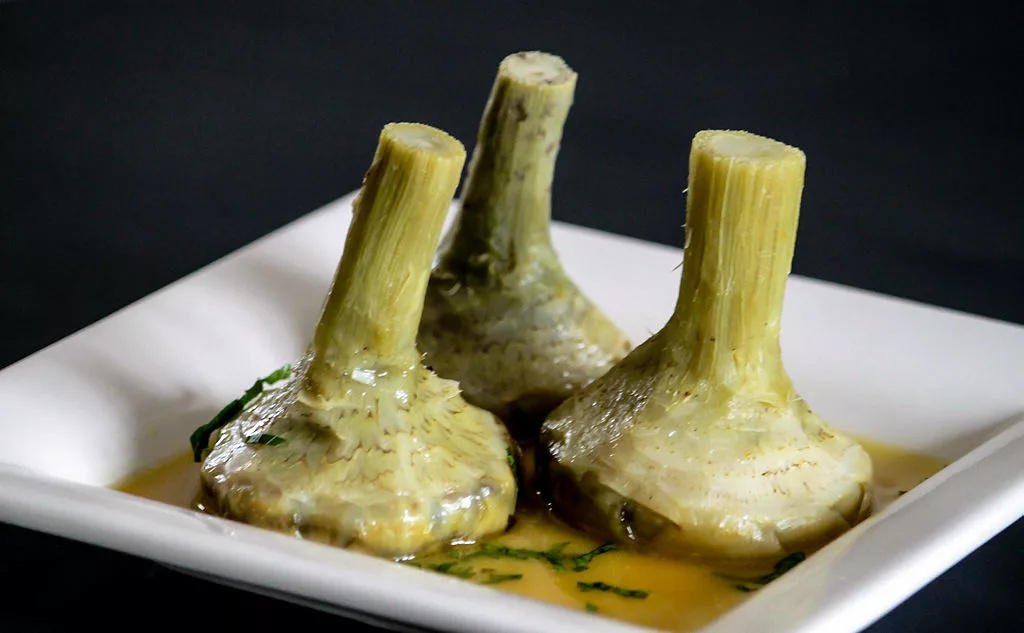
Artichokes are a staple of Roman cuisine, prepared in various traditional ways.
The carciofi alla romana are cooked in oil with mint and garlic, giving a fresh and fragrant flavor.
The carciofi alla giudia, from Rome’s Jewish quarter, are deep-fried until golden and crispy.
Excursions / Trips Around Rome
1. Ostia Antica
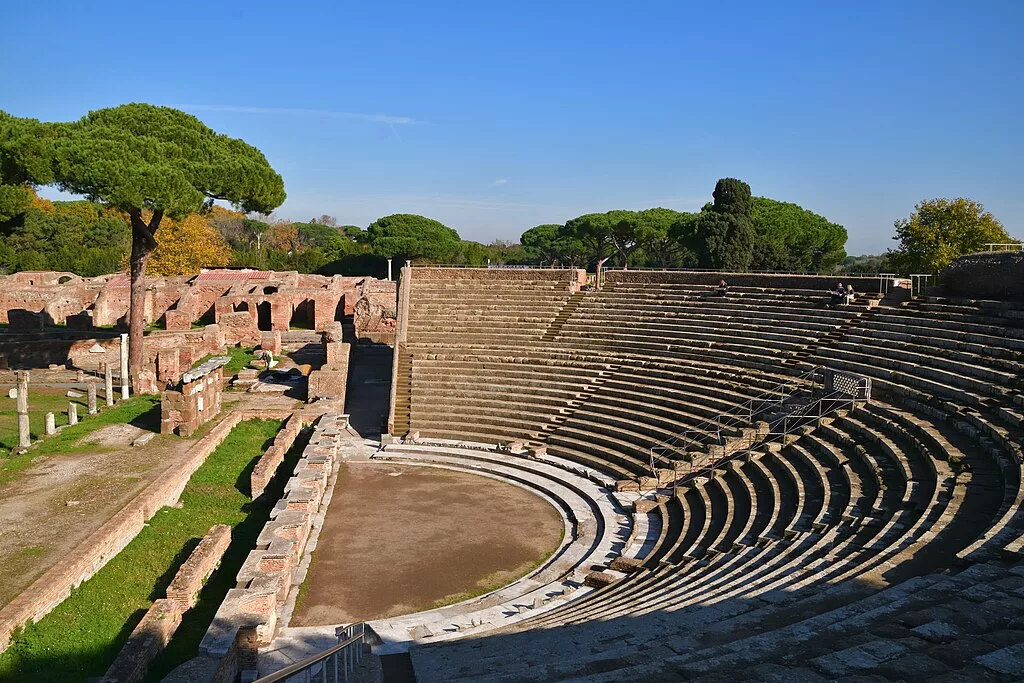
Ostia Antica is a major archaeological site about 30 km southwest of Rome.
Ostia was the ancient Roman port and river hub, playing a strategic role on the Tiber River.
The site includes very well-preserved remains: baths, warehouses, houses with mosaics, forum, and paved streets.
Ostia reached its peak in the 2nd century AD, with an estimated population of 50,000 inhabitants and numerous warehouses and temples.
2. Tivoli: Villa d’Este & Villa Adriana
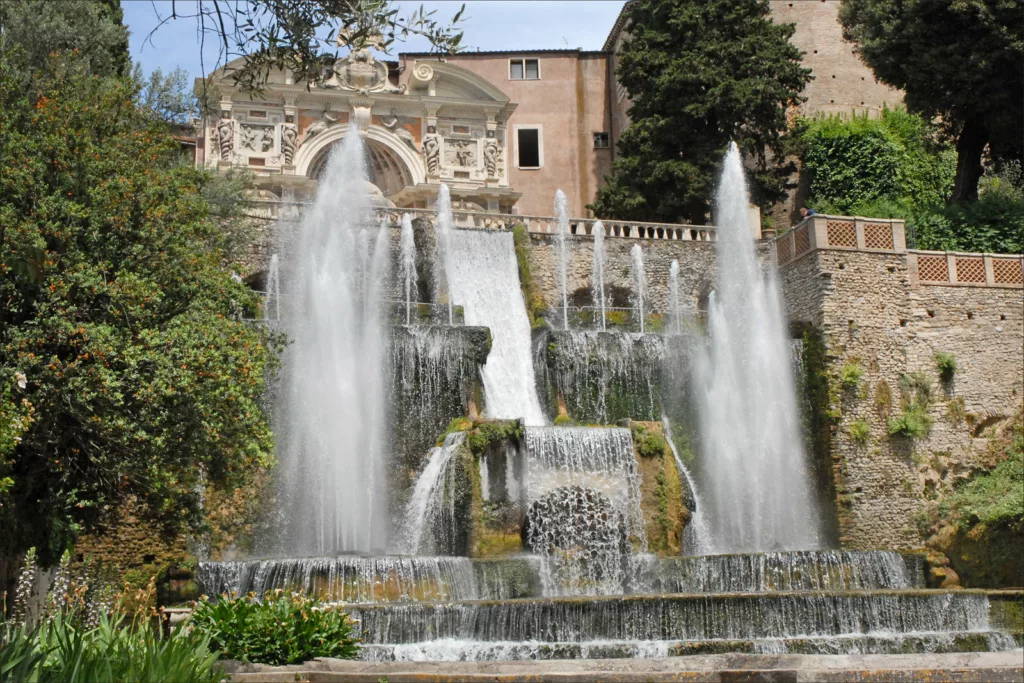
The first major attraction in Tivoli is Hadrian’s Villa (Villa Adriana), built as the residence of Emperor Hadrian between 118 and 138 AD. This archaeological site covers about 120 hectares and includes baths, theaters, palaces, and gardens inspired by Greek and Egyptian architecture.
The Villa d’Este, another jewel of Tivoli, is famous for its Renaissance gardens and elaborate water features, with over 500 fountains, pools, and statues. Among the iconic fountains, the Fountain of the Organ produces music through water jets, a design dating back to the Renaissance.
Conclusion – Visiting Rome
Visiting Rome means immersing yourself in a unique blend of history, art, and culture, where every monument tells a story of the Italian capital’s grandeur. From the Colosseum to the Pantheon, from Baroque fountains to prestigious museums like the Galleria Borghese or the Vatican Museums, the city offers an exceptional heritage that captivates every traveler. Roman parks and gardens, such as Villa Borghese or the Janiculum, provide peaceful spots for strolls in the heart of the city, while Roman cuisine, with its iconic dishes, completes the sensory experience.
To enrich your stay, excursions around Rome like Ostia Antica or Tivoli reveal historical and natural treasures that can be explored in a single day. Rome is much more than a tourist destination: it is a city where history, art, and daily life meet, offering every visitor an unforgettable journey. Prepare to discover the Eternal City, taste its authentic flavors, and be enchanted by the magic of its streets, squares, and landscapes.
Explore the must-see sights of Rome in a unique way with our Rome scavenger hunt, a mix of puzzles, exploration, and historical insights.