
Visit Ghent: 30 Must-See Attractions and Things to Do
Visiting Ghent means discovering a Flemish city with a unique charm, where medieval history blends seamlessly with a modern and lively atmosphere. Located between Brussels and Bruges, Ghent captivates visitors with its beautiful canals, historic landmarks, renowned museums, and particularly vibrant cultural scene.
Once one of the most powerful trading cities in Europe during the Middle Ages, Ghent now boasts an exceptional heritage. Between the majestic Castle of the Counts of Flanders, Saint Bavo’s Cathedral, the famous Belfry, the Graslei and Korenlei quays, and its many museums, the city is full of treasures waiting to be explored.
Whether you are planning a weekend in Ghent, a day trip, or a longer stay in Belgium, you will find here all the must-see attractions, the best activities, local specialties to taste, and practical tips to make the most of this essential destination in Flanders.
Ghent’s Historical Monuments and Heritage
The Castle of the Counts of Flanders

The origins of the Castle of the Counts of Flanders date back to the 9th century, when Count Baldwin I built the first fortifications to protect the region from Viking invasions. Initially constructed in wood, the fortress was gradually reinforced before taking on its current appearance in 1180 under the direction of Philip of Alsace. Inspired by the strongholds encountered during the Crusades, the castle is distinguished by its imposing 33-meter-high keep and powerful defensive walls.
After serving as the residence of the Counts of Flanders for several centuries, the castle lost its residential role in the 14th century in favor of a more comfortable palace. It was then used as an administrative center, courthouse, and prison. From the late 18th century onward, the site was transformed into an industrial complex housing a cotton mill and various workshops.
Threatened with demolition in the 19th century, the castle was ultimately saved thanks to the efforts of heritage preservation advocates. The city of Ghent purchased it in 1885 and undertook extensive restoration work to restore its medieval appearance. Today, Gravensteen is considered one of Belgium’s finest medieval castles and attracts hundreds of thousands of visitors every year.
For the full experience, be sure to climb to the top of the ramparts. The view over Ghent’s rooftops, canals, and historic bell towers is particularly spectacular, especially at sunset.
Saint Bavo’s Cathedral

In the heart of Ghent’s historic center, Saint Bavo’s Cathedral is one of the city’s most remarkable landmarks. This majestic Gothic building, whose origins date back to the 10th century, is now the seat of the Diocese of Ghent and a must-visit for history, architecture, and art enthusiasts.
The cathedral impresses first with its scale and elegant Brabantine Gothic architecture. Its imposing tower, nearly 90 meters high, dominates the city skyline, while the interior reveals vast luminous naves, magnificent chapels, and numerous artistic treasures. Among its most notable works are paintings by Flemish masters, including a masterpiece by Rubens, as well as superb sculptures and funerary monuments.
However, the cathedral’s greatest claim to fame is undoubtedly the Adoration of the Mystic Lamb. Created by the brothers Hubert and Jan van Eyck and completed in 1432, this masterpiece is considered one of the most important works in the history of Western art. Admired for its intricate detail, rich colors, and extraordinary realism, it attracts visitors from around the world each year.
The cathedral’s history is also closely linked to that of Ghent and Emperor Charles V, who was born in the city. Over the centuries, the building underwent several transformations, suffered damage during the religious conflicts of the 16th century, and endured fires that affected its spire. Despite these challenges, it remains one of Belgium’s most beautiful religious monuments.
During your visit, take time to explore the various chapels, the historic crypt, and the many architectural details that bear witness to more than a thousand years of history.
Saint Michael’s Bridge

Located in the heart of the historic center, this magnificent stone bridge offers one of the finest panoramas in Ghent and is a must-see spot for photography enthusiasts.
From the bridge, visitors enjoy exceptional views of the historic Graslei and Korenlei quays, the city’s iconic towers, and the Castle of the Counts of Flanders. It is also one of the few places where all three of Ghent’s famous towers can be seen in a single perspective: Saint Nicholas’ Church, the Belfry, and Saint Bavo’s Cathedral.
Built in the early 20th century to replace an older swing bridge, Saint Michael’s Bridge stands out for its elegant architecture and its imposing central lamppost topped with a statue of the Archangel Michael slaying a dragon. This representation refers to the famous biblical legend in which the archangel drives the forces of evil from heaven.
The Cloth Hall

Located in the heart of Ghent’s historic center, right next to the famous Belfry, the Cloth Hall reflects the wealth and economic power the city enjoyed during the Middle Ages. Built between 1425 and 1441 in an elegant Gothic style, it symbolizes the importance of the textile industry that brought prosperity to Ghent for centuries.
At the time, merchants displayed and inspected the valuable fabrics produced in the region before they were marketed throughout Europe. As a true economic hub of the city, the Cloth Hall illustrates the major role Ghent played in the medieval textile trade.
Today, the building captivates visitors with its refined Gothic architecture, tall pointed windows, imposing buttresses, slender turrets, and numerous carved ornaments. Its elegant façade blends perfectly with the monumental ensemble formed by the Belfry, City Hall, and Saint Bavo’s Cathedral.
Listed as a UNESCO World Heritage Site together with the Belfry since 1999, the Cloth Hall is one of the symbols of Ghent’s historical heritage. Its interior also provides access to the Belfry, one of the city’s most iconic landmarks, offering superb panoramic views over Ghent’s rooftops.
The Belfry of Ghent

Rising 95 meters above Ghent’s historic center, the Belfry was built in the 14th century and once embodied the city’s power, autonomy, and civic freedoms. The city’s charters and privileges were safeguarded within its walls, making the tower a true symbol of Ghent’s independence.
The most famous feature of the Belfry is undoubtedly its golden dragon, which has watched over the city for centuries. This imposing weather vane, now one of Ghent’s most recognizable symbols, is surrounded by numerous local legends. The original dragon, dating from the 14th century, is preserved inside the monument, while a replica crowns the top of the tower.
Inside, visitors can discover the history of the Belfry as well as its impressive carillon of 46 bells. Among them is the legendary “Klokke Roeland,” a mythical bell deeply connected to the city’s history and Flemish folk traditions. The melodies of the carillon still regularly echo through the streets of the historic center.
The visit concludes with one of the finest panoramic viewpoints in Ghent, accessible from the top of the tower.
Saint Nicholas’ Church

Located on Korenmarkt Square in the heart of Ghent’s historic center, Saint Nicholas’ Church is one of the city’s oldest monuments. With its majestic silhouette and distinctive tower, it forms part of Ghent’s famous “Three Towers,” alongside the Belfry and Saint Bavo’s Cathedral.
Built between the 13th and 15th centuries, the church is a remarkable example of Scheldt Gothic architecture, a style typical of the Scheldt Valley. It is particularly distinguished by its use of Tournai blue stone, its large lantern tower rising above the crossing of the transept, and the smaller turrets that reinforce the stability of the structure.
During the Middle Ages, the church occupied a central place in Ghent’s commercial life. Located near the grain market, it was especially popular with merchants and guilds, many of which maintained their own chapels within the building. Before the construction of the Belfry, its bell tower even served as a watchtower and housed the city’s communal bells.
The interior impresses visitors with its spaciousness, soaring Gothic vaults, and peaceful atmosphere. Visitors can also admire a remarkable organ built by the renowned French organ maker Aristide Cavaillé-Coll, whose instruments are celebrated worldwide.
After centuries marked by wars, harsh weather, and the passage of time, the church underwent extensive restoration campaigns that helped restore much of its original splendor.
Korenmarkt, the Vibrant Heart of Ghent

The true beating heart of Ghent, Korenmarkt—or “Grain Market”—is one of the city’s liveliest and most frequented squares. Located between Saint Nicholas’ Church and the banks of the River Lys, this spacious square has served for centuries as an important meeting place, marketplace, and center of social life.
As early as the Middle Ages, Korenmarkt was Ghent’s main grain market. Goods arrived by boat via the Lys and Scheldt rivers before being sold in this strategic location. Thanks to its central position, the district quickly developed and became one of the city’s principal commercial hubs.
Today, Korenmarkt is surrounded by several of Ghent’s most iconic landmarks. Visitors can admire the majestic Saint Nicholas’ Church as well as the Old Post Office, a remarkable neo-Gothic building that dominates the square. The many terraces, cafés, and restaurants lining the area make it an ideal place to take a break and enjoy the local atmosphere.
Over the centuries, the square also played a major role in the city’s transportation network. It successively served as a stop for stagecoaches and later became an important junction in Ghent’s tram system. This tradition continues today, as Korenmarkt remains one of the main transportation hubs of the city center.
Ghent-Saint-Peter’s Railway Station

Ghent-Saint-Peter’s Station (Gent-Sint-Pieters) is the city’s main gateway. Built in 1912 for the Ghent World’s Fair of 1913, it impresses visitors both through its strategic importance and its monumental architecture.
Designed by architect Louis Cloquet, the station features an elegant eclectic style combining Neo-Gothic influences with decorative elements characteristic of the early 20th century. Its imposing clock tower has become one of the district’s most recognizable landmarks.
Inside, travelers can admire magnificent murals created for the 1913 World’s Fair. These artworks depict several Belgian cities and highlight Ghent’s role as a showcase of the nation at the beginning of the 20th century.
Today, the station serves as a major transportation hub connecting Ghent to Brussels, Bruges, Antwerp, Ostend, and many other Belgian cities. Thanks to the tram and bus lines departing directly from the station, the historic city center can be reached in just a few minutes.
Vrijdagmarkt, Ghent’s Historic Square

Among Ghent’s most iconic squares, the Vrijdagmarkt, or “Friday Market,” holds a special place in the city’s history. Established at the end of the 12th century, this vast square—nearly 100 meters on each side—has served for more than 800 years as a center for commerce, gatherings, and major public events.
As its name suggests, a weekly market has been held here every Friday since 1199. It was the setting for public assemblies, official celebrations, and some of the most significant events in Flemish history.
At the center of the square stands the statue of Jacob van Artevelde, one of Ghent’s most important historical figures. Known as the “Wise Man of Ghent,” this 14th-century leader played a major role during the Hundred Years’ War by aligning Flanders with England to preserve the region’s economic prosperity.
Surrounding the square, visitors can admire beautiful guild houses that bear witness to the city’s rich mercantile past. Today, these historic buildings house numerous cafés, restaurants, and terraces where visitors can relax and enjoy the local atmosphere. In one corner of the square stands the People’s House, “Ons Huis,” a remarkable example of Ghent Art Nouveau architecture.
Graffiti Street

If Ghent is famous for its castles, churches, and canals, the city has also become one of Belgium’s capitals of street art. Behind its medieval façades lies a particularly dynamic urban art scene that transforms the streets into a genuine open-air gallery.
As you stroll through the city, you will discover numerous large-scale murals created by local and international artists. Among the most famous is ROA, a Ghent-born artist internationally recognized for his striking black-and-white animal paintings, which can be seen in several neighborhoods throughout the city. Other artists such as Bué the Warrior, Joachim, and Super A have also left their mark on Ghent’s walls with colorful and original creations.
One of the most iconic locations is undoubtedly Graffiti Street (Werregarenstraat). This small alleyway in the historic center has become a true artistic laboratory where graffiti artists can express themselves freely. The artwork changes constantly, offering visitors an ever-evolving backdrop. Every visit brings new discoveries, making it a paradise for photography enthusiasts.
Glass Alley
Glass Alley (Glazen Straatje) is a small covered passageway located in Ghent’s red-light district, known for the neon-lit windows that gave it its name.
Created in the Pieter Vanderdoncktdoorgang passage in the mid-19th century, it was originally a shopping arcade before gradually becoming associated with the red-light district. Ghent’s red-light area is mainly concentrated around Belgradostraat and Schepenenvijverstraat, with Glass Alley serving as its most recognizable landmark.
Saint Michael’s Church

Located near the famous Saint Michael’s Bridge, Saint Michael’s Church was built between the 15th and 19th centuries in the Gothic style. It impresses visitors with its grand scale and elegant architecture. Its tower, which was originally intended to be crowned by an imposing spire inspired by that of Antwerp Cathedral, was never completed due to financial constraints, giving the church its distinctive appearance today.
The church interior contains a rich artistic heritage, including magnificent confessionals, 18th-century statues, and several works by renowned Flemish masters. Among its most remarkable treasures are a painting of Christ on the Cross by Anthony van Dyck, as well as works by Gaspard de Crayer and Philippe de Champaigne.
Long associated with the city’s guilds, particularly the tavern keepers’ guild, the church reflects Ghent’s religious and cultural importance throughout the centuries.
Ghent City Hall

The uniqueness of Ghent City Hall lies in its remarkable architecture, which harmoniously combines Gothic, Renaissance, and Baroque styles, reflecting the various phases of its construction between the 15th and 18th centuries.
The building occupies an entire city block and is distinguished by its two very different façades. On the Hoogpoort side, visitors can admire an elegant Brabantine Gothic façade richly decorated with sculptures and architectural details. On the Botermarkt side, the Renaissance architecture illustrates the evolution of artistic tastes during the period.
Over the centuries, City Hall served as the center of municipal power and the setting for numerous historic events. Among the most famous was the signing of the Pacification of Ghent in 1576, a major agreement in the history of the Spanish Netherlands, commemorated in the renowned Pacification Hall.
The interior houses several prestigious rooms, including the Throne Room, the Aldermen’s Chapel, and the former City Council Chamber. These richly decorated spaces illustrate Ghent’s political and economic importance during the period when it ranked among Europe’s most prosperous cities.
Saint Peter’s Abbey

Perched atop Blandijnberg Hill, Saint Peter’s Abbey was founded in the 7th century by Saint Amand. This Benedictine abbey played a major role in the religious, cultural, and political development of Flanders for nearly a thousand years.
During the Middle Ages, the abbey was among the most influential institutions in the region. It owned vast estates, welcomed pilgrims from across Europe, and maintained close ties with the Counts of Flanders, several of whom were buried on the site. Its spiritual and intellectual influence reached its peak during the 11th and 12th centuries.
The abbey’s history was nevertheless turbulent. Devastated during the Norman invasions and severely damaged during the Wars of Religion in the 16th century, it was rebuilt in the 17th century in an elegant Baroque style. The institution was ultimately dissolved in 1796 under the French Revolutionary administration.
Today, the restored buildings still testify to the grandeur of the former monastic complex. Visitors can admire the former cloisters, historic halls, and Saint Peter’s Church, notable for its blend of Baroque and Classical architectural influences. The interior preserves numerous artworks, sculptures, and paintings inherited from the abbey’s past.
Located near Citadel Park and the university district, Saint Peter’s Abbey now hosts exhibitions, cultural events, and heritage activities.
Gerard the Devil’s Castle

Less famous than the renowned Castle of the Counts of Flanders, Gerard the Devil’s Castle is nevertheless one of Ghent’s most fascinating medieval buildings. Located along a former branch of the River Scheldt, this 13th-century fortress takes its name from Gerard of Ghent, a knight nicknamed “Gerard the Devil,” who lived there during the latter part of the Middle Ages.
Built in the Scheldt Gothic style characteristic of the region, the structure impresses with its thick stone walls, turrets, and fortress-like appearance. Originally designed as both a noble residence and a defensive stronghold, it reflects Ghent’s strategic importance during the feudal era.
Over the centuries, the building underwent numerous transformations and served a variety of purposes. It functioned as an armory, school, seminary, orphanage, psychiatric hospital, and even a fire station. More recently, it housed the Belgian State Archives until 2015.
The interior still preserves several remarkable medieval features, including a vast vaulted hall supported by columns made of Tournai stone. Although only part of the original castle survives today, the site retains an authentic charm that recalls the city’s rich medieval heritage.
The d’Hane-Steenhuyse Mansion

Located on Veldstraat, one of Ghent’s main shopping streets, the d’Hane-Steenhuyse Mansion is one of the finest 18th-century townhouses in Belgium. This elegant aristocratic residence reflects the refinement and wealth of Ghent’s nobility during the Age of Enlightenment.
Built between 1768 and 1773 for the d’Hane de Steenhuyse family, the palace harmoniously combines Louis XV, Rococo, and Neoclassical styles. Its discreet façade conceals a sumptuous interior featuring richly decorated salons, refined reception rooms, and a spectacular Italian-style ballroom adorned with mirrors, paintings, and a grand ceremonial staircase.
The mansion hosted several prominent historical figures. In 1815, King Louis XVIII of France took refuge there during the Hundred Days, when Napoleon briefly returned to power. From this Ghent residence, the king even temporarily governed his administration in exile. Other distinguished visitors included Talleyrand, Tsar Alexander I of Russia, Chateaubriand, and King William I of the Netherlands.
The building’s architecture is notable for its sophisticated layout. The reception rooms are connected in a continuous enfilade and complemented by discreet passageways once used by servants. At the rear, an elegant Louis XVI-style garden provides a peaceful atmosphere in the heart of the city.
Now owned by the City of Ghent, the d’Hane-Steenhuyse Mansion has undergone extensive restoration and stands as a valuable testament to aristocratic life during the 18th and 19th centuries.
Must-See Museums in Ghent
The Museum of Fine Arts Ghent (MSK)

Located in the heart of Citadel Park, the Museum of Fine Arts Ghent (MSK) is one of the oldest museums in Belgium. Founded in the late 18th century, it now houses a remarkable collection covering more than six centuries of European art history, from the Middle Ages to the mid-20th century.
Housed in an elegant building inaugurated in the early 20th century, the museum offers a journey through around thirty rooms displaying nearly 350 works. The collections include paintings, sculptures, drawings, prints, and tapestries from the major European artistic schools.
The MSK is particularly renowned for its Flemish masterpieces. Visitors can admire works by Hieronymus Bosch, Peter Paul Rubens, Anthony van Dyck, Jacob Jordaens, James Ensor, and Théo Van Rysselberghe. Hieronymus Bosch’s famous painting Christ Carrying the Cross is among the museum’s most admired pieces.
The collections are not limited to Flemish art. The museum also presents works by major French artists such as Renoir, Géricault, Millet, and Daumier, as well as Dutch, German, Italian, and Austrian painters. This diversity offers an exceptional overview of artistic evolution in Europe over the centuries.
Severely damaged during the Second World War, the museum was fully restored and modernized before reopening in the 21st century. Today, it is one of Ghent’s leading cultural institutions and regularly hosts internationally renowned temporary exhibitions.
STAM, Ghent City Museum

To understand Ghent beyond its monuments, a visit to STAM, the Ghent City Museum, is essential. Located on the remarkable historic Bijloke site, which combines a medieval abbey, a former convent, and a contemporary extension, the museum tells the fascinating story of the city from the Middle Ages to the present day.
Through interactive exhibitions, historical objects, models, and multimedia installations, STAM allows visitors to discover Ghent’s evolution over the centuries. The museum explores the city’s medieval past as well as its industrial, cultural, and university development, offering a complete view of Ghent’s identity.
One of the museum’s most popular attractions is undoubtedly its huge aerial photograph of Ghent, on which visitors can literally walk. This spectacular view allows you to explore the city in great detail and better understand its urban layout.
STAM also gives an important place to Ghent’s future. Urban planning, architecture, mobility, sustainable development, and city projects are presented in an accessible and engaging way. The museum therefore does more than tell the past: it also invites visitors to reflect on the city of tomorrow.
The House of Alijn

The House of Alijn is housed in the former Children of Alijn Hospice, the last preserved example of a charitable almshouse in the city, and is dedicated to everyday life in the 20th century.
Through everyday objects, photographs, films, audio testimonies, and personal memories, the museum tells the story of ordinary people. Visitors discover the traditions, celebrations, family customs, and important moments that shaped the lives of several generations of Flemish people.
The House of Alijn offers a very human approach to history. From first baby photos to children’s games, from summer holidays to first heartbreaks, the collections show how habits and lifestyles have changed over time while highlighting universal experiences.
The museum is especially popular with families thanks to its interactive activities for children. Younger visitors can explore the exhibitions in a playful way, handle certain objects, and take part in routes specially designed for them.
One of the museum’s most emblematic places is its authentic popular Flemish café, where visitors can extend their discovery in a warm and nostalgic atmosphere. The historic inner garden also offers a peaceful space in the heart of the city.
Dr. Guislain Museum

The Dr. Guislain Museum is housed in Belgium’s oldest psychiatric hospital, built in 1857, and is dedicated to the history of psychiatry and the evolution of society’s perception of mental illness.
The museum is named after Dr. Joseph Guislain, a visionary physician who was among the first to advocate for more humane treatment of people with mental disorders. At a time when patients were often marginalized and mistreated, he believed they were entitled to respect, care, and dignity.
Founded in 1986, the museum’s mission is to raise public awareness of mental health issues and combat prejudices surrounding psychological illness. Its permanent exhibition traces the history of psychiatry through medical objects, archival documents, testimonies, and works of art.
The Dr. Guislain Museum also invites visitors to reflect on the notion of normality. Through its collections and temporary exhibitions, it questions the boundaries between what is considered “normal” and what is perceived as “different” in society.
In addition to its historical interest, the museum regularly hosts contemporary art exhibitions exploring themes of identity, perception, and the human condition. This combination of history, medicine, and artistic creation makes it a unique cultural venue in Belgium.
Industry Museum

The Industry Museum traces the industrial history of Ghent, once one of Europe’s leading textile cities. Housed in a former cotton mill near Vrijdagmarkt, it presents the evolution of production techniques and the social transformations brought about by the industrial revolutions.
The permanent exhibition “People and Machines” explains how steam and then electricity transformed work and daily life. It also highlights the working conditions of laborers, especially women, children, and the first migrant workers who arrived in the mid-20th century.
The museum preserves several remarkable historic machines, including an authentic “Mule Jenny,” a spinning machine secretly introduced in 1798 by Lieven Bauwens. This invention played a major role in the development of Ghent’s textile industry.
Other areas present the history of printing and textile manufacturing. Visitors can see presses, looms, and spinning machines still in operation, making the museum a true living museum.
Especially suitable for families, the museum offers interactive activities for children, such as creating mini-zines or creative workshops in the Tinker Studio. It provides a fun way to discover Ghent’s industrial heritage.
Finally, from the upper floors of the former factory, visitors can enjoy a panorama over the city and its industrial past.
Parks and Green Spaces in Ghent
Ghent University Botanical Garden
Ghent University Botanical Garden is a vast space for research, discovery, and relaxation located near Ghent-Saint-Peter’s Station and Citadel Park. Created more than 220 years ago, it is an integral part of Ghent University and one of the most important botanical gardens in the country.
Covering 27,500 m², it is home to more than 10,000 plant species from around the world. Visitors can discover ornamental, medicinal, food, and scientific plants, spread across the outdoor gardens and more than 4,000 m² of tropical and subtropical greenhouses.
The garden includes several specialized areas, including an arboretum, a rock garden, a Mediterranean garden, and greenhouses dedicated to tropical, subtropical, and succulent plants. The indoor and outdoor ponds also host numerous aquatic species studied by researchers.
Among its most remarkable attractions are the giant water lilies in the Victoria greenhouse, banana trees, coffee plants, cocoa trees, papaya trees, and an impressive African baobab. These collections allow visitors to explore different climates and ecosystems without leaving Ghent.
The garden also plays a major scientific role. It preserves herbarium collections and a seed bank and serves as a living laboratory for university students and researchers. It therefore contributes to the study, conservation, and promotion of plant biodiversity.
Free to enter, Ghent Botanical Garden is now a haven of peace in the heart of the city, where science, nature, and heritage come together.
Blaarmeersen: Ghent’s Large Leisure Park

The Blaarmeersen sports and leisure park is one of Ghent’s largest green spaces. Located near the rowing canal known as the Watersportbaan, it is a popular place for relaxation, sport, and leisure for both locals and visitors.
At the heart of the park lies a large lake surrounded by a sandy beach where swimming is possible during the summer season. Visitors can also enjoy a variety of water activities such as kayaking, canoeing, pedal boating, windsurfing, fishing, and diving.
The site offers numerous sports facilities: football, rugby, tennis, and beach volleyball courts, an athletics track, mini-golf, a skatepark, orienteering routes, adventure courses, a climbing wall, and children’s playgrounds. Thanks to this variety, Blaarmeersen is considered Ghent’s main sports and leisure center.
Nature lovers can enjoy the walking paths that surround the lake and cross the park’s green areas. The site is also a popular spot for picnics and family outings.
Blaarmeersen is also the starting point for guided canoe and kayak tours on the River Lys. These excursions allow visitors to discover both the green landscapes around Ghent and the historic city center from the water, especially during nighttime torch-lit tours.
Citadel Park

Citadel Park is Ghent’s largest urban park and one of the city’s most popular green spaces. Located between the Lys and Scheldt rivers, it was laid out in 1875 on the site of a former Dutch citadel built between 1819 and 1831.
This military fortress, once considered one of the most modern in Europe, served successively as an infantry and artillery barracks before being dismantled to make way for the park. A few remains from this period, including casemates and a bunker dating from the Second World War, can still be seen today.
The park is renowned for its botanical richness. It contains around 1,300 trees, including several rare and remarkable species. Since 2005, information panels have allowed visitors to identify the trees and learn more about their history and characteristics.
Citadel Park also played an important role during the Ghent World’s Fair of 1913. Several buildings constructed for the occasion still remain, including the famous Floralies Palace. The park was later redesigned in 1930 for the centenary of Belgian independence.
Art also plays an important role in the park. Visitors can find a statue of the painter Émile Claus, a major figure in Belgian Luminism. An elegant wrought-iron bandstand, designed in 1885 by Charles Van Rysselberghe, is also one of the site’s emblematic features.
Its vast lawns, children’s playground, and many walking paths attract families, students, and nature lovers alike.
Bourgoyen-Ossemeersen

Bourgoyen-Ossemeersen is one of the most important nature reserves on the outskirts of Ghent. Covering more than 220 hectares, this protected area offers a landscape of wet meadows, marshes, and aquatic zones characteristic of East Flanders.
The reserve is particularly renowned for its birdlife. Every year, thousands of migratory birds stop or nest here, making the site a privileged place for wildlife observation. Nature lovers often come equipped with binoculars to observe herons, ducks, birds of prey, and many other species.
Several marked trails allow visitors to explore the reserve on foot. The Meerskantpad is specially designed to be accessible to people with reduced mobility and visually impaired visitors, offering an inclusive nature experience.
Bourgoyen-Ossemeersen is also a popular place for walking, jogging, and nature photography. Its peaceful atmosphere contrasts sharply with the lively center of Ghent, located only a few kilometers away.
Ghent Gastronomy and Specialties
Waterzooi

Its name comes from the Dutch word “zooien,” meaning “to boil.” Originally, Waterzooi was prepared with freshwater fish caught in the rivers around Ghent.
The earliest recipes used eel, perch, and pike in particular. As the rivers became more polluted, fish was gradually replaced by chicken.
The dish consists of a broth enriched with cream and egg yolks, served with vegetables and meat or fish. Waterzooi was especially appreciated by Emperor Charles V.
Paling in ’t Groen

Paling in ’t Groen is a traditional Flemish dish made with eel cooked in a green herb sauce. Its name literally means “eel in green sauce.”
The green sauce is prepared from a mixture of fresh herbs such as parsley, mint, tarragon, and sorrel. Pieces of eel are simmered directly in this fragrant sauce. The dish is usually served hot with bread or fries.
Cuberdons

Cuberdons are traditional sweets closely associated with Ghent. Because of their cone shape, they are nicknamed “neuzekes,” or “little noses.”
Cuberdons have a firm outer crust and a soft, syrupy center. Their traditional flavor is raspberry. One theory attributes their invention to the Ghent pharmacist De Vynck in 1873. Their limited shelf life explains why they are rarely exported outside Belgium.
Mastelles

Mastelles are traditional pastries from Ghent, recognizable by their round shape with a hollow in the center. They are flavored with cinnamon, which gives them their characteristic taste.
The name “mastel” probably comes from the old word “masteluin,” a mixture of wheat and rye flour. One famous version is the “gestreken mastel” (“ironed mastel”), cut in half, filled with butter and brown sugar, then flattened while hot. This traditional preparation is especially associated with the festivities of Ghent’s Patershol district.
In the past, mastelles were blessed during the feast of Saint Hubert and eaten as symbolic protection against rabies.
Ganda Ham
Ganda Ham is a dry-cured ham and one of Ghent’s most renowned gastronomic specialties.
Its name, “Ganda,” comes from the ancient Celtic name for the city of Ghent. This ham is made using a traditional Flemish method of salting and maturation. The recipe is based on simple ingredients: high-quality Belgian pork and sea salt.
The production process lasts at least ten months in order to develop its characteristic flavor. The Ganda Ham brand was created in 1985, but the family business has been producing dry-cured ham since the 1950s.
Day Trips from Ghent
Bruges
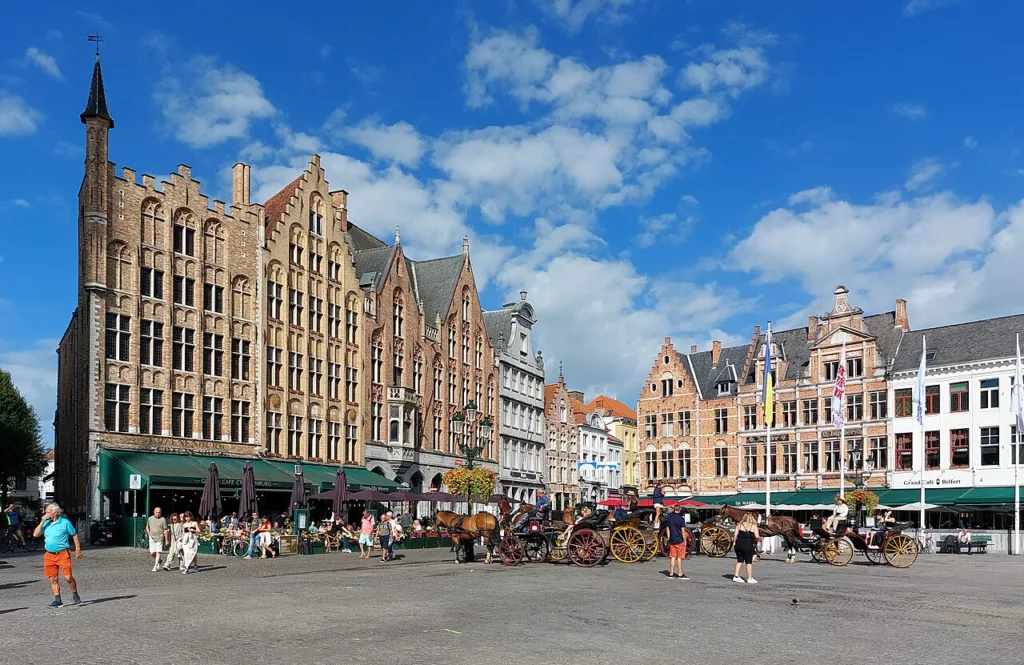
Bruges is one of the most popular day trips from Ghent thanks to its remarkably well-preserved historic center. Bruges’ historic canals, which once connected the city to the sea, contributed greatly to its commercial prosperity during the Middle Ages. The city is often nicknamed the “Venice of the North” because of its picturesque network of canals.
A stroll through its cobbled streets reveals medieval squares, Gothic buildings, and exceptional religious heritage. Visitors can explore Bruges by boat along the canals, on foot, by bike, or even by horse-drawn carriage. Must-see sights include the Markt, the Belfry, and the Basilica of the Holy Blood.
Antwerp

Antwerp is Belgium’s second-largest city and makes an excellent day trip from Ghent.
The city is world-famous for its diamond district, one of the most important diamond trading centers in the world. Antwerp Cathedral of Our Lady is a Gothic masterpiece housing several works by the Flemish painter Rubens.
The Grote Markt, surrounded by historic guild houses, is the heart of the old town. Antwerp Central Station is often considered one of the most beautiful railway stations in the world.
The MAS Museum (Museum aan de Stroom) offers excellent exhibitions on the city’s history as well as panoramic views over Antwerp. The city is also renowned for its major role in the world of fashion thanks to the famous “Antwerp Six.”
Brussels — About 30 Minutes from Ghent by Train
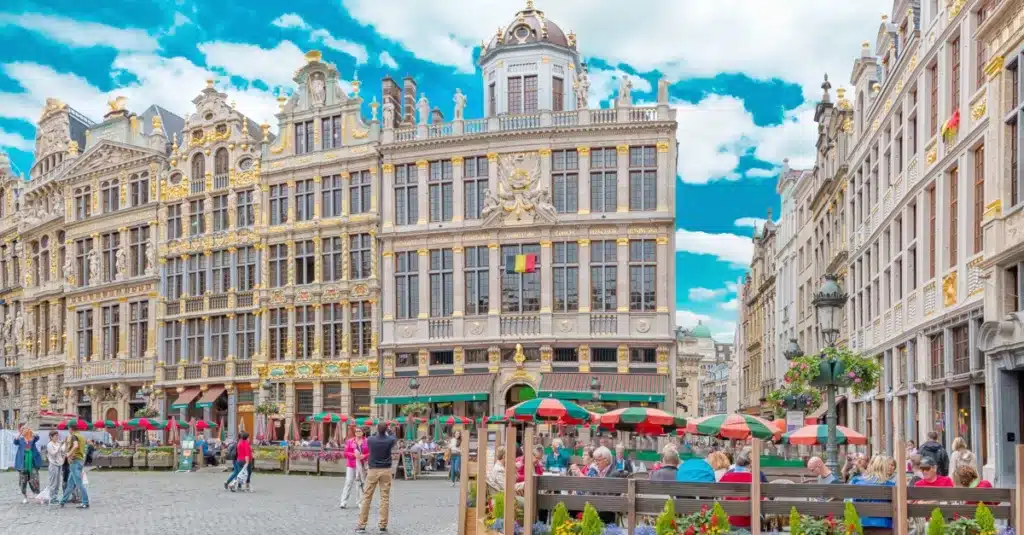
Brussels is the capital of Belgium and the main political center of the European Union.
Brussels’ Grand Place is considered one of the most beautiful squares in Europe and is listed as a UNESCO World Heritage Site. The city is famous for iconic landmarks such as the Atomium and Manneken Pis.
Brussels is also renowned for its gastronomy, especially waffles, chocolates, and craft beers. Art lovers can visit many museums, including the Royal Museums of Fine Arts. The European Quarter offers visitors the chance to discover the major institutions of the European Union.
Ypres (Ieper) — About 1 Hour 5 Minutes from Ghent by Train
Ypres is a historic city in West Flanders, known worldwide for its role during the First World War.
The city was almost entirely destroyed during the war before being meticulously rebuilt. The majestic Cloth Hall (Lakenhalle) dominates the city center and now houses the In Flanders Fields Museum.
This museum traces the history of the fighting in Flanders and the human impact of the conflict. Every evening, the “Last Post” ceremony is held beneath the Menin Gate in tribute to missing soldiers. The area around Ypres contains numerous military cemeteries and war memorials visited by travelers from around the world.
Conclusion
Visiting Ghent means discovering one of Belgium’s most captivating cities. Between its rich medieval heritage, iconic monuments, picturesque canals, fascinating museums, and local gastronomy, the capital of East Flanders offers a complete experience for every traveler.
Whether you love history, architecture, culture, or are simply looking for an authentic getaway, Ghent will charm you at every street corner. Easy to reach and pleasant to explore on foot, it is an essential destination for a weekend or a longer stay in Belgium.
If you are planning your trip, hesitate no longer: visiting Ghent means discovering a dynamic, elegant city full of surprises, where every district tells part of its fascinating story.