Visit Avignon: 30 Must-See Attractions and Things to Do
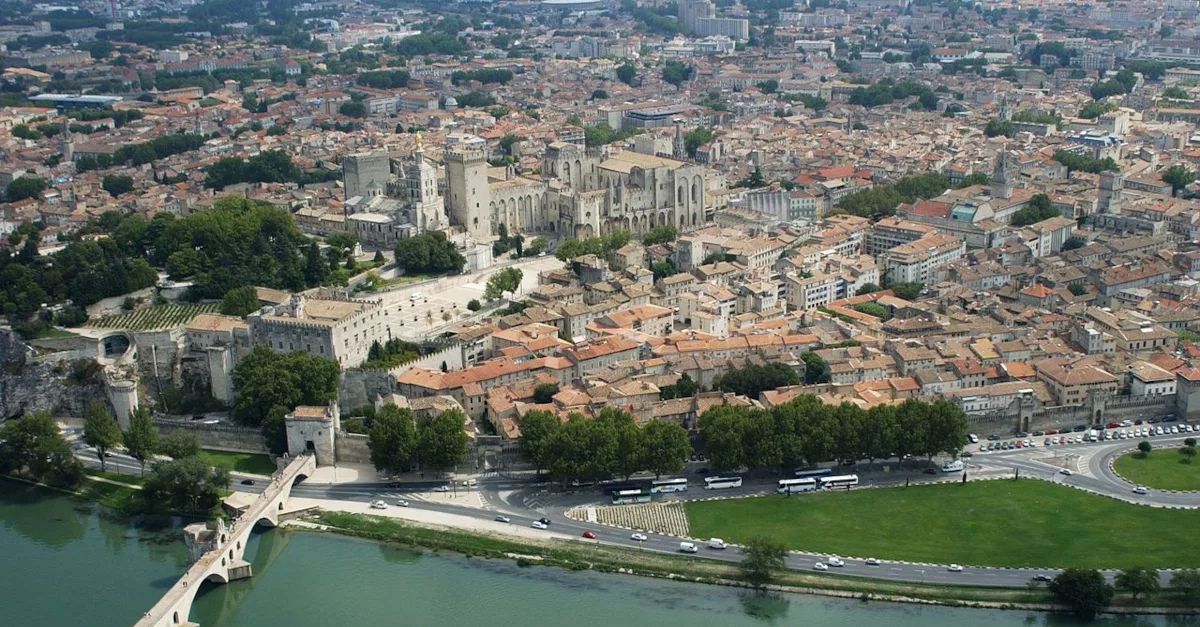
Visiting Avignon means discovering a city with a rich medieval, historical, and cultural heritage located in the Vaucluse region. The city is famous for its Palace of the Popes, the Avignon Bridge, and its ramparts, which tell the story of its unique past.
Avignon also charms visitors with its museums, parks, and walks along the Rhône River. The local gastronomy, featuring traditional dishes such as papeton d’aubergine and Provençal beef stew (daube provençale), completes the experience.
Festivals, markets, and cultural events punctuate local life and attract visitors throughout the year. This comprehensive guide will help you plan your stay and make the most of everything the city has to offer.
Discover the former City of the Popes and its history with our treasure hunt in Avignon, a unique blend of an escape game and a cultural tour.
Monuments & Historical Heritage – Avignon
1. Palace of the Popes

The Palace of the Popes in Avignon is one of the largest and most important medieval Gothic buildings in Europe. Six papal conclaves took place in this palace, leading to the election of Benedict XII, Clement VI, Innocent VI, Urban V, Gregory XI, and Benedict XIII.
The palace combines two sections: the Old Palace, built under Benedict XII, and the more lavish New Palace, constructed under Clement VI. Its architecture belongs to the “International Gothic” style and was decorated by renowned artists such as Simone Martini and Matteo Giovannetti.
At the time, the palace housed the largest library in Europe, containing thousands of volumes and fostering the development of intellectual figures such as Petrarch. Today, the Palace of the Popes hosts conferences, exhibitions, and performances. Its Cour d’Honneur is used during the annual Avignon Festival.
With 15,000 square meters of floor space, it is equivalent in size to four Gothic cathedrals combined.
Discover why the popes settled in Avignon and uncover the hidden details of this palace with our route, “Avignon Highlights“.
2. Avignon Bridge (Saint-Bénézet Bridge)
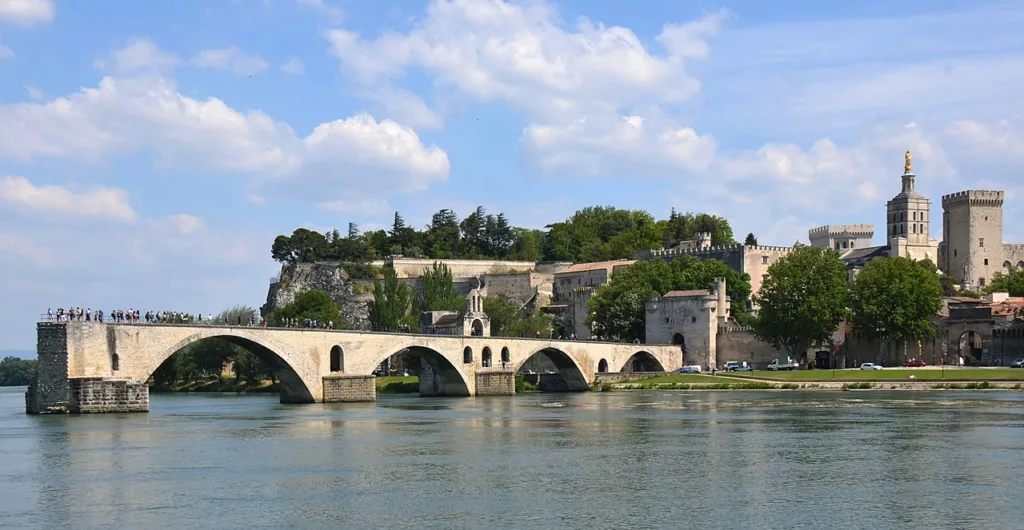
The Saint-Bénézet Bridge, also known as the Avignon Bridge, is a medieval bridge spanning the Rhône River, of which only four arches remain today. The bridge is world-famous thanks to the children’s song “Sur le pont d’Avignon,” which recalls the dances and celebrations once held on its arches. Construction began around 1177 and was completed around 1185, originally in wood.
The rebuilt stone bridge originally featured 22 arches and stretched approximately 900 meters. It suffered repeated destruction from Rhône floods, and the high maintenance costs eventually led to its abandonment in the 17th century.
Legend tells that the bridge was commissioned to a young shepherd named Bénézet, who received a divine command. He is said to have miraculously lifted a huge stone to lay the first foundation. On one of the surviving piers stands the Saint-Bénézet Chapel, with the Saint Nicholas Chapel above it.
One end of the bridge is marked by the Philippe-le-Bel Tower, which served as the gateway to Villeneuve-lès-Avignon.
3. Notre-Dame des Doms Cathedral
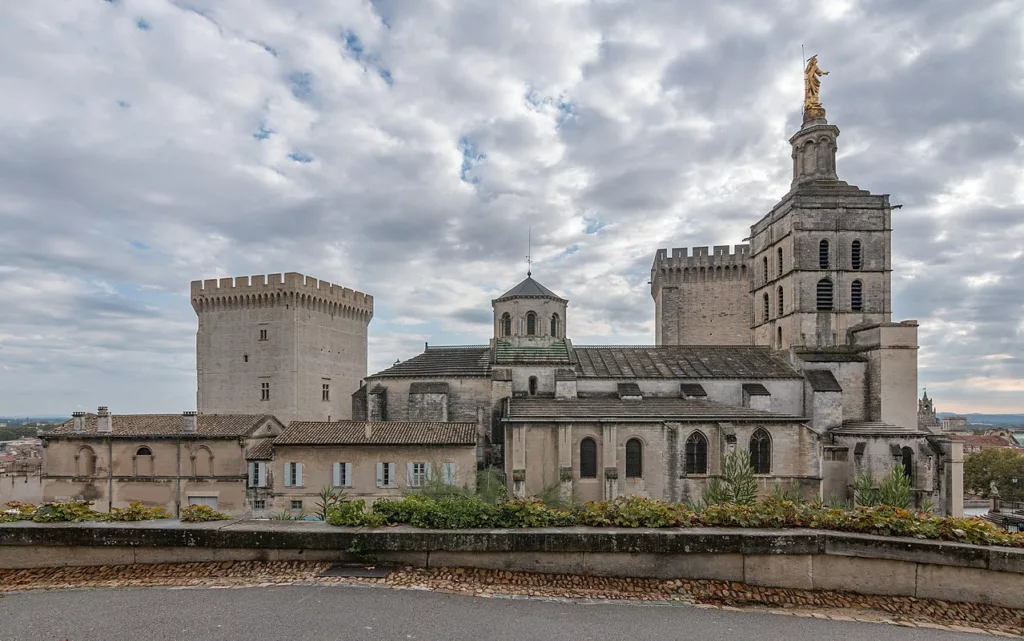
Notre-Dame des Doms Cathedral is located in Avignon, right next to the Palace of the Popes, overlooking the city from the Rocher des Doms.
It was mainly built during the 12th century in the Provençal Romanesque style. Its bell tower is topped by a gilded lead statue of the Virgin Mary, installed in 1859.
In 1475, the Diocese of Avignon was elevated to the rank of archdiocese, making the cathedral a metropolitan cathedral. Inside, visitors can see the tombs of Popes Benedict XII and John XXII, as well as macabre frescoes such as the “Tale of the Three Living and the Three Dead.”
Discover the meaning behind the cathedral’s name in our Avignon treasure hunt.
4. Saint-Michel Gate in Avignon
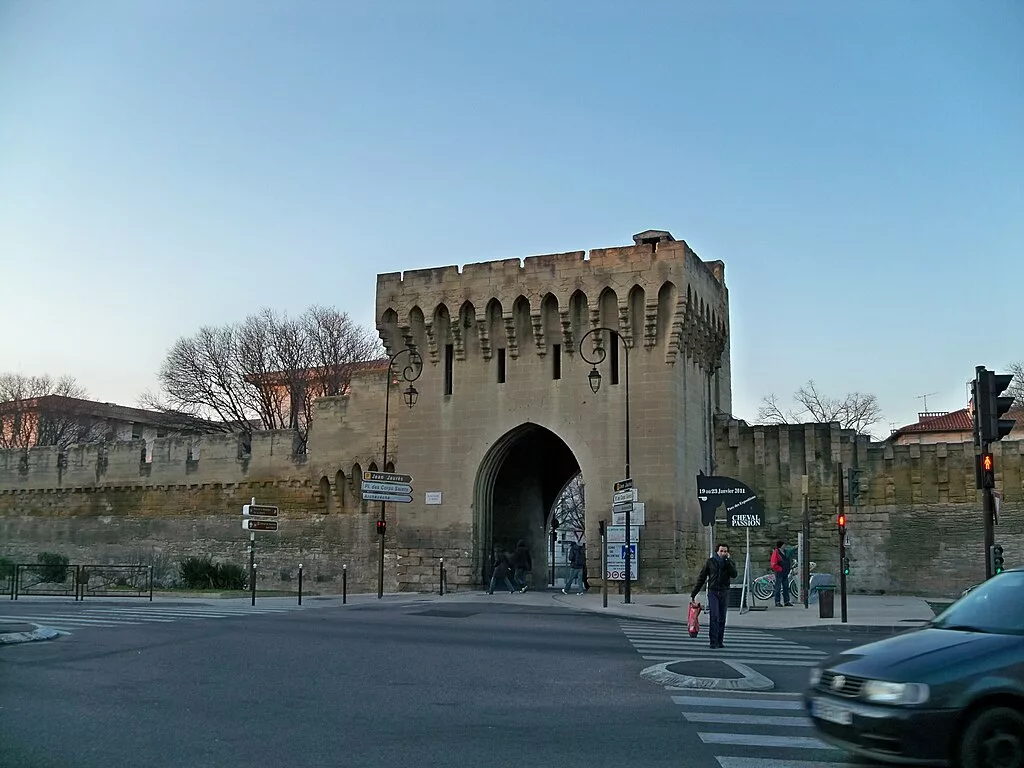
The Saint-Michel Gate is one of the gateways in Avignon’s city walls, located in the southern part of the city, west of Limbert Gate. It was restored in 1868–1869 and again after the bombings of 1944.
Historically, it carried other names, including “Saint-Antoine Gate” and later “Liberty Gate” during the Revolution of 1792.
The Avignon city walls extend for approximately 4.3 km, encircling the old town. These fortifications were built during the 14th century, particularly under Pope Innocent VI (beginning in 1355), to protect the city from incursions by the Great Companies. Originally, the walls included twelve gates, but this number was reduced to seven during modifications carried out between 1481 and 1487.
With advances in artillery, parts of the fortifications were reinforced during the 16th century, with additional battlements and loopholes added.
5. Grand Avignon Opera House
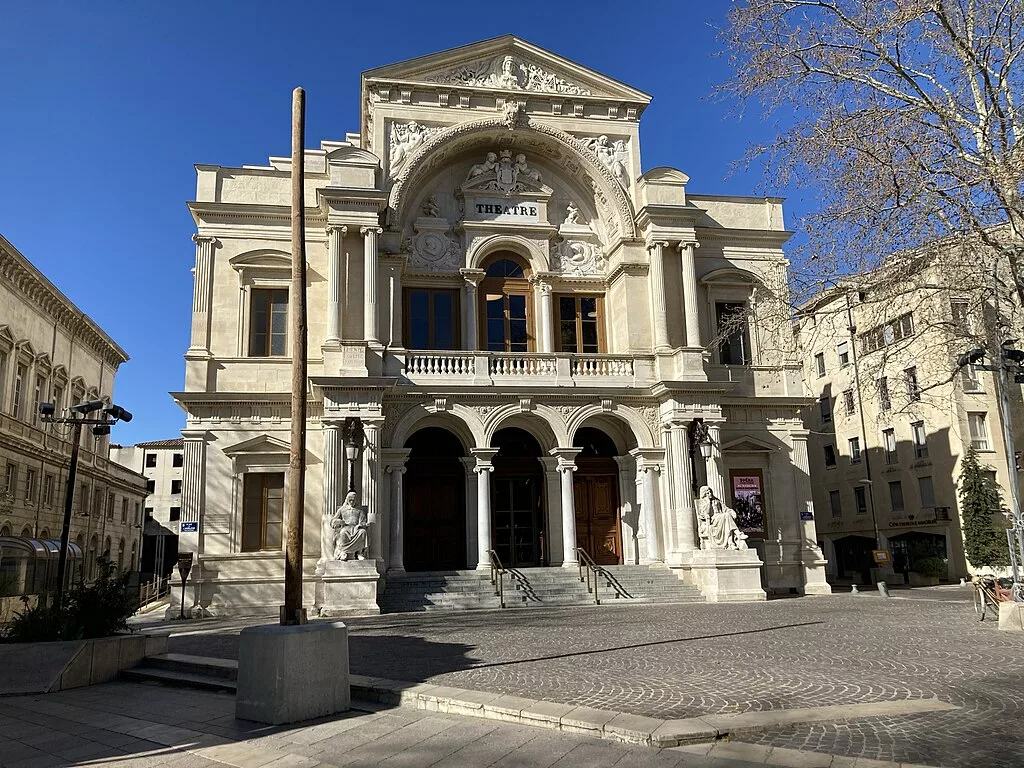
The Grand Avignon Opera House is located on Place de l’Horloge in Avignon. It was inaugurated in 1847 after the reconstruction of a municipal theater destroyed by fire.
The architects responsible for its construction were Léon Feuchère and Théodore Charpentier. The Grand Avignon Opera House reopened on October 14, 2021, following nearly four years of extensive renovations.
The main auditorium, designed in the Italian style, now accommodates 900 seats following the renovation and features a modernized ventilation system.
Discover the meaning of the statues standing in front of the Opera House with our Avignon tour.
6. Avignon City Hall
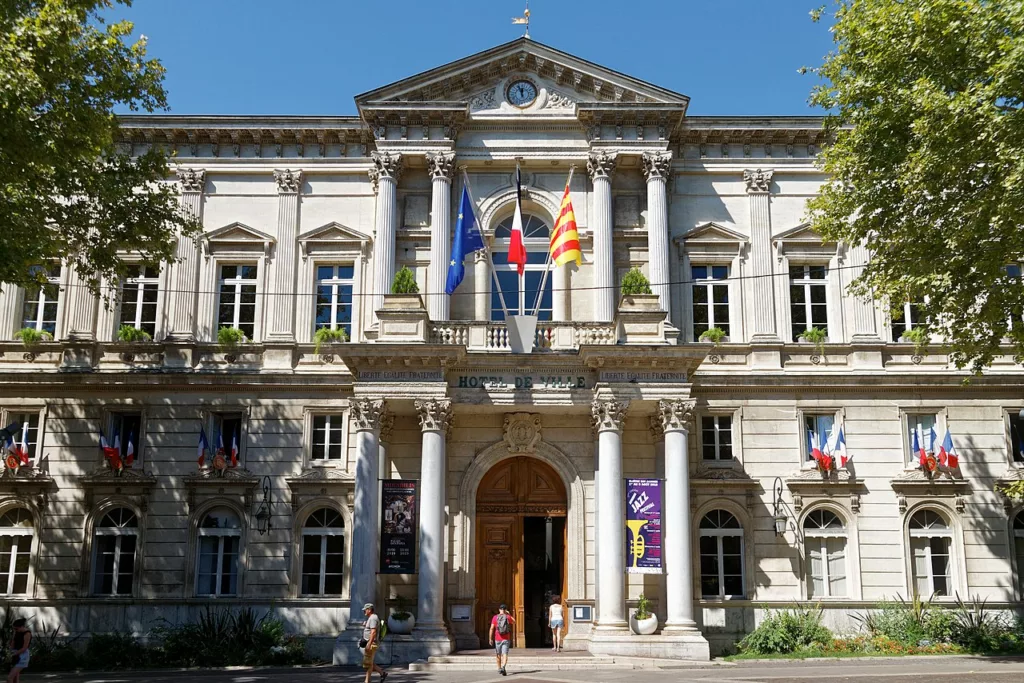
Avignon City Hall is located on Place de l’Horloge, a lively central square in the city.
It is built in a neoclassical style, with an elegant cut-stone façade. The architects responsible for its reconstruction in the 19th century were Joseph-Auguste Joffroy for the structure and Léon Feuchère for the façade.
The modern building was completed in 1856, although its Jacquemart tower is much older. The Jacquemart Tower, in Gothic style, dates from 1363 and is one of the rare remains of the former medieval municipal building.
In 1447, the consuls of Avignon purchased the former residence of the Cardinal of Albano, including its tower, to establish the town hall there.
Discover the hidden details of the city hall in our Avignon treasure hunt.
7. Rue des Teinturiers
The Rue des Teinturiers runs through Avignon’s historic center within the city walls, alongside a canal fed by the Sorgue. Its name comes from its industrial past: between the 14th and 19th centuries, numerous dyeing workshops used the canal water to wash, rinse, and dye fabrics.
At its peak, up to 23 paddle wheels powered silk workshops and mills; today, four wheels still remain as witnesses to this past. The street is paved with pebbles, known as calades, and shaded by centuries-old plane trees, giving it a very bucolic atmosphere, especially in summer.
Among the remarkable buildings in the district are: the Maison du IV de Chiffre, the Jean-Henri Fabre House, the Chapel of the Grey Penitents, and the bell tower of the Cordeliers convent.
The Maison du IV de Chiffre, dating from 1493, is one of the last Gothic houses in Avignon, with a mysterious “IV” monogram engraved on its façade.
8. Saint-Martial Chapel
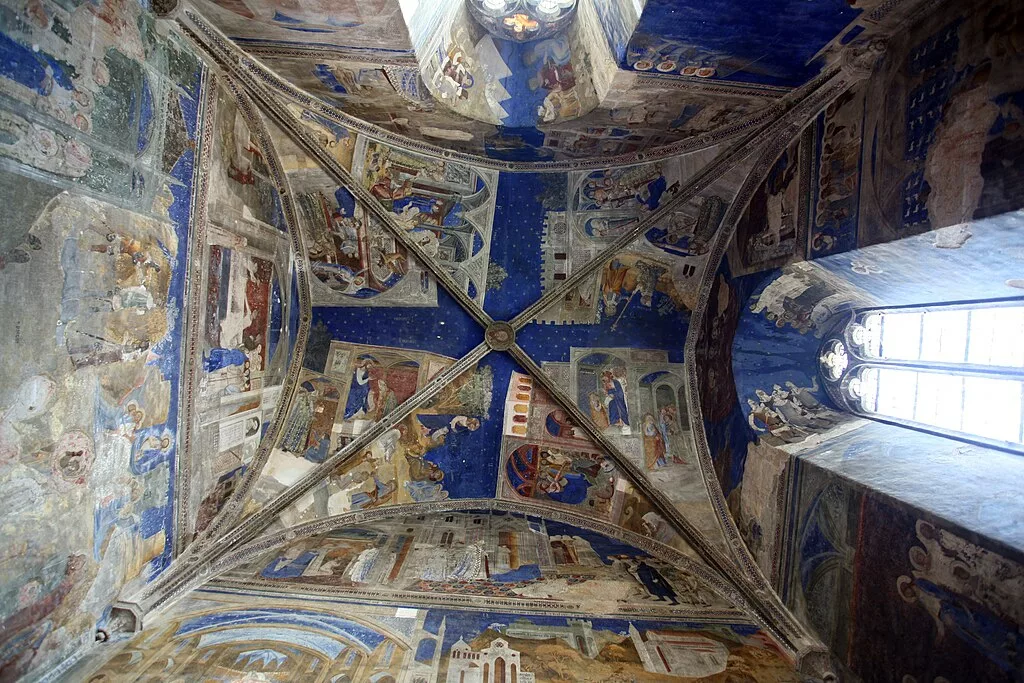
The Saint-Martial Chapel is located inside the Palace of the Popes, on the second floor of the Saint-Jean Tower. It was decorated between 1344 and 1345 by the Italian painter Matteo Giovannetti, at the request of Pope Clement VI.
The chapel’s fresco cycle recounts the life of Saint Martial, Bishop of Limoges, with miracles, sermons, and resurrections. The painted scenes are read from top to bottom, from the vaults down to the floor.
Giovannetti’s work is remarkable for its decorative richness, realism, and individualized characters, showing expressive crowds.
9. Les Halles Market

Les Halles d’Avignon is a large covered market located on Place Pie, in the heart of the old town. More than forty merchants are based there: greengrocers, fishmongers, butchers, cheesemongers, wine merchants, caterers, and more.
The market is renowned for the freshness of its products and the quality of the Provençal terroir it showcases.
On the north façade, a green wall by Patrick Blanc adds a striking artistic and botanical touch.
Every Saturday at 11 a.m., “La Petite Cuisine des Halles” takes place: chefs prepare recipes using market products while sharing their expertise with visitors.
Discover local specialties with our Avignon route.
10. Saint-Agricol Church

Saint-Agricol Church, also known as the Saint-Agricol Collegiate Church, is located at 23 Rue Saint-Agricol, in Avignon’s historic center.
It is dedicated to Saint Agricol, Bishop of Avignon in the 7th century, whose relics are preserved there.
The current building was rebuilt in the early 14th century under the initiative of Pope John XXII, who made it a collegiate church in 1321. Inside, visitors can admire works by Simon de Châlons, Nicolas Mignard, and other artists, as well as numerous tombs and epitaphs.
Discover the secrets of the sculpted details in this church with our Avignon route.
11. Rue de la République, Avignon

Rue de la République is one of the main pedestrian thoroughfares within Avignon’s city walls, laid out in the 19th century.
Its construction took place between 1856 and 1867, under the municipality of Paul Pamard, to connect the train station to Place de l’Horloge.
Initially named “Rue Bonaparte,” it changed names several times: “République,” “Pétrarque,” then back to “République” in 1870. The creation of this street required opening a breach in the old city walls, making it a modern and strategic axis.
The architectural style that characterizes this street is very “Haussmannian”: the buildings date from the second half of the 19th century. Notable buildings include the former Hautpoul barracks, now the administrative complex, and the Lapidary Museum, housed in a former Jesuit chapel.
There is also a fountain with a bronze bust of Paul Pamard, a former mayor of Avignon, created by Victorien Bastet. The Saint-Martial Protestant church, located at the corner of the street, also marks the district’s historic and spiritual route.
Museums & Culture – Avignon
1. Petit Palais Museum

The Petit Palais Museum is housed in the former palace of the archbishops of Avignon, located on Place du Palais, next to the Palace of the Popes. It opened in 1976 to house a large collection of “Italian primitives,” mainly from the Campana collection deposited by the Louvre Museum.
The museum displays more than 300 Italian paintings from the 13th to the 16th centuries, as well as works from the Avignon School from the Calvet Museum. It also features a major collection of medieval Provençal sculptures from the 12th to the 15th century.
The museum building covers nearly 3,000 m² and includes two inner courtyards.
Since 2025, it has been renamed “Petit Palais Museum – Louvre in Avignon”, following a strengthened partnership between the City of Avignon and the Louvre.
2. Calvet Museum
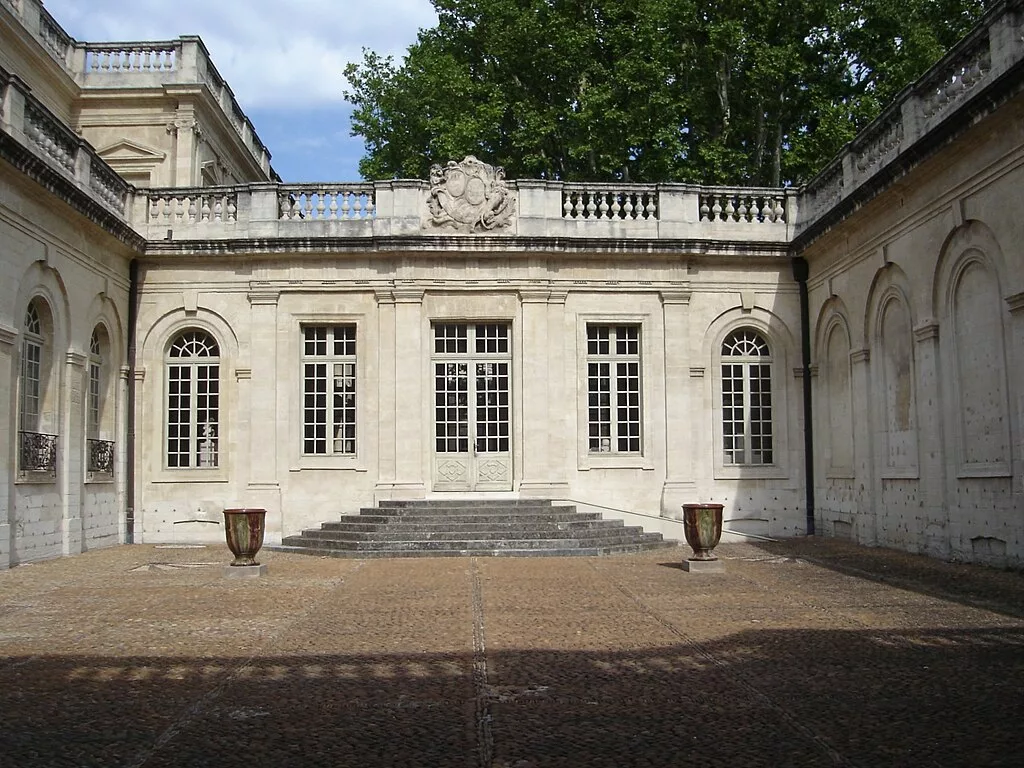
The Calvet Museum is Avignon’s main museum, managed by the Calvet Foundation.
It is housed in the former 18th-century Villeneuve-Martignan private mansion, located at 65 Rue Joseph Vernet. The museum’s founder, Esprit Calvet, bequeathed his collection of rare objects, books, and curiosities to the city of Avignon in 1810, giving birth to the institution.
Since the 1980s, its collections have been divided between two buildings: the Fine Arts Museum and an archaeological Lapidary Museum.
The Lapidary Museum, attached to the Calvet Museum, is housed in the former Jesuit chapel and displays Greek, Roman, Celtic, and Gallo-Roman sculptures.
The Calvet Museum has a very rich collection of paintings from the 15th to the 20th century: Northern masters, Provençal painters (Mignard, Levieux, and others), and modern artists such as Soutine. It also holds remarkable sculptures, including works by Camille Claudel, as well as decorative arts: faience, bronzes, and furniture.
3. Collection Lambert
The Collection Lambert is a contemporary art museum founded by gallerist and collector Yvon Lambert, established in Avignon since 2000. It is housed in two 18th-century private mansions in the heart of Avignon: the Hôtel de Caumont and the Hôtel de Montfaucon.
In 2012, Yvon Lambert donated more than 550 works to the French State, which are permanently deposited in the museum. The permanent collection includes around 2,000 works from the 1960s to today, covering movements such as minimal art, conceptual art, land art, photography, video, and 1980s painting.
Artists represented include Jean-Michel Basquiat, Sol LeWitt, Nan Goldin, Anselm Kiefer, Cy Twombly, Robert Ryman, Andres Serrano, Christian Boltanski, and many others. In 2015, the Collection Lambert doubled its exhibition space with the addition of the Hôtel de Montfaucon, through an architectural project led by architects Cyrille and Laurent Berger.
4. Requien Museum
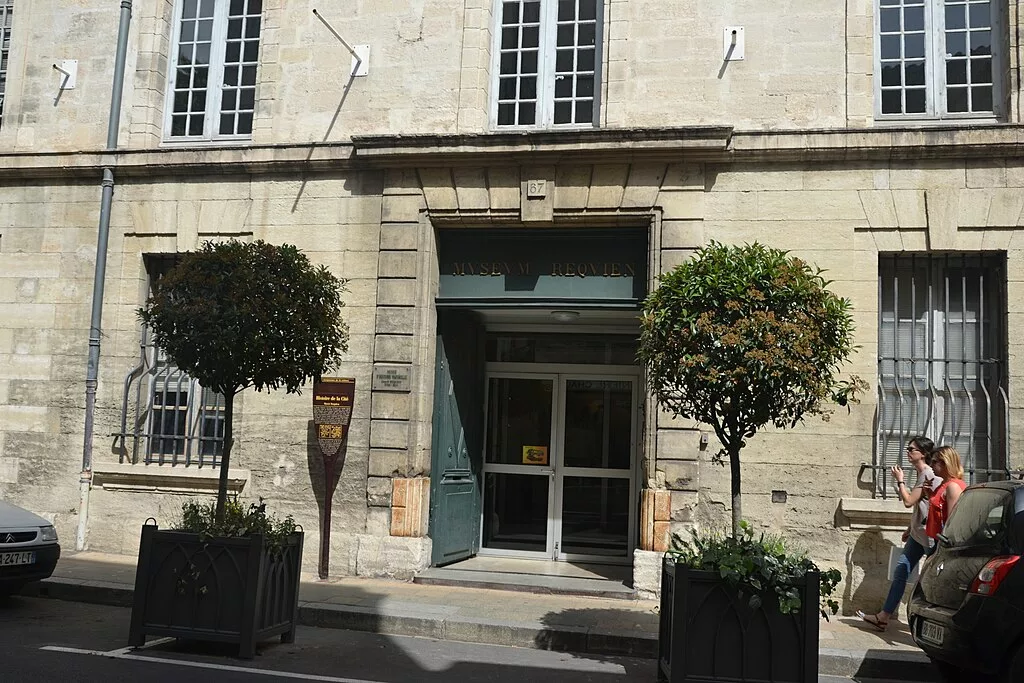
The Requien Museum is Avignon’s natural history museum, named in honor of Esprit Requien, a naturalist from Avignon (1788–1851).
It was founded in 1840 by Esprit Requien himself, originally as a natural history cabinet.
Since 1943, the museum has been housed in the Hôtel Raphélis de Soissans, an 18th-century building located at 67 Rue Joseph Vernet, right next to the Calvet Museum.
The collections include more than 1.2 million specimens: minerals, rocks, fossils, shells, and more. The museum retraces the geological history of the Vaucluse, with permanent exhibitions on the region’s fauna and flora from ancient times.
It also has a very rich herbarium, with between 150,000 and 300,000 plant specimens, making it a major botanical collection.
The museum also has a specialized library of around 9,600 books, as well as reserves accessible to researchers.
Parks, Gardens & Walks – Avignon
1. Rocher des Doms and Panoramic Gardens

The Rocher des Doms is a rocky spur overlooking the Rhône in Avignon, which served as a protective site for the city’s foundation.
At the top of the rock lies the Jardin des Doms, a public English-style garden covering around 3 hectares.
The highest point of the rock rises about 30 meters above the Rhône, offering an exceptional panorama over Avignon, the Saint-Bénézet Bridge, Île de la Barthelasse, and the surrounding landscapes.
The garden was laid out in the 19th century, with trees, lawns, ponds, fountains, and statues, including Jean Althen, Félix Gras, and “Venus with Swallows.”
There is an esplanade with an orientation table where visitors can admire the Rhône Valley, Mont Ventoux, Fort Saint-André, and other landmarks.
The rock was occupied as early as the Neolithic period, as shown by archaeological excavations and remains.
Major Events – Avignon
1. Avignon Festival
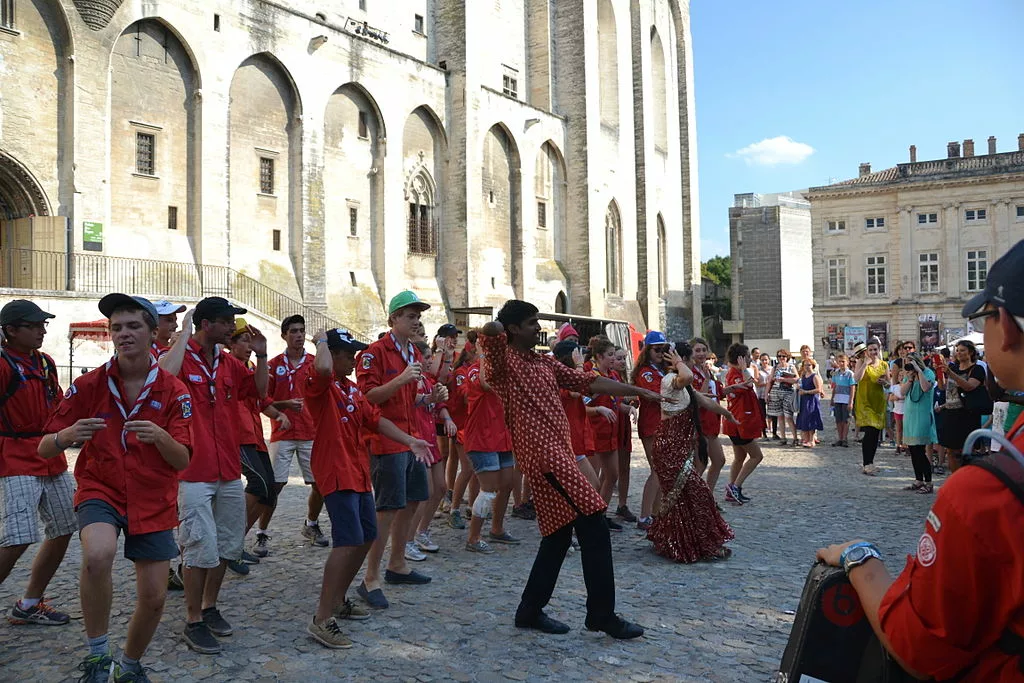
The Avignon Festival was founded in 1947 by Jean Vilar. It takes place every summer in July, mainly in the Cour d’Honneur of the Palace of the Popes, as well as in many venues throughout the city center.
The official festival is often called the “In”, and there is also a parallel festival, the “Off”, featuring hundreds of performances across the city.
The Avignon Festival is one of France’s earliest theater festivals and remains one of the most prestigious contemporary performing arts events.
Each edition offers not only theater performances, but also readings, debates, film screenings, and exhibitions. Jean Vilar wanted to “give theater a space beyond closed-door venues” and create a dialogue between architecture and dramatic poetry.
The festival is run by a non-profit organization, with public partners such as the City of Avignon and the Ministry of Culture. Since its beginnings, it has become a social phenomenon: for three weeks, Avignon literally becomes a “theater city,” attracting tens of thousands of spectators.
Excursions / Day Trips around Avignon
1. Villeneuve-lès-Avignon and Fort Saint-André
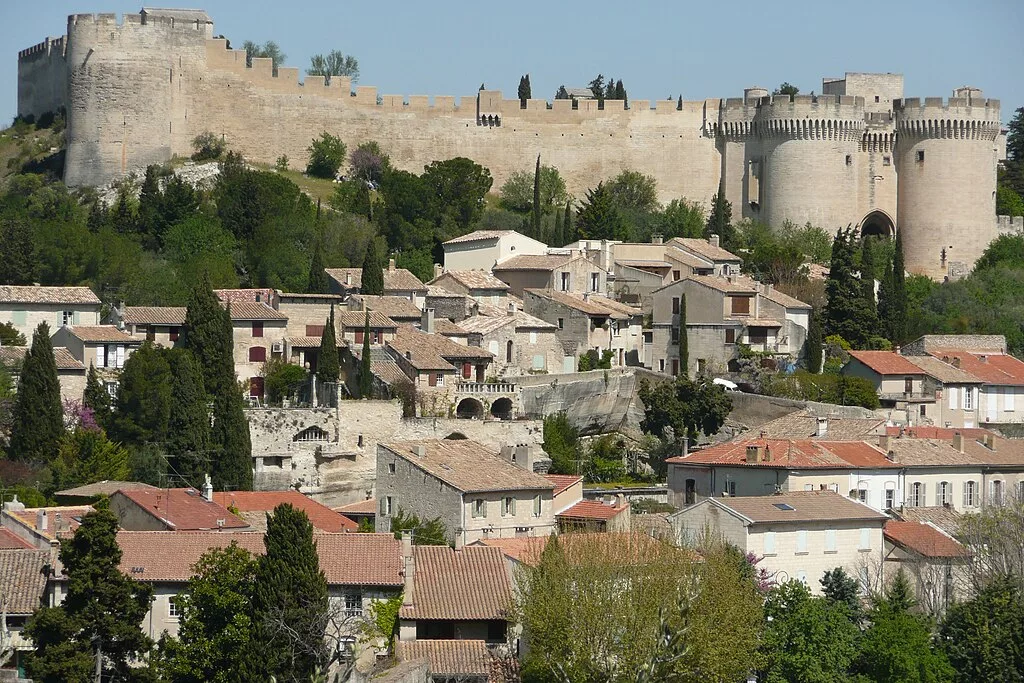
Located on the right bank of the Rhône, Villeneuve-lès-Avignon offers spectacular views of Avignon, the Palace of the Popes, and the Saint-Bénézet Bridge.
One of the major sites on this excursion is Fort Saint-André, a 14th-century medieval fortress that overlooks the town and offers breathtaking views.
Nearby stands the Philippe-le-Bel Tower, built at the end of the 13th century to watch over the bridge between Avignon and Villeneuve.
The visit can include the Chartreuse du Val de Bénédiction, a former Carthusian monastery founded in the 14th century, now a cultural and spiritual center.
The Mediterranean garden adjoining Fort Saint-André, labeled a “Remarkable Garden,” invites visitors to stroll among olive trees, pines, and aromatic flowers.
The Notre-Dame Collegiate Church, a Gothic church dating from the 14th century, also reveals a peaceful cloister to discover during the visit.
Along the way, the Mourgues Hill offers a natural lookout point with a wooded park, from which visitors can admire the silhouette of Avignon and Mont Ventoux.