Visit Cambridge: 30 Must-See Attractions and Things to Do
Visiting Cambridge means immersing yourself in one of the most prestigious university cities in the world. Located in the east of England, just one hour from London, Cambridge captivates visitors with its exceptional historical heritage, world-famous colleges, renowned museums, and beautiful green spaces lining the River Cam.
Famous for its university founded in the 13th century, the city is home to iconic landmarks such as King’s College, Trinity College, St John’s College, the magnificent King’s College Chapel, and the celebrated Mathematical Bridge. From traditional punting excursions on the Cam to exploring university museums, strolling through botanical gardens, and wandering the historic city center, Cambridge offers a unique experience that combines culture, history, and the British way of life.
In this complete guide to visiting Cambridge, discover the city’s must-see monuments, best museums, most beautiful parks, local culinary specialties, and the finest excursions in the surrounding area, including Ely, Audley End House, and Bury St Edmunds. Whether you’re planning a day trip or a longer stay, Cambridge is an essential destination when traveling in England.
Historic Monuments and Heritage of Cambridge
King’s College
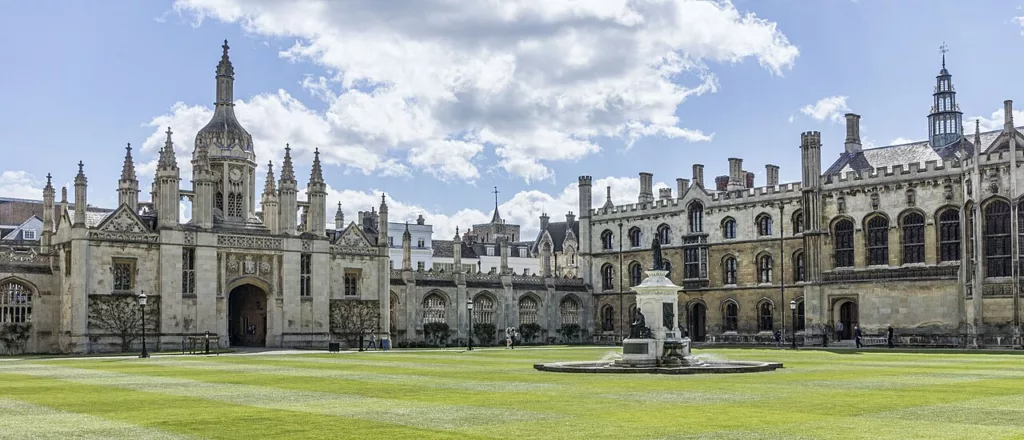
Founded in 1441 by King Henry VI, King’s College is one of the most prestigious colleges of the University of Cambridge. It is located in the heart of the city along King’s Parade and the banks of the River Cam. Originally, the college admitted only students from Eton College, another institution established by Henry VI.
The site is best known for its spectacular chapel, King’s College Chapel, whose construction spanned from 1446 to 1531. A masterpiece of late English Gothic architecture, it houses the world’s largest fan vault, impressive 16th-century stained-glass windows, and the famous painting Adoration of the Magi by the Flemish artist Peter Paul Rubens. The chapel is also home to the renowned King’s College Choir, whose Christmas concert, Festival of Nine Lessons and Carols, is broadcast worldwide every year.
Beyond its remarkable architecture, King’s College has educated numerous influential figures, including economist John Maynard Keynes, mathematician and computer science pioneer Alan Turing, and several Nobel Prize winners. Its vast lawns, historic buildings, and privileged location along the River Cam make it one of the most photographed places in Cambridge.
A visit to King’s College offers an opportunity to discover the history of the university, British academic excellence, and one of the finest architectural ensembles in the United Kingdom.
Cambridge Market Square
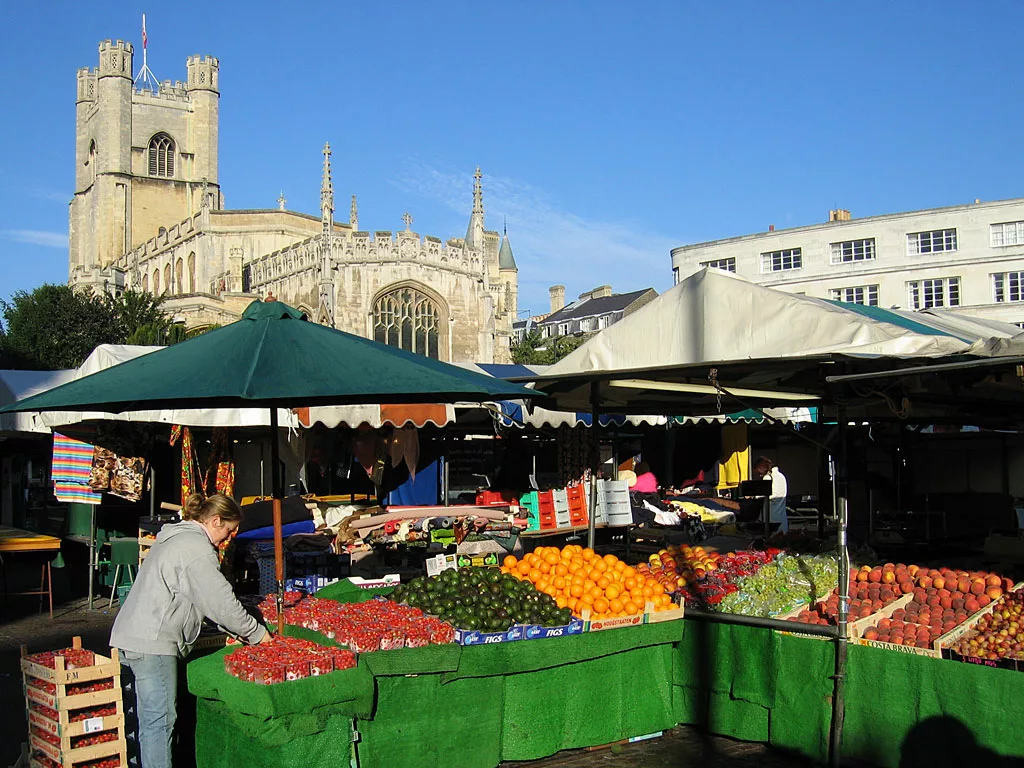
Located in the historic center of Cambridge, Market Hill, also known as Market Square, has served as the city’s marketplace since Saxon times. Even today, it hosts an open-air market almost every day, making it one of the liveliest and most frequented places in Cambridge.
Surrounded by shopping streets, cafés, and historic buildings, the square offers a quintessentially English atmosphere. Visitors can browse a wide variety of stalls selling local produce, culinary specialties, clothing, flowers, books, and handcrafted goods. It is an ideal place to experience local life while enjoying the city’s vibrant university atmosphere.
The square is dominated by the silhouette of Great St Mary’s, the University Church of Cambridge, whose tower offers one of the finest panoramic views over the colleges and rooftops of the city. Nearby are also the Guildhall, the historic seat of municipal administration, and several shopping centers.
Market Hill also boasts a rich history. During the Peasants’ Revolt of 1381, the square witnessed clashes in which protesters destroyed university records. For several centuries, it was also supplied by Hobson’s Conduit, an ingenious water distribution system built in the 17th century.
Today, Market Hill remains the true heart of Cambridge—a must-visit destination for strolling, shopping, and soaking up the unique atmosphere of this university city.
Cambridge American Cemetery: A Place of Remembrance and Reflection

Located a few kilometers from the center of Cambridge, between the villages of Coton and Madingley, the Cambridge American Cemetery is the principal American World War II military cemetery in the United Kingdom. Dedicated in 1956, it honors American service members who lost their lives in Europe between 1941 and 1945.
The site covers more than 12 hectares and contains the graves of 3,812 American military personnel, primarily airmen who participated in aerial operations over Europe and sailors involved in North Atlantic convoys. An impressive Wall of the Missing also bears the names of more than 5,000 soldiers whose remains were never recovered.
The memorial includes an elegant Portland stone chapel, a reflecting pool, and a modern visitor center that recounts the involvement of American forces during the war. Inside, maps, mosaics, and stained-glass windows illustrate the major military operations launched from England.
Among those commemorated are musician Glenn Miller and Joseph P. Kennedy Jr., the elder brother of future President John F. Kennedy. Today, the Cambridge American Cemetery remains a deeply moving place of remembrance, offering visitors a poignant testimony to the sacrifices made during the Second World War.
Trinity College: Excellence at the Heart of Cambridge
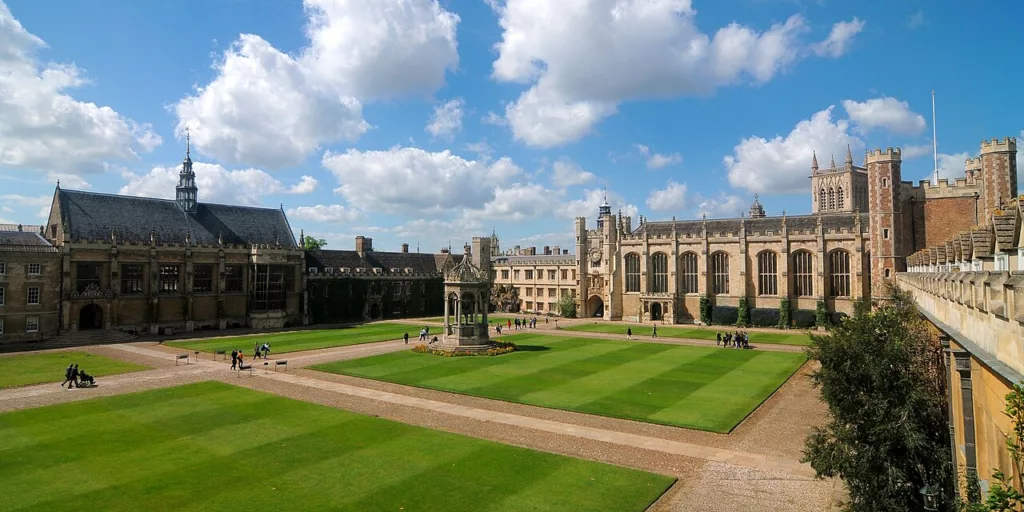
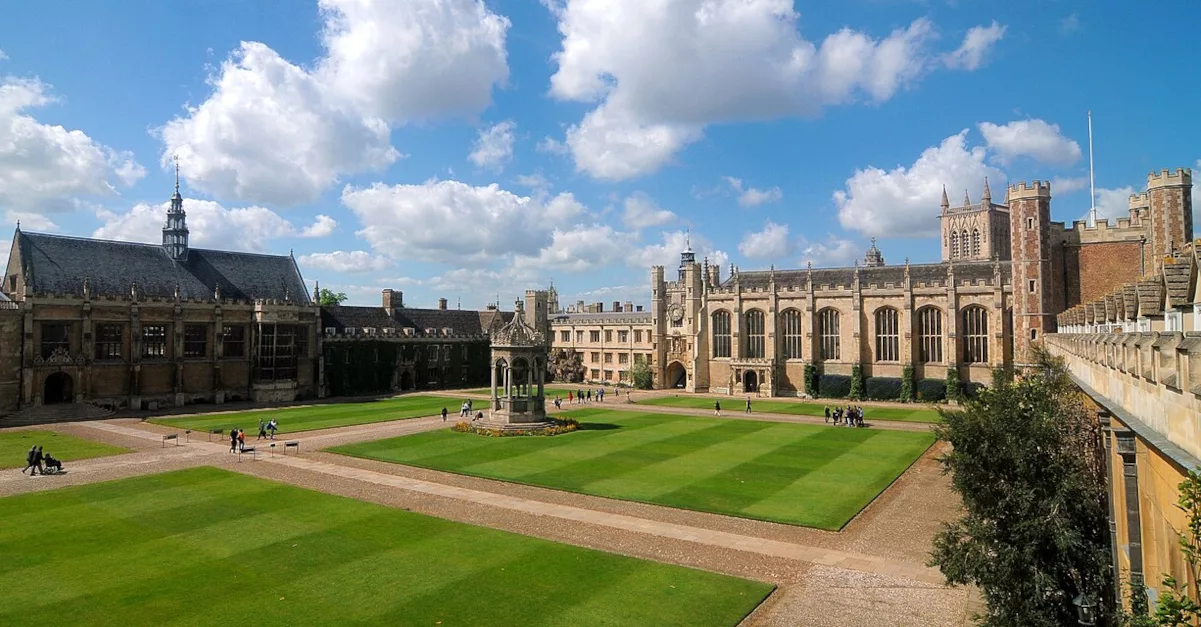
Founded in 1546 by King Henry VIII, Trinity College is the largest and one of the most prestigious colleges of the University of Cambridge. Located on Trinity Street in the heart of the city, it is renowned for its remarkable architecture, academic excellence, and the global influence of its alumni.
The college is particularly famous for its imposing Great Court, considered one of the largest enclosed courtyards in Europe, as well as the magnificent Wren Library, designed by architect Christopher Wren. This historic library houses exceptional treasures, including manuscripts by Sir Isaac Newton and several first editions of Shakespeare’s works.
Trinity College has been home to some of history’s greatest intellectual figures, including Isaac Newton, Charles Babbage, Bertrand Russell, Alan Turing, as well as numerous British Prime Ministers and Nobel Prize winners. The college alone counts more than thirty Nobel laureates among its alumni and researchers.
Visitors also appreciate its beautifully maintained gardens, historic buildings, and stunning views of the River Cam from the famous “Backs.” A symbol of British academic excellence, Trinity College is an essential stop for discovering the heritage and history of Cambridge.
Bridge of Sighs: One of Cambridge’s Most Photographed Landmarks
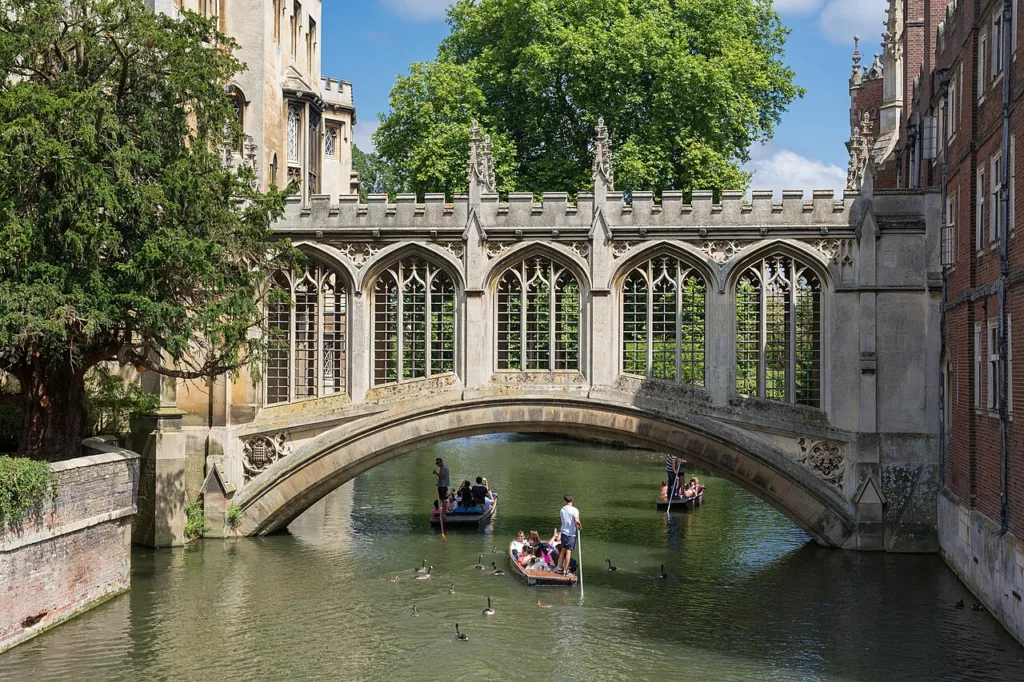
The Bridge of Sighs is one of Cambridge’s most iconic landmarks. Located within St John’s College, it spans the River Cam and connects the college’s historic buildings with New Court. Built in 1831 by architect Henry Hutchinson, this covered Neo-Gothic bridge is now one of the most photographed sites in the city.
Its name was inspired by Venice’s famous Bridge of Sighs, although the two structures share few architectural similarities. With its elegant stone arches and ornate windows, the bridge provides a romantic setting that blends perfectly into the landscape of the “Backs,” the gardens and green spaces that line the river behind the colleges.
Over the years, the Bridge of Sighs has become one of Cambridge’s defining symbols. It has appeared in several films and television productions, including The Theory of Everything, based on the life of Stephen Hawking. Queen Victoria herself is said to have declared it her favorite spot in the entire city.
Great St Mary’s: Cambridge’s University Church
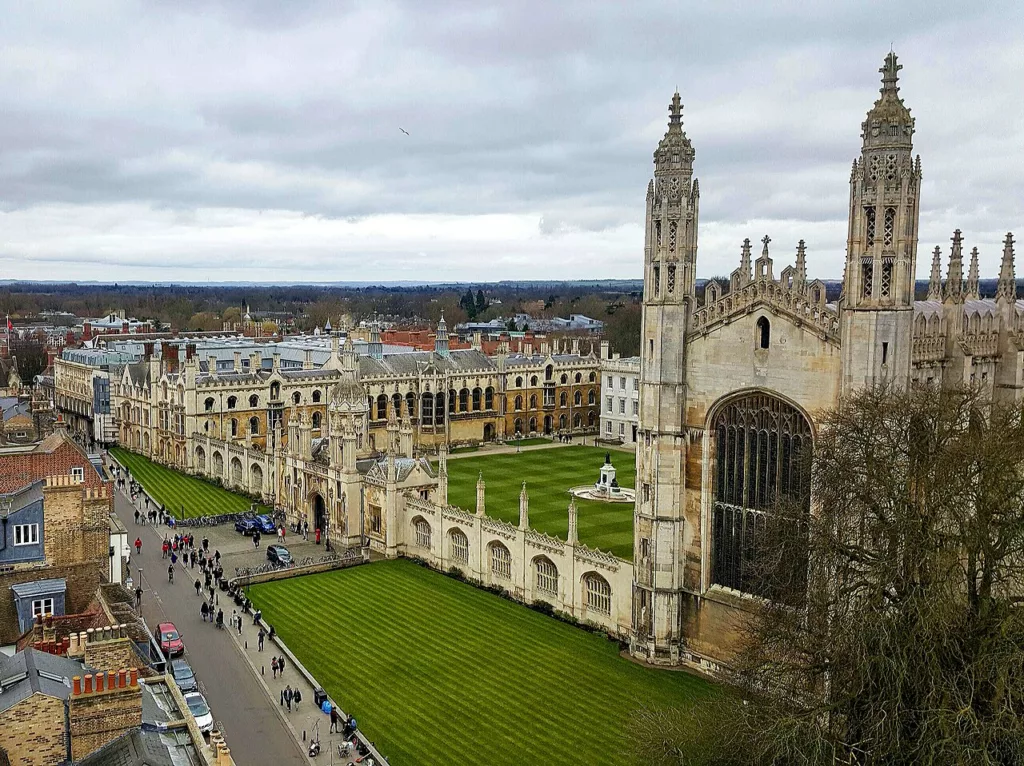
Located in the heart of Cambridge’s historic center, opposite the Senate House and just a short walk from King’s College, Great St Mary’s is the official university church of the University of Cambridge. Built between 1478 and 1519 in the English Perpendicular Gothic style, it is one of the city’s most important religious landmarks.
Since the Middle Ages, the church has maintained close ties with the university. Before the construction of the Senate House, it hosted university meetings and debates. Even today, it serves as a venue for academic ceremonies, university sermons, and several official events connected to Cambridge life.
The interior is distinguished by its magnificent 19th-century stained-glass windows, historic organs, and impressive Gothic architecture. However, one of the main attractions for visitors is the climb to the tower, which offers exceptional panoramic views over Cambridge’s colleges, courtyards, and rooftops.
Great St Mary’s also has a rich religious and intellectual history. Prominent figures of the Reformation, such as Erasmus, preached here, while the funeral service of physicist Stephen Hawking was held in the church in 2018.
St John’s College: Tradition, Prestige, and Heritage
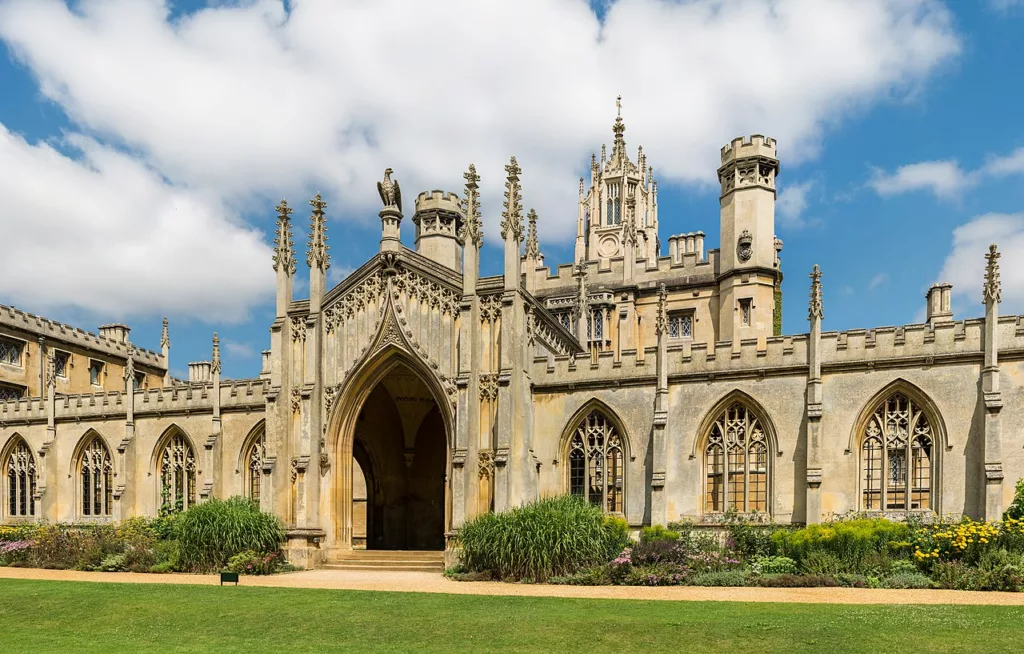
Founded in 1511 by Lady Margaret Beaufort, mother of King Henry VII, St John’s College is one of the largest and most prestigious colleges of the University of Cambridge.
The college captivates visitors with its historic courtyards, Neo-Gothic chapel, ancient library, and elegant gardens stretching toward the famous “Backs.” Among its most iconic landmarks is the renowned Bridge of Sighs, a covered bridge built in 1831 that connects different parts of the college and stands as one of Cambridge’s most photographed symbols.
Over the centuries, St John’s College has welcomed many distinguished figures, including poet William Wordsworth, abolitionist William Wilberforce, physicist Paul Dirac, mathematician Roger Penrose, and former Indian Prime Minister Manmohan Singh. The college also counts several Nobel Prize winners among its alumni and researchers.
Corpus Clock: Cambridge’s Most Unusual Timepiece
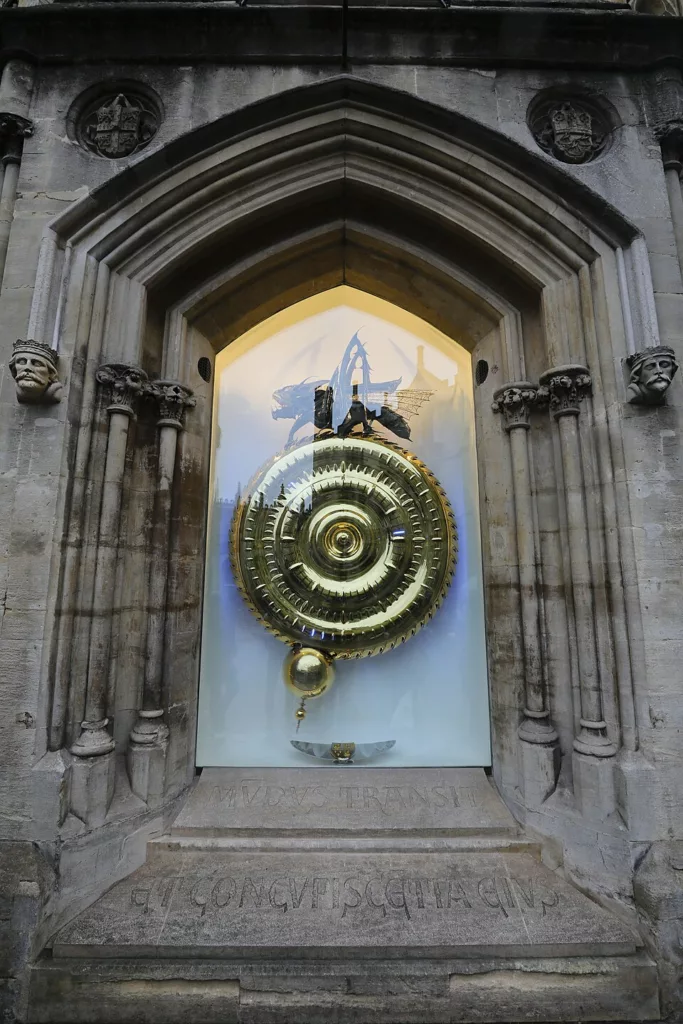
Installed at the entrance of Corpus Christi College, at the junction of Bene’t Street and King’s Parade, the Corpus Clock is one of Cambridge’s most original attractions. Unveiled in 2008 by renowned physicist Stephen Hawking, this monumental work of art quickly gained international fame.
Its gold-covered circular dial features neither hands nor traditional numbers. Instead, the time is displayed through lights that illuminate small openings. What immediately draws attention, however, is the metallic creature perched atop the clock: the “Chronophage,” or “time eater.” This giant mechanical insect appears to devour each passing second, dramatically reminding viewers of the relentless passage of time.
Designed by clockmaker and inventor John C. Taylor, the Corpus Clock combines technical ingenuity, contemporary art, and philosophical reflection. Its mechanism, inspired by 18th-century clocks, is entirely mechanical and was designed to operate accurately for several centuries.
Mathematical Bridge: Engineering Elegance in Cambridge
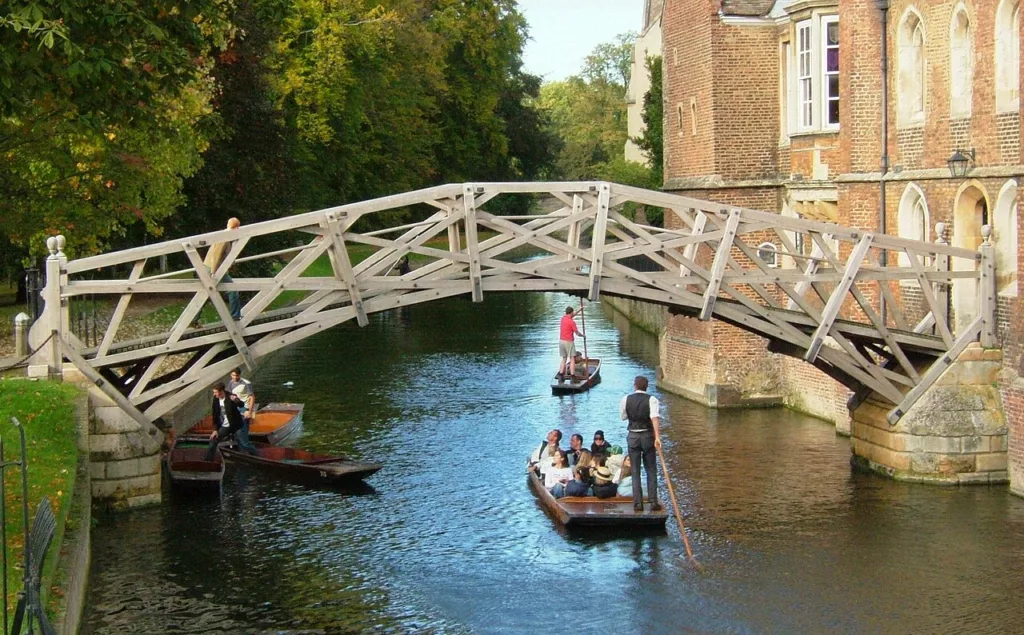
The Mathematical Bridge is one of Cambridge’s most famous bridges. Located within Queens’ College, it spans the River Cam and connects two parts of the college in an especially picturesque setting. Built in 1749 by engineer William Etheridge, it is now one of the city’s most photographed landmarks.
At first glance, the bridge appears to form an elegant arch, but it is actually composed entirely of straight timber beams assembled according to a remarkable geometric principle. This engineering achievement earned it the name “Mathematical Bridge” and makes it an outstanding example of 18th-century structural design.
The bridge is also surrounded by a famous legend claiming that Isaac Newton designed it without using bolts or screws. Although this story is false—Newton died before the bridge was built—it contributes to the site’s fame and continues to spark visitors’ curiosity.
Pembroke College: A College Steeped in History
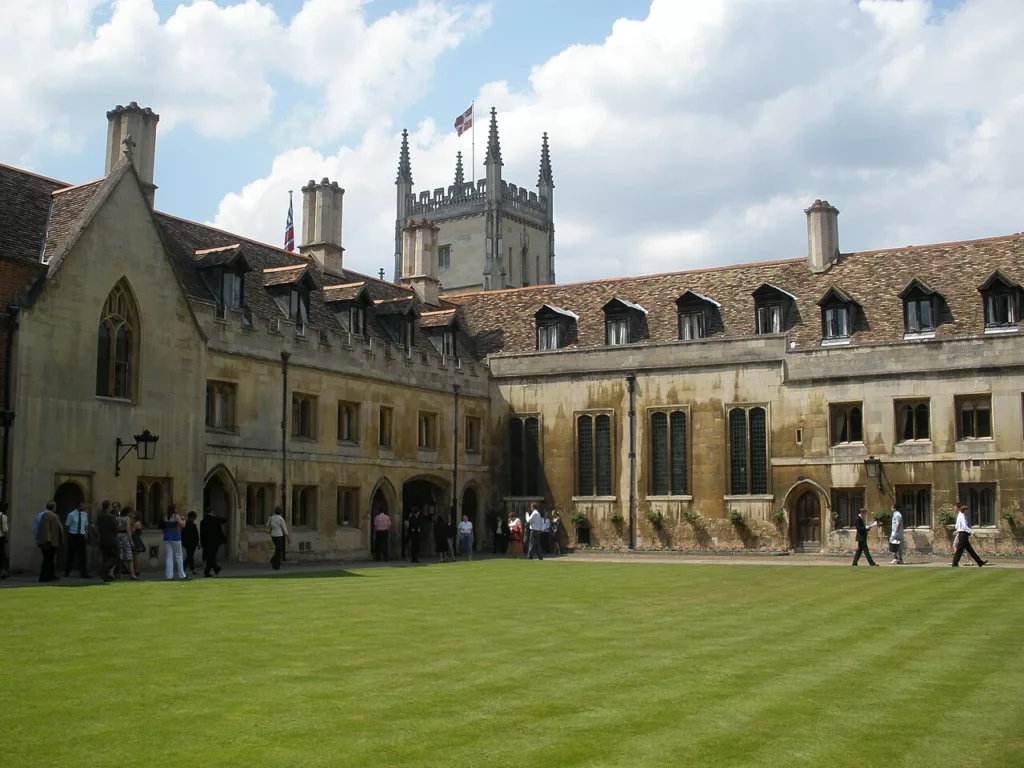
Founded in 1347 by Marie de St Pol, Countess of Pembroke, Pembroke College is the third-oldest college of the University of Cambridge. Located on Trumpington Street in the heart of the city, it is distinguished by its harmonious blend of medieval, classical, and contemporary architecture, reflecting nearly seven centuries of academic history.
The college features several remarkable buildings, including its 14th-century gatehouse, considered the oldest surviving college entrance in Cambridge. It is also home to the first chapel designed by the renowned architect Sir Christopher Wren, inaugurated in 1665, as well as a magnificent 19th-century Neo-Gothic library.
Pembroke’s gardens, among the most pleasant in Cambridge, provide a peaceful setting with immaculate lawns, centuries-old trees, and the college’s famous orchard. The institution is also recognized for its academic excellence and consistently ranks among the university’s top-performing colleges.
Over the centuries, Pembroke College has welcomed many notable figures, including British Prime Minister William Pitt the Younger, poet Edmund Spenser, physicist George Gabriel Stokes, and actors Tom Hiddleston and Naomie Harris.
Queens’ College: One of Cambridge’s Most Beautiful Colleges
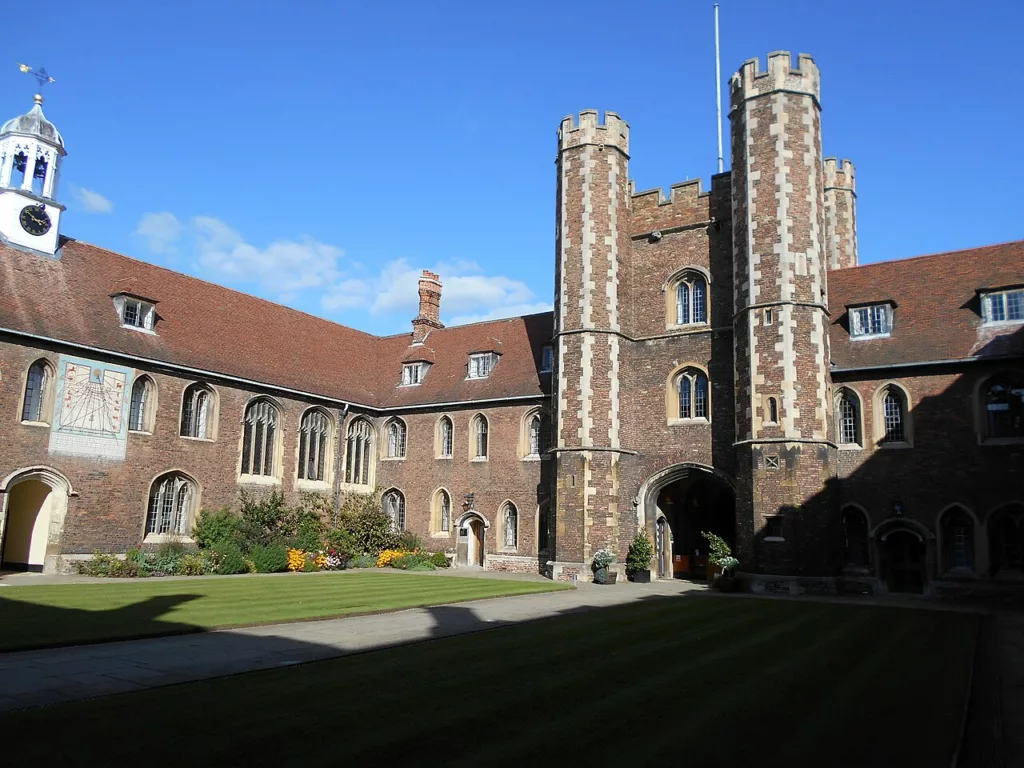
Founded in 1448 by Queen Margaret of Anjou and refounded in 1465 by Elizabeth Woodville, Queens’ College is one of the oldest and most picturesque colleges of the University of Cambridge. Its plural name, “Queens’,” pays tribute to its two royal founders.
The college is distinguished by its remarkable architectural heritage. Its medieval buildings, among the best preserved in Cambridge, stretch across both sides of the River Cam and are connected by the famous Mathematical Bridge, one of the city’s most iconic landmarks. Visitors can also admire Old Court, considered one of the finest medieval collegiate complexes in England, as well as the college’s historic library, which houses valuable manuscripts and rare books.
Over the centuries, Queens’ College has welcomed many distinguished figures, including the humanist Erasmus, writer Stephen Fry, journalist Emily Maitlis, and Demis Hassabis, a pioneer in artificial intelligence and Nobel Prize laureate.
Our Lady and the English Martyrs: Cambridge’s Tallest Church
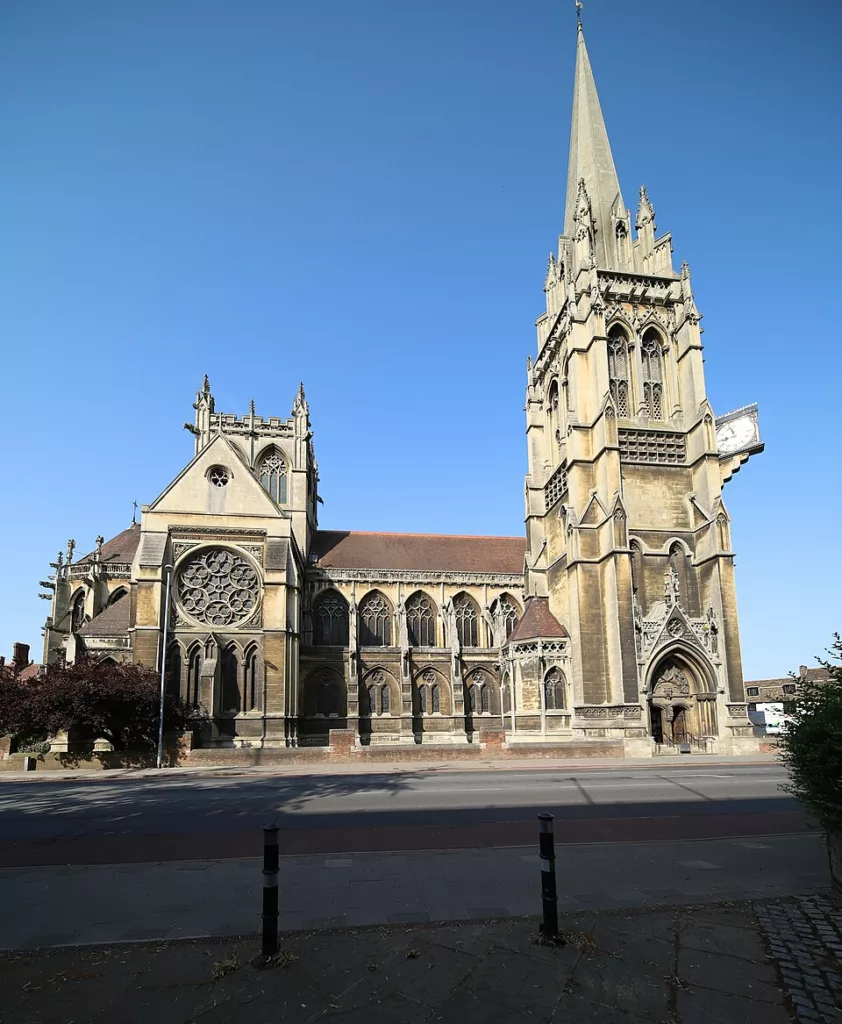
Located at the southern entrance to the city center, the Church of Our Lady and the English Martyrs, often referred to as OLEM, is one of Cambridge’s most impressive religious landmarks. Built between 1885 and 1890 in the Neo-Gothic style, it is the tallest structure in the city, with a spire rising 65 meters above the skyline.
Constructed thanks to the generous funding of Yolande Lyne-Stephens, then considered one of the wealthiest women in England, the church symbolizes the revival of Catholicism in Cambridge after several centuries of religious restrictions. Its inauguration sparked considerable debate in a city then strongly shaped by Anglican and university traditions.
The interior impresses visitors with its grand proportions, Gothic vaults, colorful stained-glass windows, and richly carved stone decoration. The windows notably depict the history of the English Martyrs as well as that of several Cambridge colleges. The church also houses a remarkable 16th-century statue of the Virgin and Child, regarded as one of the oldest religious treasures preserved in the city.
Visible from afar thanks to its elegant spire, Our Lady and the English Martyrs is today one of the most recognizable landmarks in Cambridge and is well worth a visit for both the beauty of its architecture and its historical significance.
Must-Visit Museums in Cambridge
Fitzwilliam Museum: Cambridge’s Largest Museum
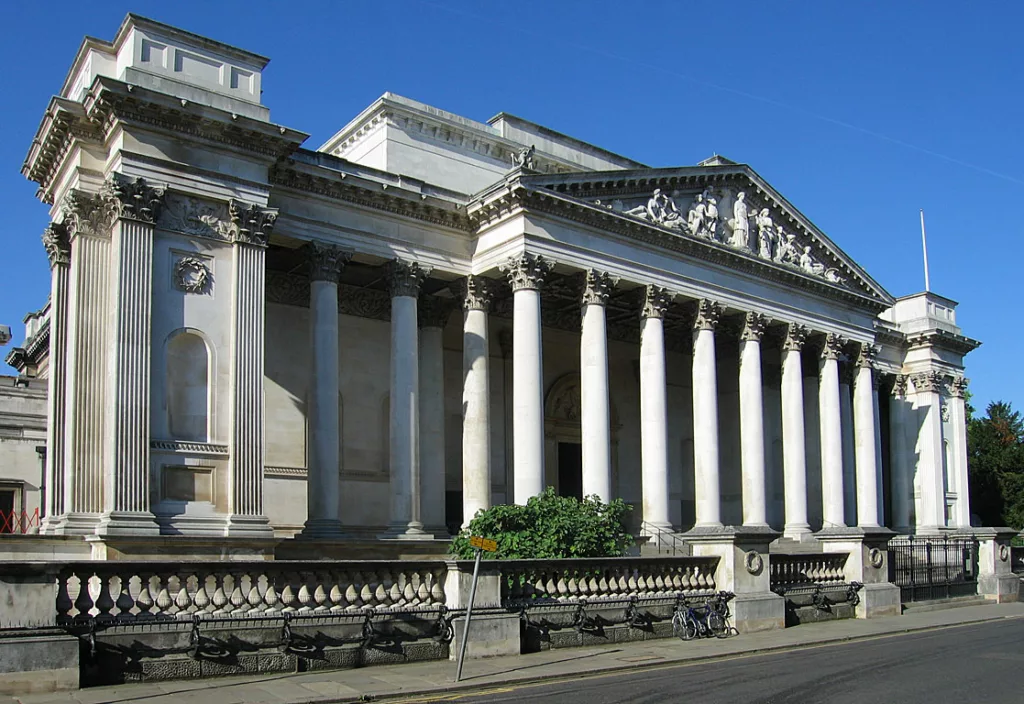
Located on Trumpington Street, the Fitzwilliam Museum was founded in 1816 through the bequest of Richard FitzWilliam. Today, it houses more than 500,000 works of art and objects spanning nearly five millennia of history and artistic creation.
Housed in a majestic Neoclassical building, the museum impresses visitors both through its architecture and the richness of its collections. Visitors can admire Egyptian, Greek, and Roman antiquities, rare manuscripts, decorative arts, ancient coins, and an exceptional collection of European paintings.
Among the artists represented are great masters such as Rembrandt, Rubens, Van Dyck, Canaletto, Monet, Renoir, Degas, Cézanne, Picasso, and Vincent van Gogh. The museum also holds one of the most important collections of Egyptian art in the United Kingdom outside the British Museum.
Admission is free, making it an essential visit for art, history, and culture enthusiasts.
Museum of Zoology: A Fascinating Journey Through the Animal Kingdom
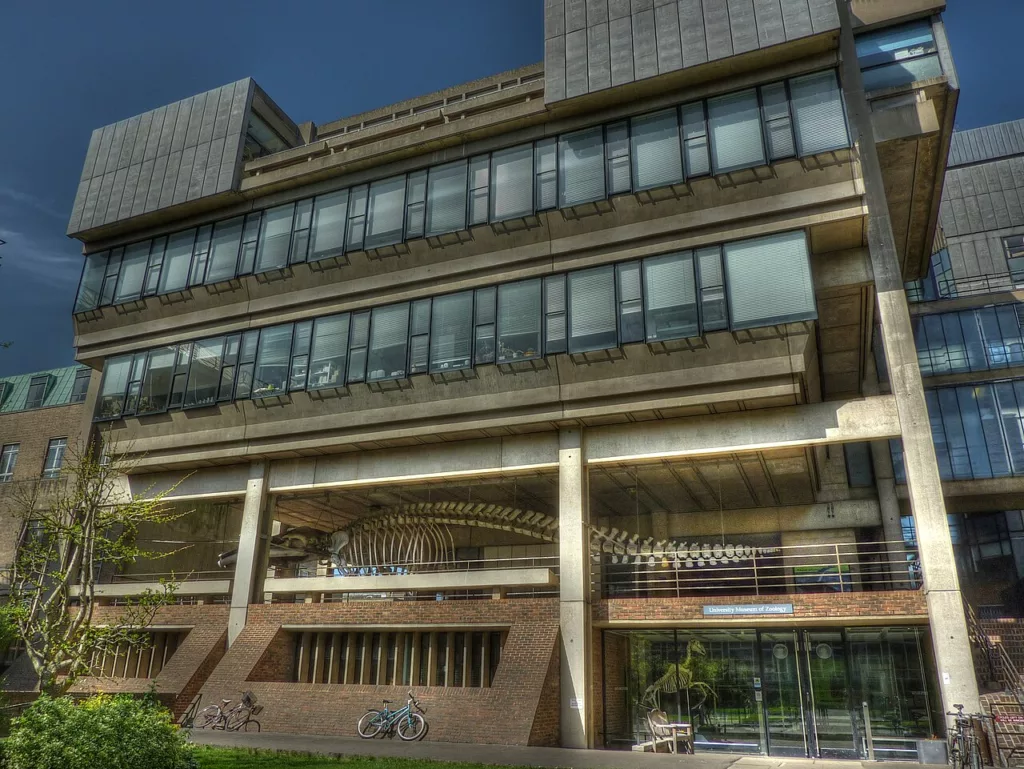
Located in the heart of Cambridge within the David Attenborough Building, the University of Cambridge Museum of Zoology is one of the most important natural history museums in the United Kingdom. Founded in the 19th century, it houses an exceptional collection dedicated to the diversity of the animal world, featuring specimens from across the globe.
The museum preserves several million scientific objects, including fossils, skeletons, insects, birds, mollusks, and numerous rare or extinct animals. Among its most impressive exhibits is the skeleton of a fin whale measuring more than 21 meters in length, suspended in the main gallery and serving as the museum’s iconic centerpiece.
Visitors can also discover specimens associated with some of history’s greatest naturalists, including Charles Darwin, whose collections gathered during the voyage of HMS Beagle are on display. The museum also houses remains of famous extinct species, such as the dodo of Mauritius and the Rodrigues solitaire.
Renovated and modernized in 2018, the Museum of Zoology now offers an interactive and accessible experience that helps visitors better understand evolution, biodiversity, and the challenges of species conservation. Free to visit and suitable for all ages, it is a fascinating destination for families, science enthusiasts, and anyone curious about the wonders of the animal kingdom.
Centre for Computing History: The Story of Computing at Your Fingertips

Located in eastern Cambridge, the Centre for Computing History is a unique museum dedicated to the evolution of computing and digital technologies. Founded in 2007, it traces the history of the digital age through an impressive collection of computers, video game consoles, and iconic technological artifacts.
The museum showcases hundreds of machines that shaped the history of computing, from the earliest mechanical calculators to the personal computers of the 1980s and 1990s. Visitors can discover legendary models such as the Altair 8800, BBC Micro, ZX Spectrum, and Apple II. Unlike many traditional museums, a large portion of the collection is interactive and can be used by the public.
Among the most remarkable attractions is the “Megaprocessor,” a giant working replica of a microprocessor designed to visually explain how a computer functions internally. The museum also holds one of the largest collections of retro video games and gaming consoles in the United Kingdom.
Kettle’s Yard: A Unique Art Space in Cambridge
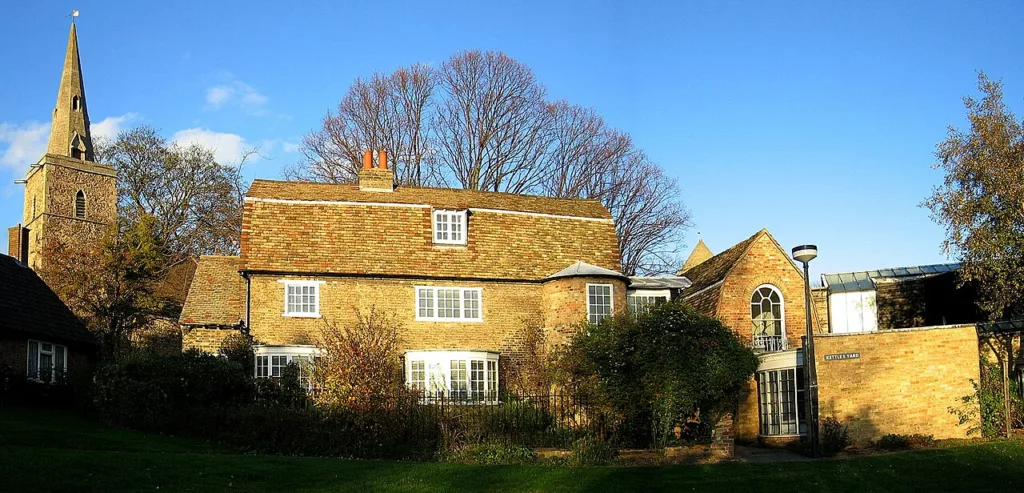
Located in the historic Castle Street district, Kettle’s Yard is one of Cambridge’s most distinctive cultural venues. Part artist’s home, part gallery, and part museum, this unique space offers an intimate experience where art, architecture, and everyday life blend harmoniously.
Kettle’s Yard was originally the home of Jim Ede, a former curator at the Tate Gallery, who settled in Cambridge during the 1950s. Together with his wife Helen, he transformed several cottages into a welcoming home designed to display his collection of modern art in a domestic setting rather than a traditional museum environment. In 1966, the couple donated the house and its collections to the University of Cambridge.
The permanent collection features major works of 20th-century British and European modern art, including creations by Henry Moore, Barbara Hepworth, Joan Miró, Ben Nicholson, and Constantin Brâncuși. The artworks are displayed alongside everyday objects, pebbles, plants, and carefully arranged furniture, creating a peaceful and inspiring atmosphere.
Today, Kettle’s Yard also hosts temporary exhibitions, concerts, and cultural events.
The Polar Museum: Discovering the Polar Worlds
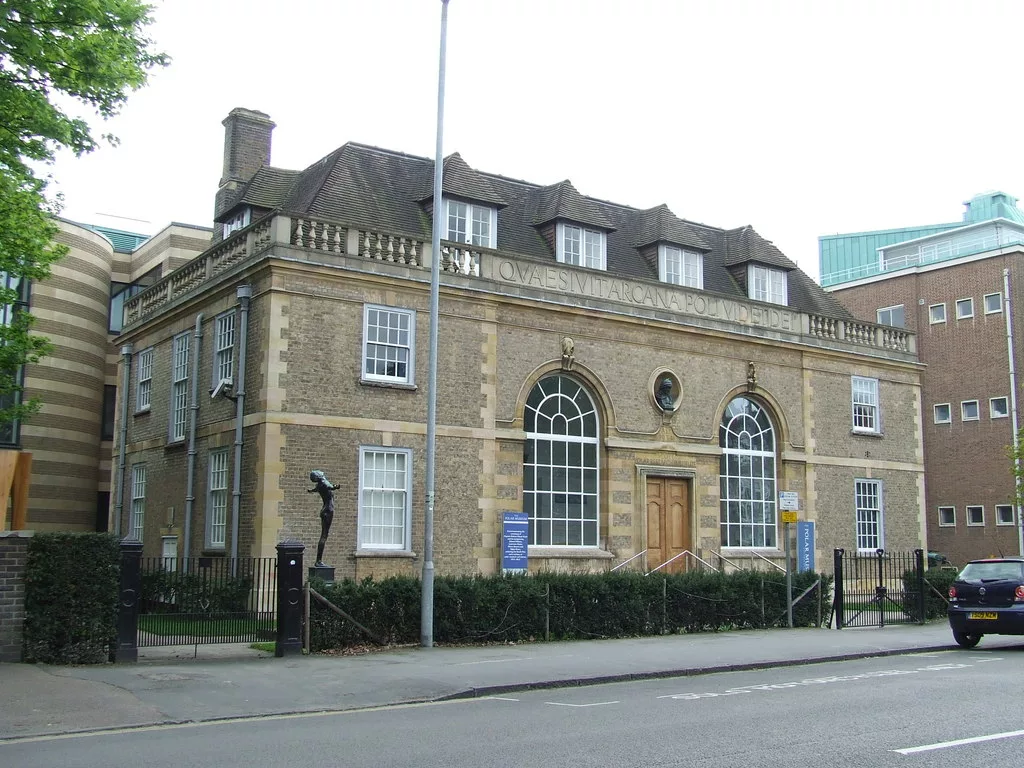
Located within the Scott Polar Research Institute, the Polar Museum is one of Cambridge’s most original museums. Created to preserve the memory of the great polar expeditions and promote research on the Arctic and Antarctic, it offers visitors a fascinating journey into some of the most extreme regions on the planet.
The museum traces the history of polar exploration through a rich collection of objects, photographs, maps, and historical documents. Among the most remarkable items are objects that belonged to famous explorers Robert Falcon Scott and Ernest Shackleton, including a camera used at the South Pole, a reindeer-skin sleeping bag, and a sextant used during the Endurance expedition.
The exhibitions also present Arctic cultures, polar wildlife, and contemporary issues related to climate change. Through interactive displays and historical accounts, visitors discover the challenges faced by scientists and explorers in these extreme environments.
Admission is free, and the museum is a fascinating visit for lovers of history, geography, and adventure.
Parks and Green Spaces in Cambridge
Cambridge University Botanic Garden: A Natural Oasis in the Heart of the City
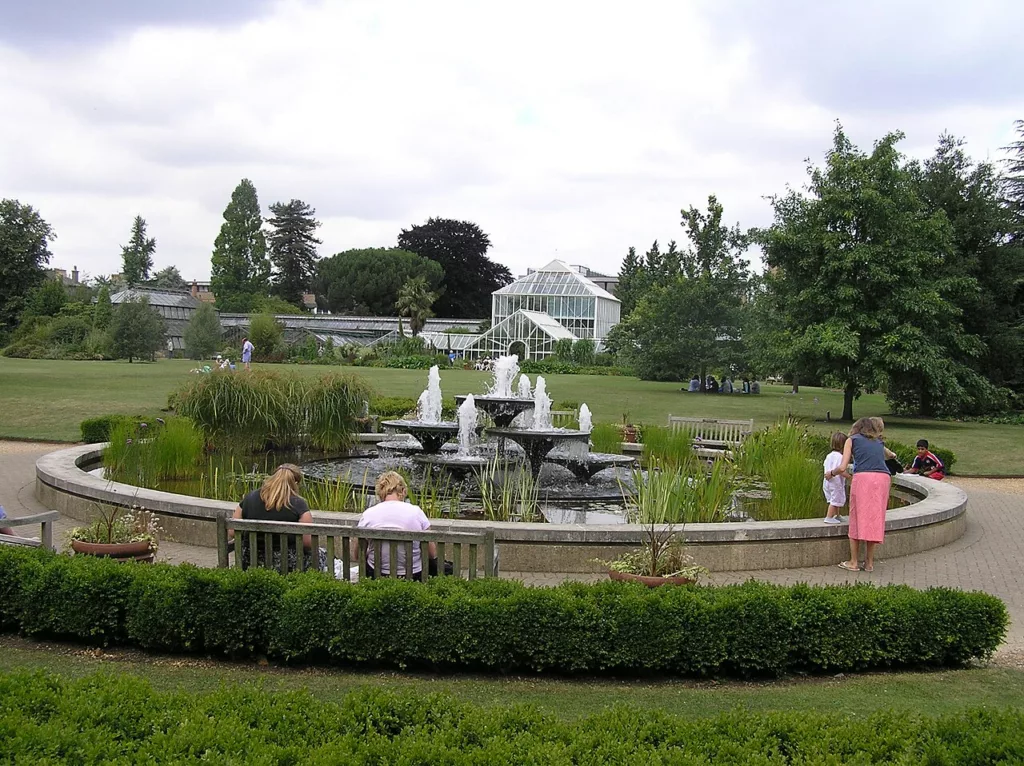
Created in 1831 by botanist John Stevens Henslow, mentor of Charles Darwin, the Cambridge University Botanic Garden is one of the most beautiful botanical gardens in the United Kingdom. Located just a few minutes from the city center, it covers 16 hectares and is home to more than 8,000 plant species from around the world.
Both a scientific research center, a university teaching site, and a pleasure garden, it offers visitors a remarkable journey through the diversity of the plant kingdom. Here, you can discover vast collections of rare trees, alpine rock gardens, themed gardens, a peaceful lake, and spectacular glasshouses showcasing tropical, desert, and carnivorous plants.
The garden also plays an important role in research carried out by the University of Cambridge in botany, genetics, and species conservation. Several major scientific discoveries related to plant evolution have been made here over the decades.
The Backs: Cambridge’s Most Beautiful Panorama
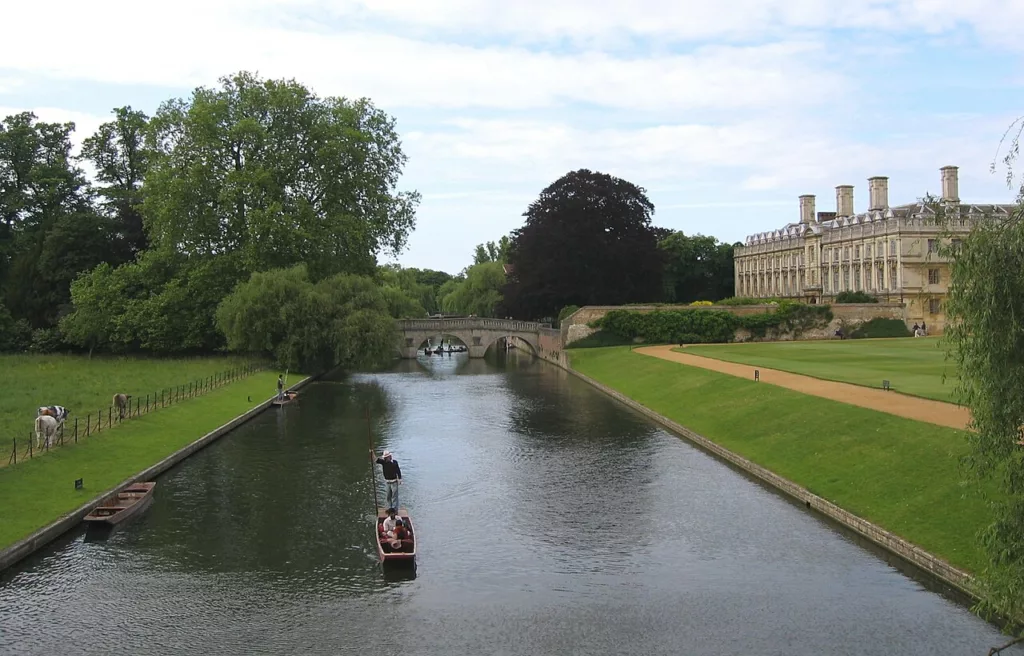
The Backs refers to the collection of gardens, lawns, and green spaces that line the River Cam behind several of the most prestigious colleges of the University of Cambridge.
Stretching along the river, The Backs include the rear grounds of St John’s College, Trinity College, Clare College, King’s College, and Queens’ College. Visitors can admire several famous landmarks from here, such as the Bridge of Sighs, the Mathematical Bridge, and the majestic King’s College Chapel rising above the green lawns.
For centuries, these grounds served as pastures, orchards, and gardens for the colleges. Today, they form a vast landscaped area where ancient trees, shaded paths, and picturesque views of the River Cam come together. The best way to discover The Backs is either on foot or by traditional punt, which allows visitors to admire the colleges from a unique perspective.
Jesus Green: A Vast Riverside Space for Relaxation
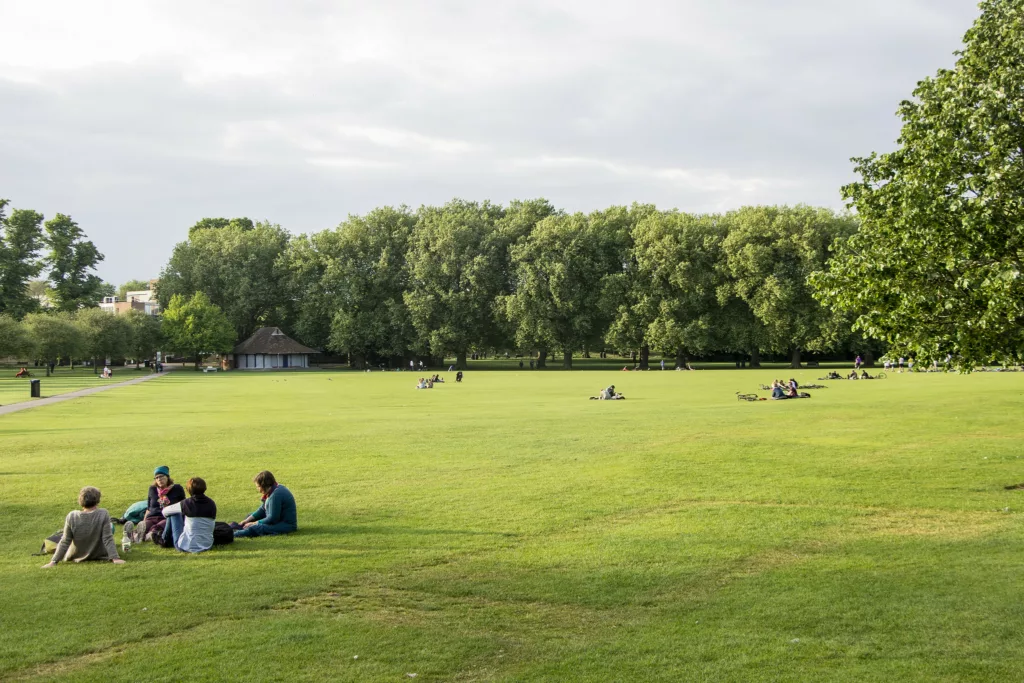
Located north of Cambridge’s historic center, Jesus Green is one of the city’s largest and most pleasant parks.
Formerly used as grazing land, the site was transformed into a public park in the late 19th century. Today, it is an ideal place for a walk, a picnic, or a relaxing break by the water. A magnificent avenue of plane trees crosses the park and provides a particularly enjoyable setting in every season.
Jesus Green is also famous for its open-air swimming pool, Jesus Green Lido, built in the 1920s. Measuring 91 meters in length, it is among the longest outdoor swimming pools in the United Kingdom and attracts many swimmers every summer.
Nearby is Jesus Lock, an iconic lock on the River Cam that marks the transition between different navigable sections of the river. The surrounding area is very popular for rowing, canoeing, and traditional punting trips.
Each year in May, the park hosts the famous Cambridge Beer Festival, one of the largest beer festivals in the United Kingdom.
Parker’s Piece: The Birthplace of Modern Football
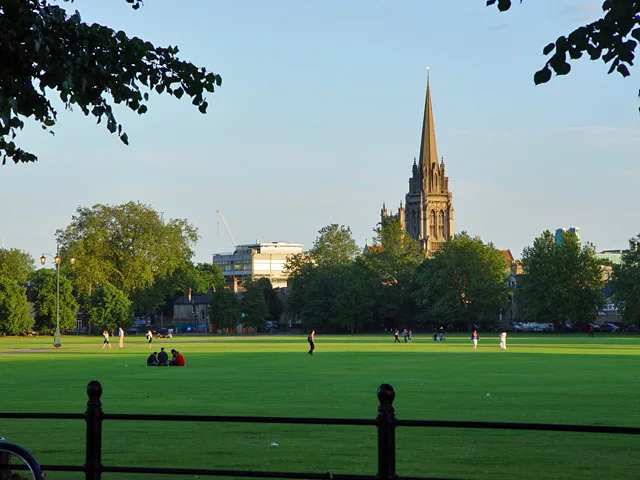
Located just a few minutes from Cambridge’s historic center, Parker’s Piece is one of the city’s most iconic green spaces. This vast common of nearly 10 hectares offers a pleasant setting for walking, picnicking, or enjoying sports activities in the heart of Cambridge.
Beyond its peaceful appearance, Parker’s Piece holds a special place in sporting history. In the 19th century, students from the University of Cambridge regularly played football here and developed the famous “Cambridge Rules.” These rules, which emphasized skill and prohibited the most violent forms of play, strongly influenced the first official laws of football adopted by the Football Association in 1863. For this reason, Parker’s Piece is often regarded as one of the birthplaces of modern football.
The park has also hosted major historical events, including a banquet attended by nearly 15,000 people to celebrate Queen Victoria’s coronation in 1838. Today, it remains a popular meeting place for locals and regularly hosts cultural events, sports activities, and concerts.
Food and Specialties of Cambridge
Cambridge Chelsea Bun

The Chelsea bun is a traditional British sweet bun made from enriched dough rolled with sugar, butter, raisins, and sometimes spices. Although its origins are associated with London, this pastry is also very popular in Cambridge’s tea rooms and bakeries. Its soft texture and lightly caramelized glaze make it an ideal treat to enjoy with tea. It is often served for breakfast or as a sweet afternoon break.
Fish and Chips

Fish and chips is one of the most iconic dishes in British cuisine. It usually consists of a fillet of white fish, often cod or haddock, coated in crispy batter and served with thick-cut chips. In Cambridge, many pubs and restaurants serve this traditional specialty with mushy peas and tartar sauce. This popular dish has been enjoyed across the United Kingdom since the 19th century.
Afternoon Tea
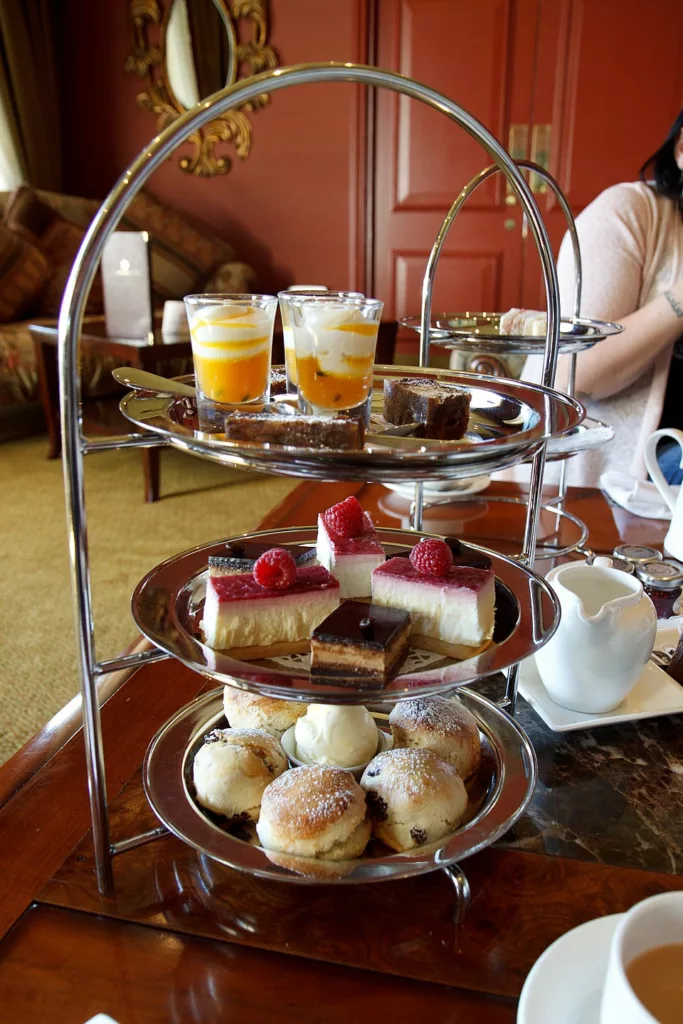
Afternoon tea is a British tradition dating back to the 19th century, consisting of tea served with sandwiches, scones with cream and jam, and a selection of pastries. In Cambridge, several historic hotels and tea rooms continue this elegant custom. It is a wonderful way to experience the British art of living in a refined setting.
Cambridgeshire Craft Beers
Cambridgeshire has a long brewing tradition and is now home to several well-regarded craft breweries. Local beers range from traditional English ales to more modern creations inspired by IPAs and contemporary hop-forward styles. Cambridge pubs often showcase regional brews, giving visitors the chance to discover local flavors. Each year, the Cambridge Beer Festival attracts thousands of beer enthusiasts from across the country.
Huntingdon Fidget Pie

Originating from the neighboring Huntingdonshire region, Huntingdon Fidget Pie is a traditional savory pie associated with historic Cambridgeshire. It is made with smoked bacon, apples, onions, and sometimes potatoes, all enclosed in a crisp pastry crust. The combination of sweet apples and savory meat gives it its distinctive flavor.
Excursions from Cambridge
Ely: A Historic City Dominated by Its Cathedral
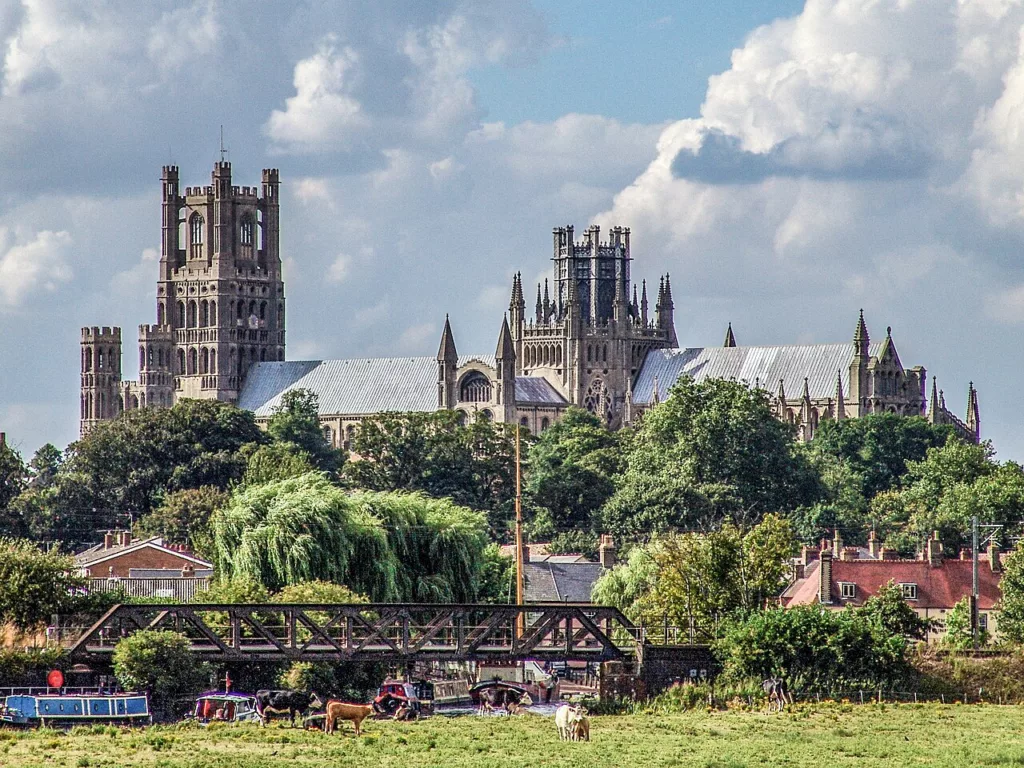
Located around 25 kilometers north of Cambridge, the small city of Ely is one of the most popular excursions in the region. Its main landmark is the majestic Ely Cathedral, often nicknamed the “Ship of the Fens” because of its imposing silhouette, visible for miles around.
Built between the 11th and 14th centuries, it is considered one of the masterpieces of English medieval architecture. Visitors can admire its spectacular central octagon, unique in the United Kingdom. The city also features charming historic streets, half-timbered houses, and a pleasant traditional market.
Ely is also associated with Oliver Cromwell, whose former home can now be visited. The banks of the River Great Ouse offer lovely walks and many cafés. Accessible by train from Cambridge in under 20 minutes, Ely is an ideal excursion for discovering the history and heritage of eastern England.
Audley End House: One of England’s Finest Country Houses
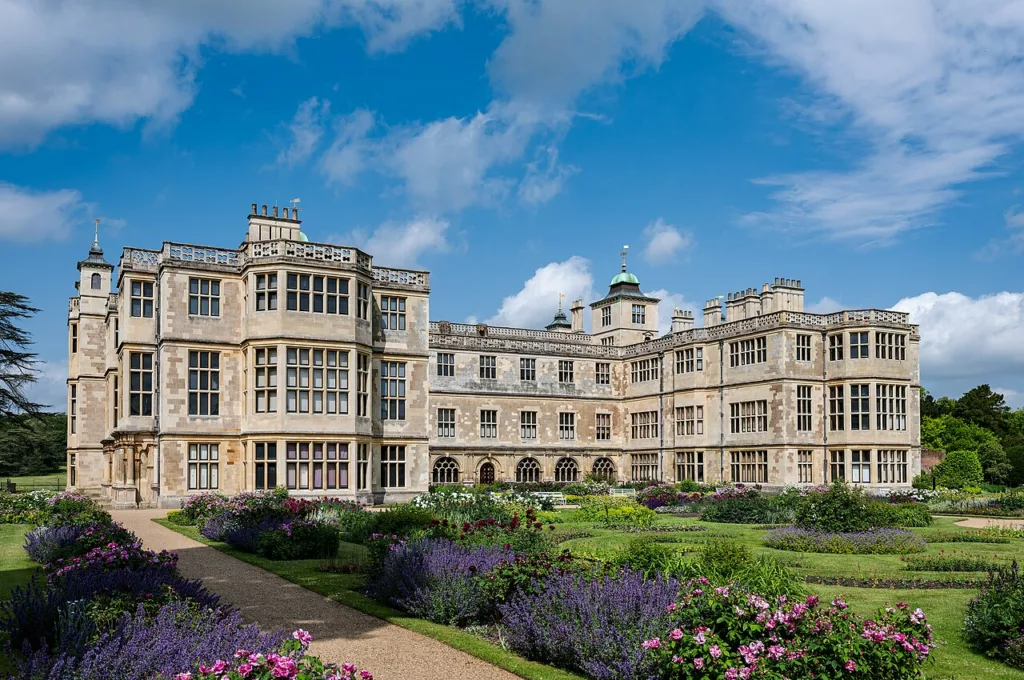
Located near Saffron Walden, about thirty kilometers from Cambridge, Audley End House is one of the country’s most impressive stately homes. Built in the early 17th century for Thomas Howard, it once rivaled royal palaces in size and luxury.
Today, visitors can discover its richly decorated drawing rooms, period apartments, and vast, perfectly preserved Victorian kitchens. The estate is surrounded by magnificent gardens designed by the famous landscape architect Lancelot Brown. Historic stables, woodland areas, and a traditional farm complete the visit.
The site also offers a better understanding of British aristocratic life through the centuries.
Bury St Edmunds: Heritage, Gardens, and English Traditions
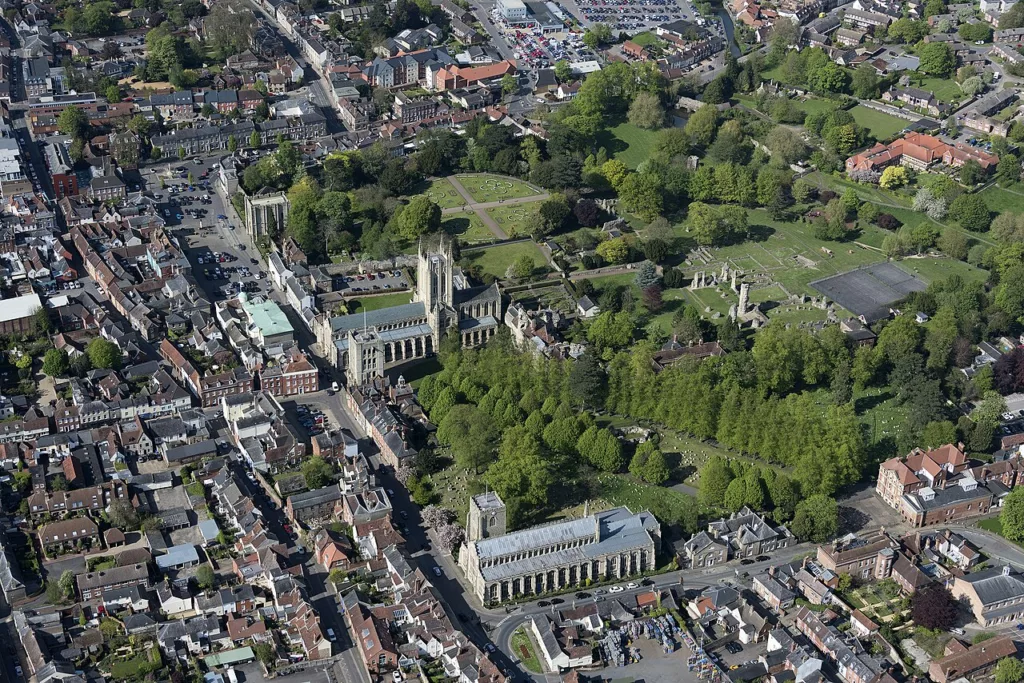
About an hour’s drive from Cambridge, Bury St Edmunds is one of England’s most elegant historic towns. It developed around the former medieval abbey dedicated to Saint Edmund, the martyred king of East Anglia.
The abbey ruins, set within beautiful public gardens, are now one of the town’s main attractions. Bury St Edmunds is also renowned for its splendid St Edmundsbury Cathedral, whose modern tower dominates the historic center. Its streets are filled with Georgian buildings, independent shops, and traditional tea rooms.
The town is also famous for its brewing tradition thanks to the Greene King brewery, one of the best-known in the United Kingdom. Weekly markets and numerous festivals bring the town to life throughout the year.
Houghton Mill: A Historic Mill on the Great Ouse
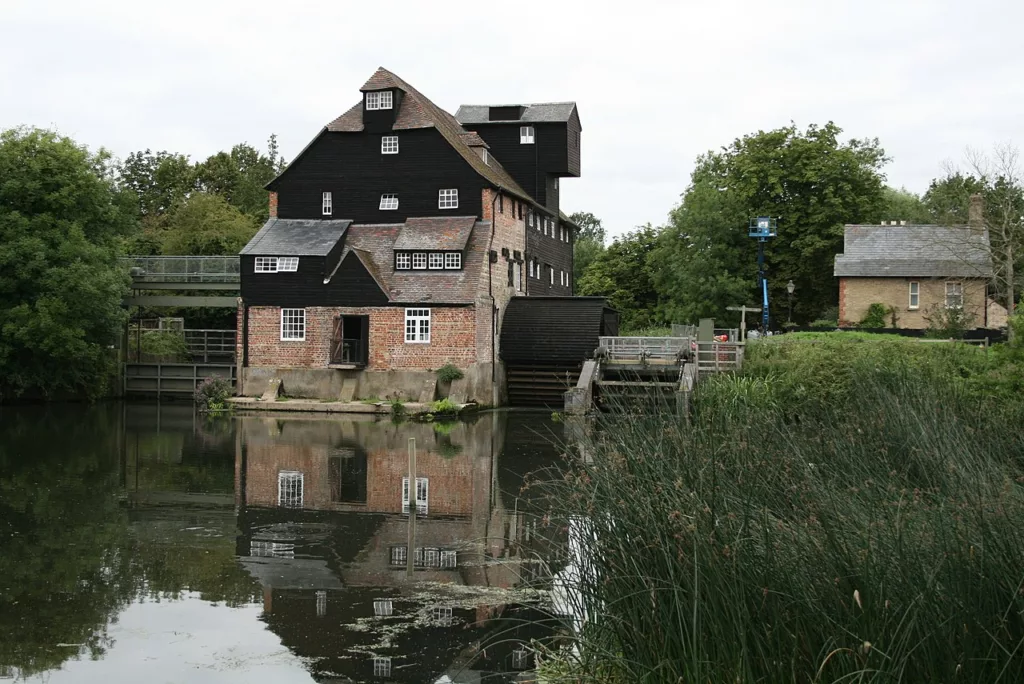
Located in the village of Houghton, west of Cambridge, Houghton Mill is one of the last working watermills in England. Managed by the National Trust, this historic mill dates back at least to the 17th century and continues to produce flour using water power.
Visitors can discover how the traditional mechanisms work and watch the millstones in action. The site is set in a particularly peaceful natural environment on the banks of the River Great Ouse. The surrounding trails cross wet meadows and offer excellent opportunities for walking and birdwatching. The former millers’ cottages and tearoom complete the visit nicely.
Conclusion
Between its exceptional university heritage, remarkable architecture, fascinating museums, and peaceful green spaces, Cambridge offers far more than a simple visit to a university city. From prestigious colleges such as King’s College, Trinity College, and St John’s College to punting trips on the River Cam, every district reveals a different facet of British history and culture.
The city appeals just as much to history lovers as to fans of art, science, and nature. Its renowned museums, botanical gardens, academic traditions, and elegant atmosphere make it a unique destination in England. Local specialties and the many possible excursions to Ely, Audley End House, Bury St Edmunds, and Houghton Mill complete the experience.
Whether you come for a day trip from London or for a longer stay, visiting Cambridge is an opportunity to discover one of England’s most beautiful cities, where centuries of university history meet a dynamic and welcoming city. It is an essential destination for anyone wishing to explore British heritage, culture, and way of life.
Similar Posts
Visit Edinburgh: 30 Must-See Attractions and Things to Do
Edinburgh, the capital of Scotland, is a city rich in history, culture, and spectacular landscapes. From Edinburgh Castle to the…
Visit London: 30 Must-Do and Must-See Things
London, the cosmopolitan capital of the United Kingdom, is a city where history, culture, and modernity meet on every street…