Visit Annecy: 30 Must-See Attractions and Things to Do
Visiting Annecy means immersing yourself in a charming and picturesque town located in Haute-Savoie, on the shores of the lake that bears its name and surrounded by the Alpine mountains. The town is famous for its crystal-clear lake, the iconic Thiou Canal, its medieval streets, and the castle overlooking the old town.
Annecy captivates visitors with its historical heritage, museums, gardens, markets, and walks along the lake or in the surrounding mountains. Its local gastronomy, featuring specialties such as tartiflette, fondue, and Savoyard diots sausages, perfectly complements the experience.
Festivals, cultural events, and water activities enliven local life throughout the year. This comprehensive guide will help you plan your stay and make the most of everything Annecy has to offer.
Discover Annecy from a different perspective with our “Annecy Highlights” trail, a unique blend of an Escape Game and a cultural tour.
Monuments & Historical Heritage – Annecy
1. Annecy Castle
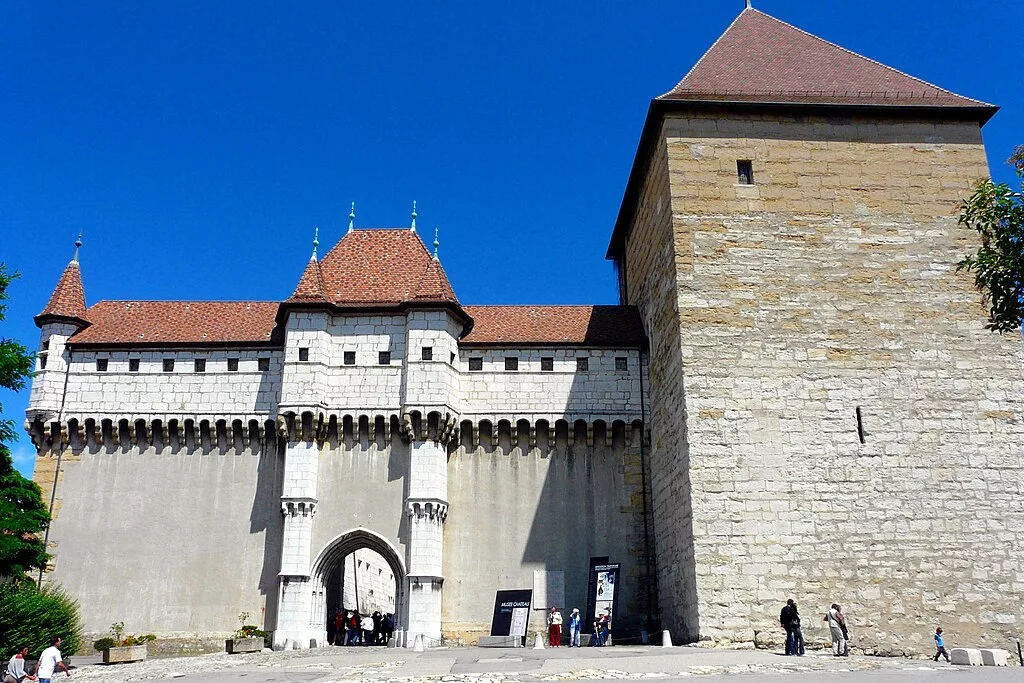
Perched above the old town, the Annecy Castle is a fascinating testament to Alpine history. Built between the 12th and 16th centuries, it first served as the residence of the Counts of Geneva and later, from the 15th century onward, as the residence of the Dukes of Genevois-Nemours. Several fires, notably in 1340 and at the beginning of the 15th century, damaged the fortress, but it was rebuilt each time.
Abandoned as a residence in the 17th century, the castle was converted into military barracks until 1947. In 1953, the city of Annecy acquired and restored it with the support of France’s Historic Monuments authorities. Listed as a historic monument in 1959, it is now a rich and diverse museum.
The Annecy Castle Museum features collections dedicated to Alpine archaeology, regional heritage, medieval sculpture, and landscapes painted during the 18th and 19th centuries. In the Queen’s Tower, the oldest part of the castle (12th century), visitors can admire the original medieval structure. The Nemours Residence is an excellent example of Renaissance architecture: built in the 16th century for the Duchess of Genevois-Nemours, it stands out for its regular stonework and finely crafted windows.
Since 1993, the Perrière Tower and Residence have housed the Regional Observatory of Alpine Lakes (ORLA). Covering approximately 700 m², this educational exhibition space features aquariums, models of Lake Annecy, reconstructions of ancient dwellings, and fishing equipment, allowing visitors to explore the ecology, archaeology, and biodiversity of Alpine lakes.
During your visit, the castle’s main courtyard offers a magnificent view over Annecy’s rooftops. Inside, the grand reception hall, medieval kitchens, and historic fireplaces provide insight into court life during the Middle Ages. Finally, the well, dug to a depth of 40 meters, reaches lake level—an impressive sight.
2. Palais de l’Île
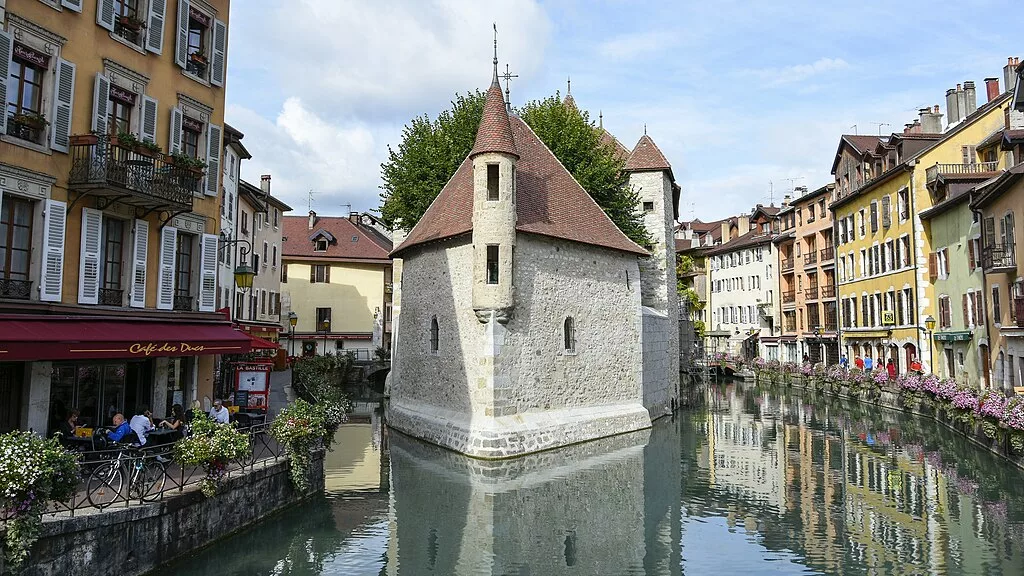
The Palais de l’Île, also known as Annecy’s “Old Prisons,” is one of the most iconic landmarks of the old town, situated on a small rocky island in the middle of the Thiou River. As early as the 12th century, a fortified house—the oldest part of the building—stood on the site and served as both a prison and a mint for the Counts of Geneva.
In 1355, Count Amadeus III of Geneva obtained from Emperor Charles IV the right to mint coins, and the palace housed a mint until the end of the 14th century. In the 15th century, it became a courthouse, housing the courts, the Chamber of Accounts, and the Presidial Council. Until the 18th century, it retained judicial and penitentiary functions.
Over time, the building’s purpose changed: it became a retirement home in the 19th century and was threatened with demolition at the beginning of the 20th century. Thanks to the efforts of André Theuriet and Charles Suisse, it was designated a historic monument on February 16, 1900. Several restoration campaigns followed, notably in 1983–1985, as well as more recent work on the roof and façades.
Today, the Palais is a museum and houses the CIAP (Centre for the Interpretation of Architecture and Heritage). The visitor route allows guests to explore the former prison cells, the chapel, the courtrooms of the old courthouse, and temporary exhibitions dedicated to architecture and local heritage.
Discover the meaning of a hidden coat of arms on the Palais de l’Île through our Annecy trail experience.
3. Saint-Maurice Church
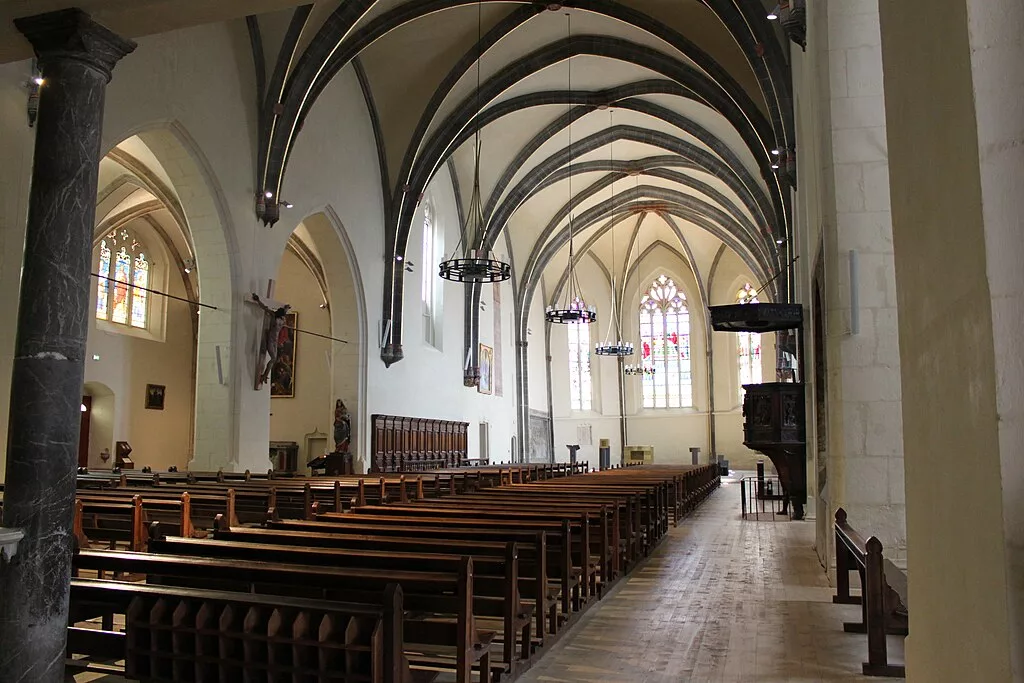
The Saint-Maurice Church is the oldest church in Annecy. It was founded in 1422 as the chapel of the Dominican convent by Cardinal Jean-Allarmet de Brogny following a major fire in the town. Construction continued until the beginning of the 16th century, with side chapels funded by trade guilds and noble families.
Architecturally, the church adopts the Savoyard Flamboyant Gothic style, typical of the Alps, featuring a wide central nave designed to accommodate large numbers of worshippers, as was common in Dominican churches. The building has settled slightly over time: from the square or the street, it may appear to lean—a real effect caused by its structure and the ground beneath it.
Inside, several noteworthy features deserve attention:
-
A 15th-century funerary painting depicting the tomb of Philibert de Monthoux, an advisor to the Dukes of Savoy.
-
A carved pulpit dating from 1715, supported by a colossal figure.
-
An organ dating from 1869, modified during the 1960s.
-
Four bells in the bell tower: the oldest comes from Bern, another is a Paccard bell, and the third is made of steel.
4. Basilica of the Visitation
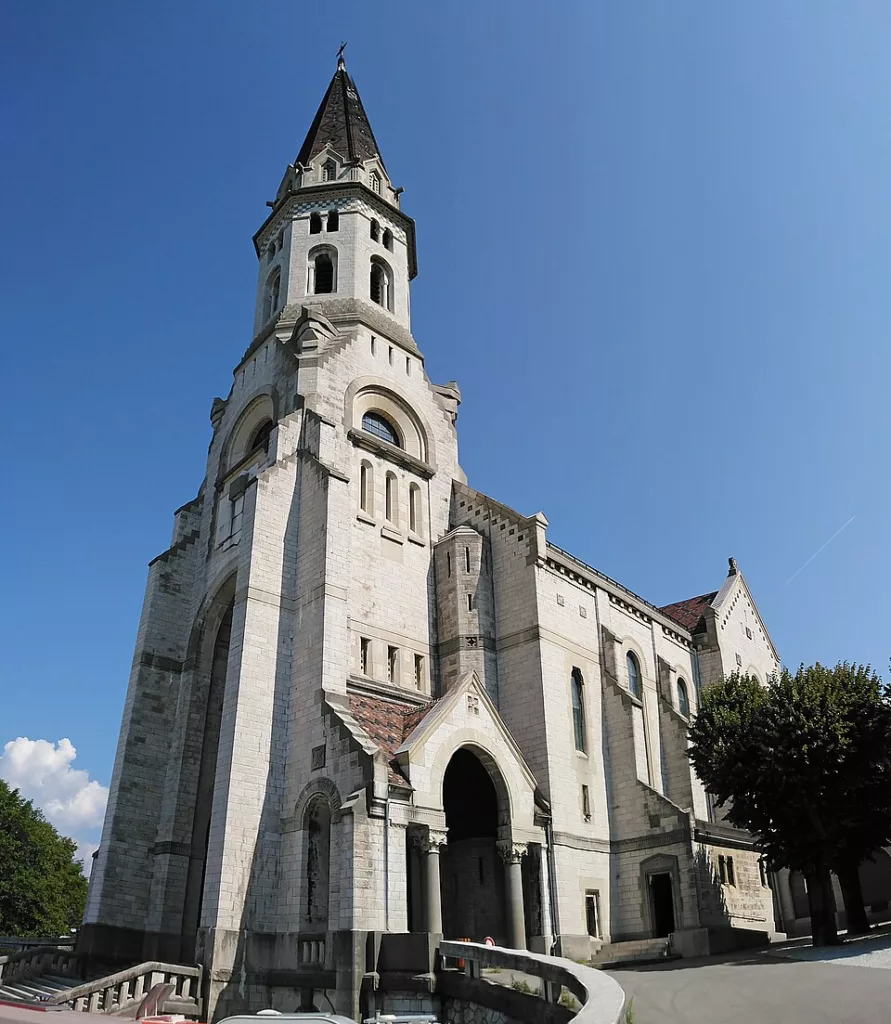
The Basilica of the Visitation overlooks Annecy from the Crêt du Maure, on the slopes of the Semnoz massif, making it a true landmark in the city’s landscape. Built between 1922 and 1930 according to plans by architect Alfred-Henri Recoura, it stands on a crypt with low arches designed by Henri Adé. The building was consecrated in 1949 by Cardinal Federico Tedeschini and received the title of minor basilica in 1951.
Inside, the contrast is striking between the fairly sober exterior and the richly decorated interior: the columns are made of blue Savoy marble, the mosaics in the apse are made of Venetian enamels, and the stained-glass windows tell the story of Saint Francis de Sales and Saint Jane de Chantal. Two gilded bronze sarcophagi hold the remains of the two saintly founders of the Order of the Visitation.
The bell tower is a very distinctive feature: it rises to 72 m, with a concrete structure, and is topped by a 7 m bronze cross. It has a carillon of 38 bells or 36 according to some sources, some cast by the Paccard foundry, including the largest, “Marie Françoise,” which weighs nearly 4 tonnes.
In an annex of the monastery, a Salesian museum traces the life of Saint Francis de Sales, Saint Jane de Chantal, and the history of the Order of the Visitation.
5. Pont des Amours
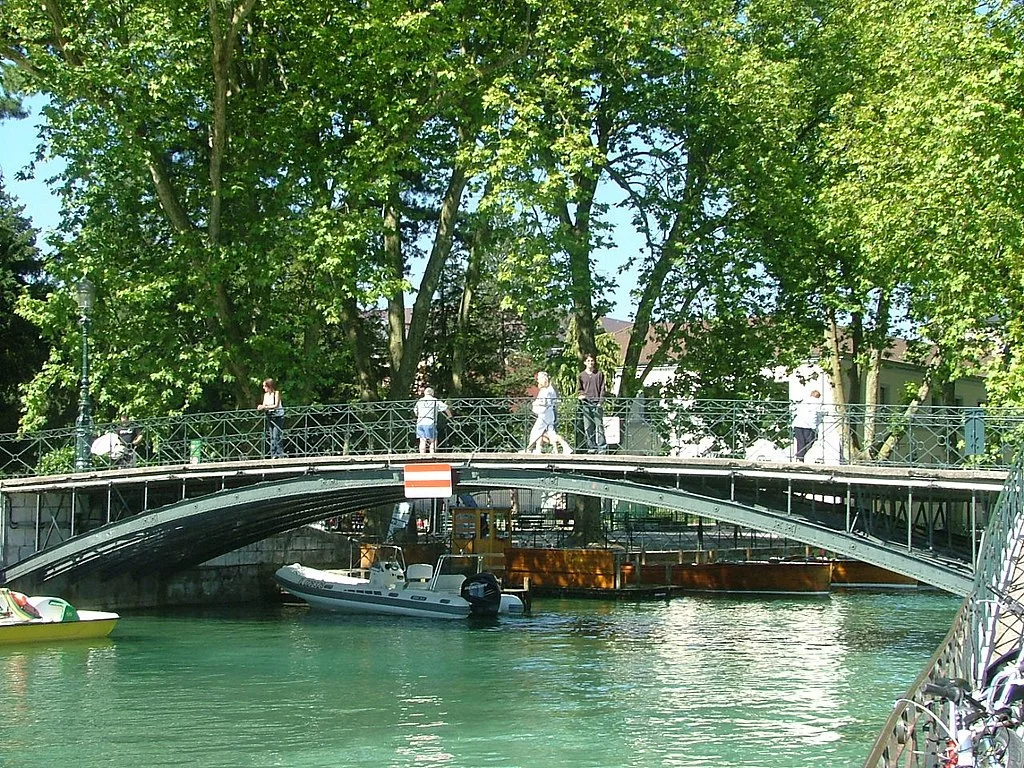
The Pont des Amours is one of Annecy’s most famous symbols. It spans the Vassé Canal, where Lake Annecy meets the canal and Charles-Bosson Park. This charming wrought-iron bridge was built at the end of the 19th century and quickly became a romantic spot, famous for its view of the lake and the surrounding mountains.
According to local legend, lovers who kiss on the bridge will see their love last forever.
Discover the original name of this bridge and a nearby sculpture that can be used to tell the time in our Annecy treasure hunt.
6. Notre-Dame-de-Liesse Church
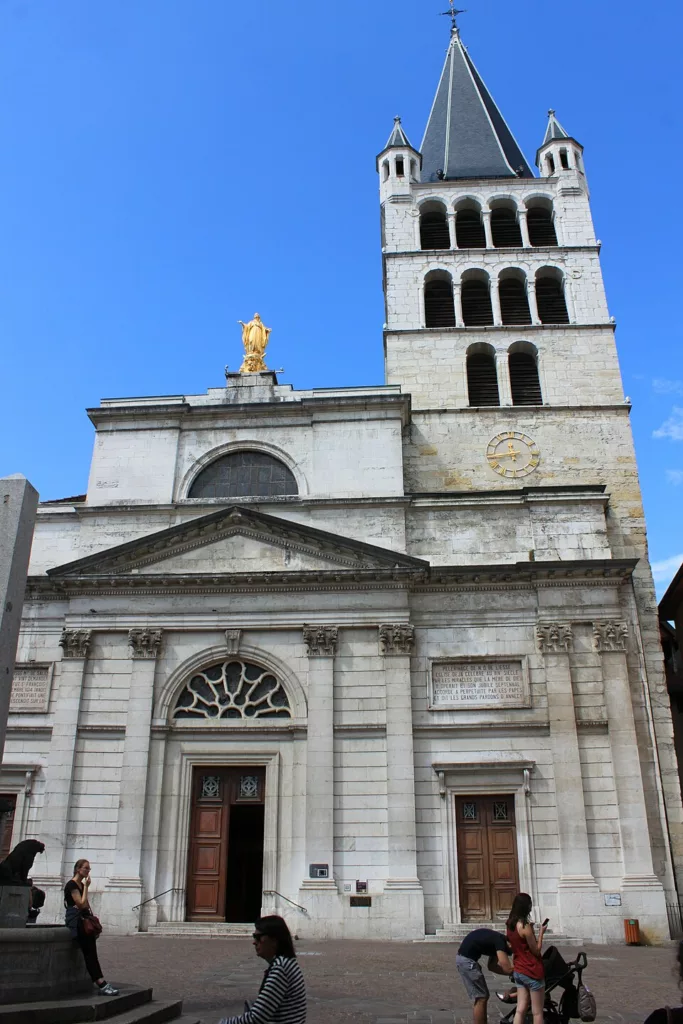
The Notre-Dame-de-Liesse Church, located in the very heart of Annecy’s old town on Place Notre-Dame, is a building steeped in history. Its origins date back to the 14th century: founded around 1360 by Count Amadeus III of Geneva, it was built to serve as a necropolis for his family. The original construction was completed around 1394, and the church was consecrated in 1398.
During the French Revolution in 1793, the choir was destroyed and the building was partly repurposed as a fodder store for the army, while the surrounding square was renamed “Place de la Liberté.” In the mid-19th century, between 1846 and 1851, the church was largely rebuilt by engineer François Justin, while retaining some older elements such as the bell tower and a Gothic window in the south wall.
Its architecture is “Sardinian” neoclassical, a style very common in Savoyard territories at the time, with a façade inspired by Roman antiquity. The bells are remarkable: the oldest dates from 1655.
Outside, a gilded statue of the Virgin Mary, created by sculptor Mathurin Moreau, overlooks the church roof. In addition, the stained-glass windows, notably made by Louis Balmet, depict important scenes from Annecy’s religious history.
Discover the hidden details on this façade in our Annecy treasure hunt.
7. Saint-Pierre Cathedral
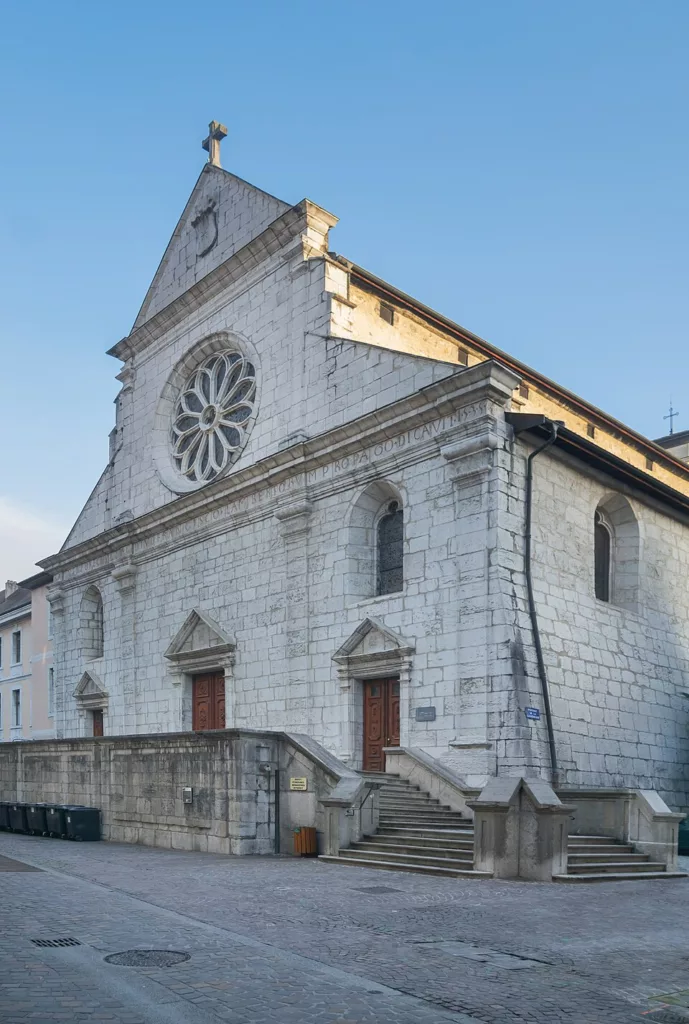
The Saint-Pierre Cathedral in Annecy, located in the old town centre on Rue Jean-Jacques Rousseau, is the seat of the Diocese of Annecy. Originally built between 1535 and 1538 as the chapel of the Franciscan, or “Cordeliers,” convent, the works were led by architect Jacques Rossel.
Its architecture combines Gothic influences, especially inside with its three naves, and touches of Italian Renaissance on its façade, which features Tuscan pilasters, three triangular pediments, and a large Gothic rose window.
During the French Revolution, the cathedral was deconsecrated: it was transformed into a “Temple of the Goddess Reason,” and its bell tower was partly demolished. The bell tower was rebuilt around 1828.
One of the cathedral’s treasures is its organ: built between 1840 and 1842 by Nicolas-Antoine Lété, it weighs around 10 tonnes and has more than 2,000 pipes.
Discover a mysterious inscription on this building in our Annecy trail.
8. Saint-François-de-Sales Church
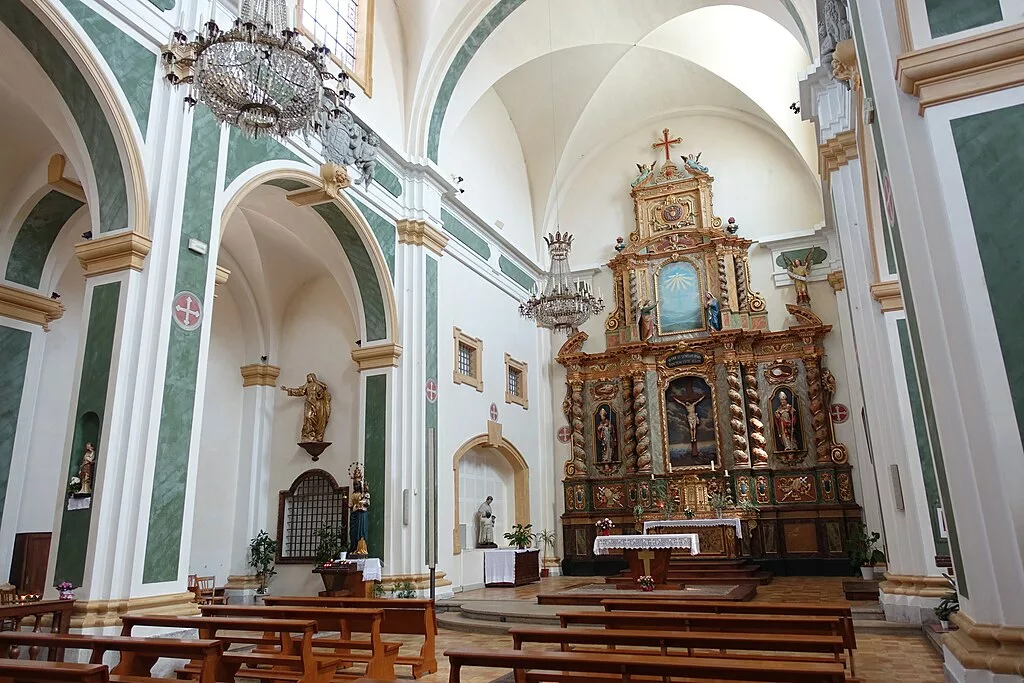
The Saint-François-de-Sales Church, sometimes called the “Church of the Italians,” is located opposite the Palais de l’Île, in the heart of Annecy’s old town. Its origins lie in the chapel of the first Visitation monastery, founded in 1610 by Francis de Sales and Saint Jane de Chantal.
Rebuilt in 1642 in a Baroque style strongly inspired by the Church of the Gesù in Rome, the building features a grand Italian-style façade and a bright interior.
During the French Revolution, the church was deconsecrated: it served as a factory and then a workshop before falling into neglect. Restored in the 19th century, it was returned to worship in 1923 and then purchased by the city of Annecy in 1968.
Today, a Saint-François-de-Sales memorial can be found there, paying tribute to the life, spiritual work, and holiness of Francis de Sales, a major figure in Savoyard religious history.
Annecy Museums
1. Animated Film Museum
The Annecy Animated Film Museum, formerly housed in the Conservatory of Art and History, is currently being renewed: closed since August 30, 2024, it is scheduled to open in 2026 as part of the International City of Animated Film. This new museum will be located on the Haras site in Annecy, in the heart of the city, reinforcing its status as a world capital of animation.
Within the International City, the permanent exhibition, covering around 400 m², will showcase historic animation film collections, notably from the Annecy Castle Museum. Next to it, a 160 m² gallery will host temporary exhibitions dedicated to animation in all its forms.
The City will also include a 332-seat cinema dedicated to animation, with regular programming including events, retrospectives, and previews. Led by CITIA, organizer of the International Animated Film Festival, this project reflects Annecy’s strong cultural ambition.
2. Conservatory of Art and History
The Conservatory of Art and History in Annecy is housed in the former Grand Seminary, a historic building constructed at the end of the 17th century. It is now owned by the Haute-Savoie Department, which has installed its “Culture & Heritage” department there, as well as the reserves of the departmental collections.
The conservatory houses rich heritage collections, including the Paul Payot collection, which highlights mountain imagery, as well as the Chastel collection, composed of paintings from the 16th, 17th, and 19th centuries. The building also hosts temporary exhibitions, music rooms, projection rooms, and educational spaces.
Eventually, a new Haute-Savoie history museum is set to open in this location: the project, announced by the department, plans around 3,400 m² of exhibition space dedicated to historical collections, including archaeology, fine arts, natural sciences, and ethnography.
Parks, Gardens & Walks – Annecy
1. Le Pâquier
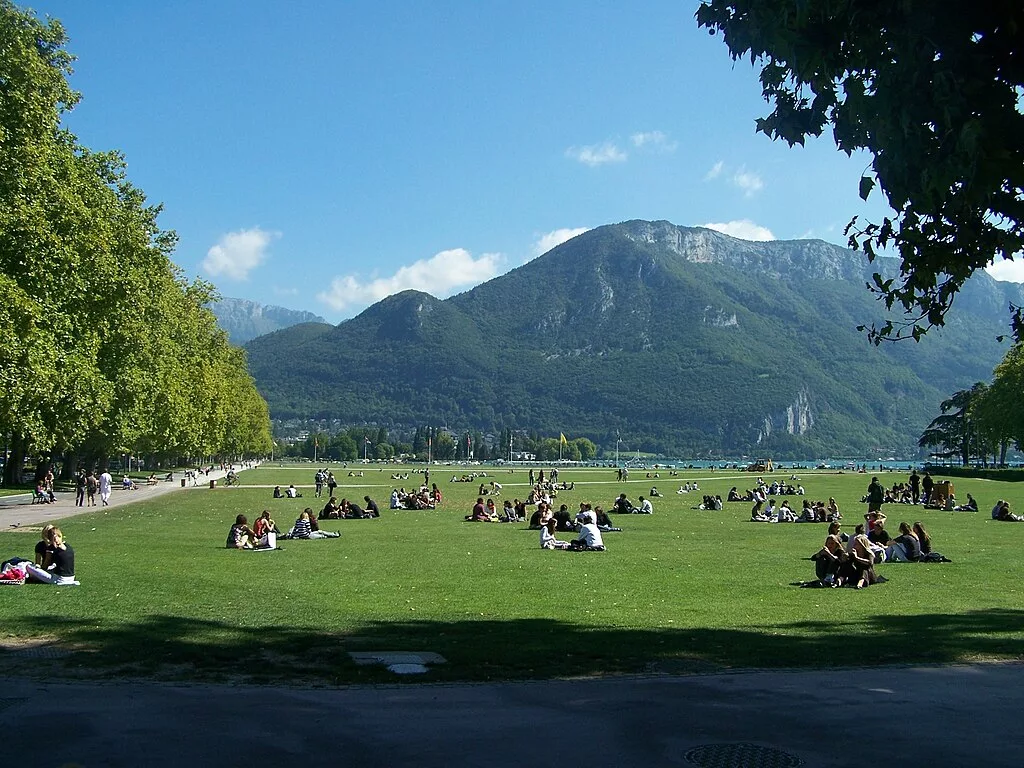
The Pâquier, a vast 7-hectare green esplanade, is one of Annecy’s most iconic places. Located directly on the lakeshore, it offers breathtaking views of the mountains and is a favourite spot among locals for walking, running, picnicking, or simply enjoying the sunshine. Once a communal pasture, which is where its name comes from, it is now the city’s great green lung.
It is also the heart of Annecy’s major events: the International Animated Film Festival, the Lake Festival, sports gatherings, concerts, and fireworks all take place here. From Le Pâquier, you can easily reach the Pont des Amours, the Gardens of Europe, the old town, or the piers for lake cruises.
2. Gardens of Europe
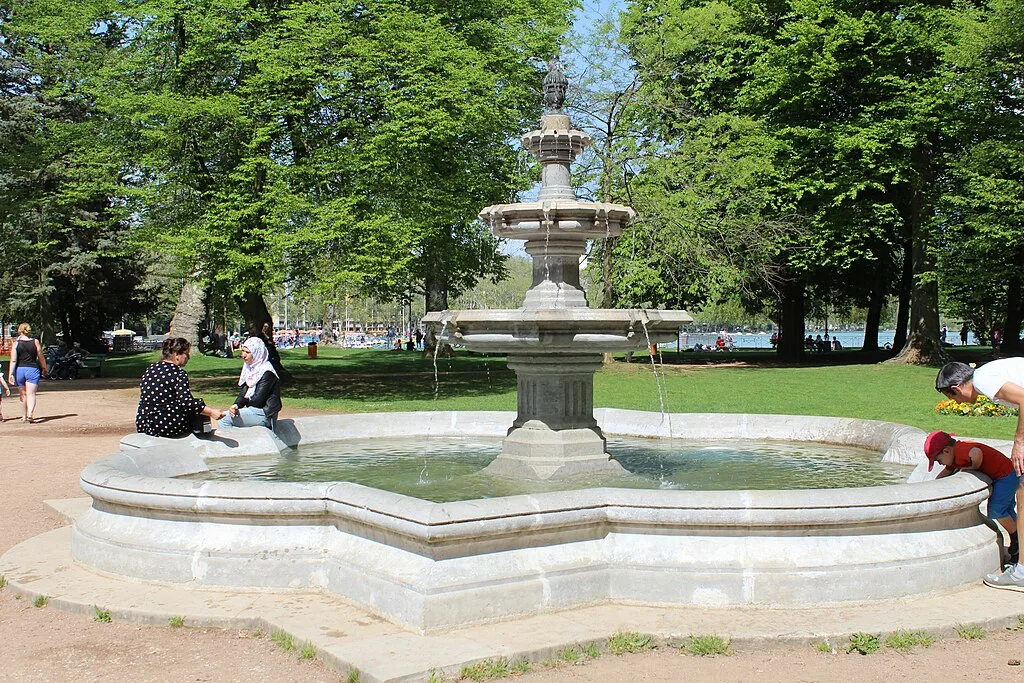
The Gardens of Europe, located between Annecy Town Hall and the lake, form a highly popular English-style park for walking. Historically, this land was once marshy: it belonged to Lombard bankers and then to the Order of the Visitation. In 1863, after Savoy was annexed to France, the municipality decided to turn it into a landscaped garden; more than 650 trees and 1,000 shrubs were planted there by January 1864.
Among its remarkable features: a statue of Claude Louis Berthollet stands in the centre of the park, paying tribute to the Savoyard chemist. There is also a gnomon, or sundial, called “L’Unique,” installed at the far end of the gardens facing the Île aux Cygnes. The park has around 250 trees: ginkgo, tulip tree, giant sequoias, pines, and more.
The gardens also provide a setting for cultural events: the Annecy Paysages festival installs permanent or temporary art installations there.
3. Lake Annecy
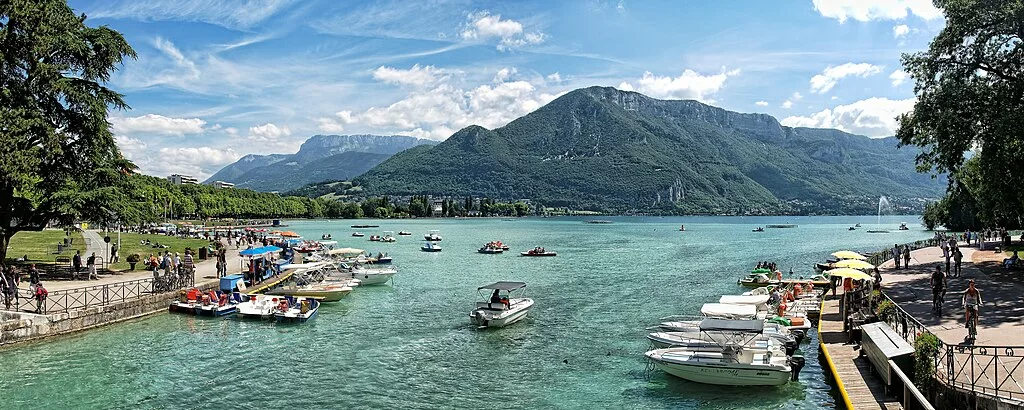
The Lake Annecy, sometimes nicknamed the “Blue Lake,” is a natural lake of glacial origin located in Haute-Savoie, in the Alps. It covers around 27 km², measures 14.6 km in length, and reaches a maximum depth of around 82 m. It is fed by several streams, including the Eau-Morte, Ire, and Laudon, as well as an underwater spring, the Boubioz, while its main outlet is the Thiou.
Thanks to the exceptional purity of its waters — among the purest in Europe in an urbanized setting — Lake Annecy is a true ecological treasure. Its shores are home to protected natural areas, such as the Roc de Chère reserve and reed beds.
As for activities, the lake offers a wide range of leisure options: swimming, windsurfing, paddleboarding, scuba diving, snorkeling, and more. Archaeological remains dating back to the Neolithic period lie beneath the water: several pile-dwelling sites are listed as UNESCO World Heritage sites.
Savoyard Gastronomy
Dishes & Specialties
Tartiflette
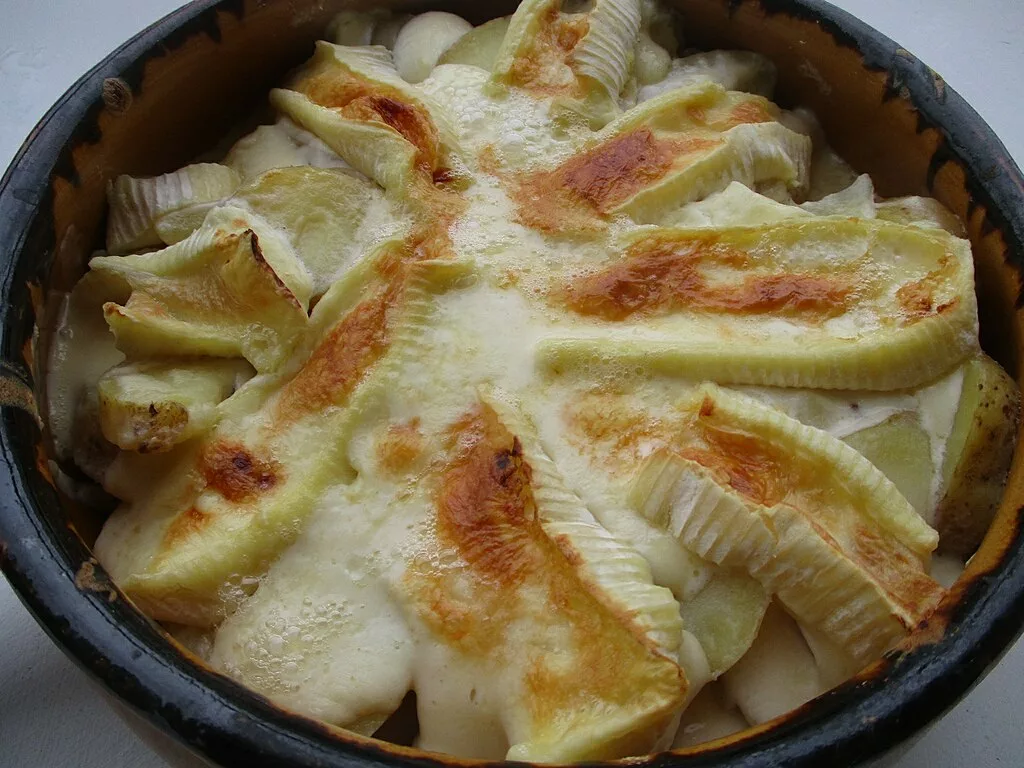
Tartiflette is a Savoyard dish made with potatoes, Reblochon cheese, bacon lardons, and onions, sometimes deglazed with white wine. The word “tartiflette” is said to come from the Arpitan word tartiflâ, meaning “potato.” This gratin is not an ancient dish: in its modern form, it was popularized in the 1980s at the initiative of the Reblochon Interprofessional Syndicate to boost cheese sales.
It is inspired by a traditional Savoyard dish called péla, cooked in a pan with a long-handled spatula. A very common variation is croziflette, in which potatoes are replaced by Savoy crozets.
Savoyard Fondue
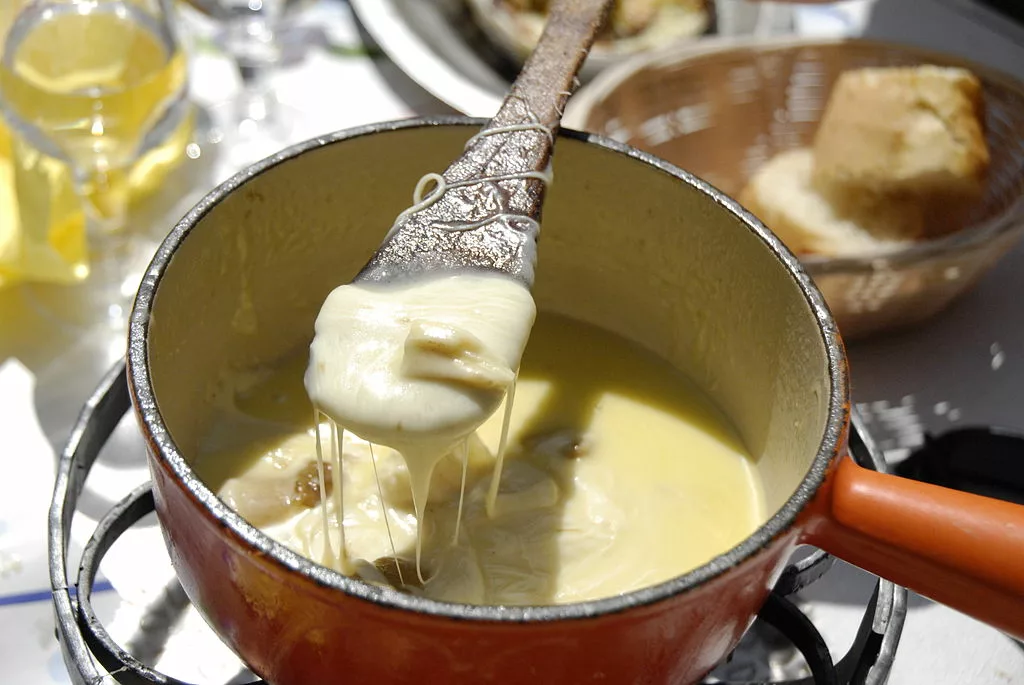
Savoyard fondue is a dish of melted cheese served in a fondue pot, into which pieces of bread are dipped using a fondue fork. Traditionally, a blend of cheeses is used: Beaufort and/or Comté, Savoy Emmental, and Tomme de Savoie. The cheese is melted in dry Savoy white wine, sometimes seasoned with nutmeg, salt, and pepper. Some recipes add a little kirsch to enhance the flavours, although this is not systematic. Fondue is often enjoyed in a group around the same pot, making it a convivial dish deeply rooted in Alpine tradition.
Crozets
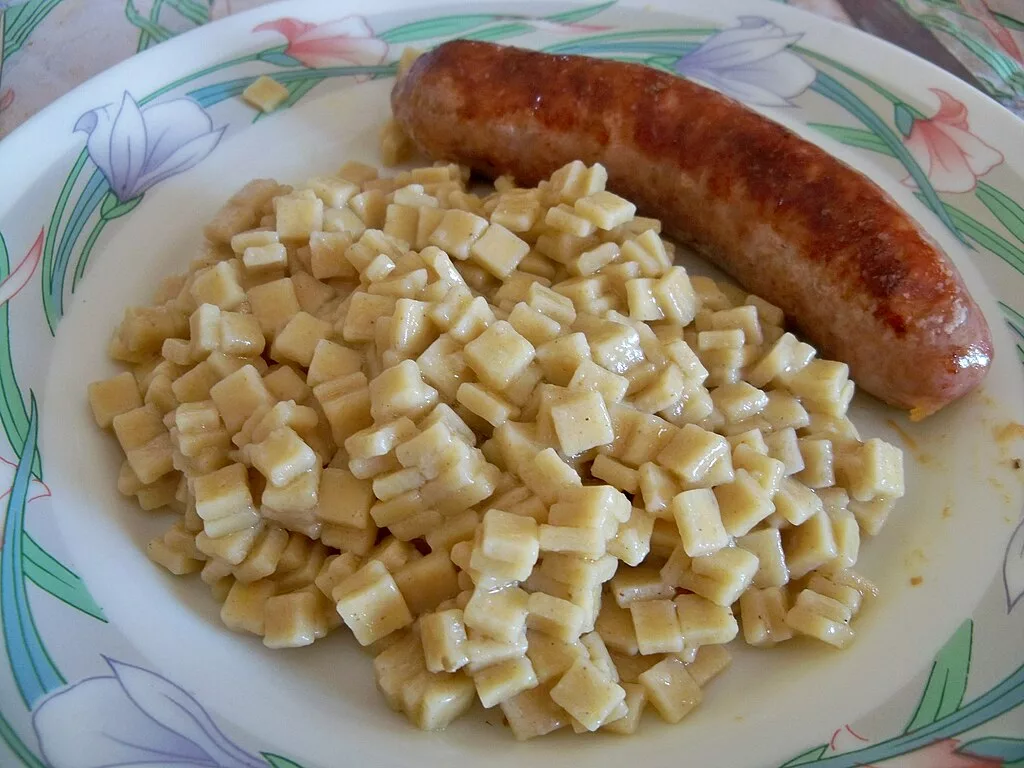
Crozets, or Savoy crozets, are small, flat, square-shaped pasta traditionally made in the Savoy region from durum wheat or buckwheat flour. The name is thought to come from the Franco-Provençal word croé, meaning “small.”
These pasta pieces were once made at home and dried, and are now used in typical dishes such as croziflette, a variation of tartiflette, or crozets with diots, Savoyard sausages.
Desserts & Sweet Treats
Savoy Cake:
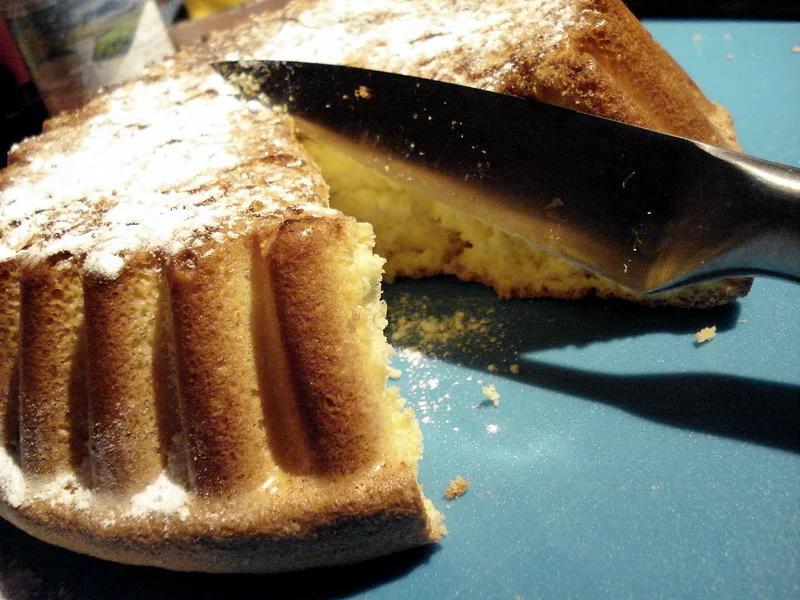
The Savoy Cake is a traditional pastry from Savoy, light and soft, made with flour, eggs, sugar, and sometimes flavoured with lemon zest or vanilla. It is known for its airy texture, achieved by beating the egg whites for a long time until stiff.
Historically, the cake was baked in a chimney mould, or Savoyard mould, to ensure even cooking. It can be eaten plain, dusted with icing sugar, or served with local jams.
Major Events – Annecy
1. International Animated Film Festival
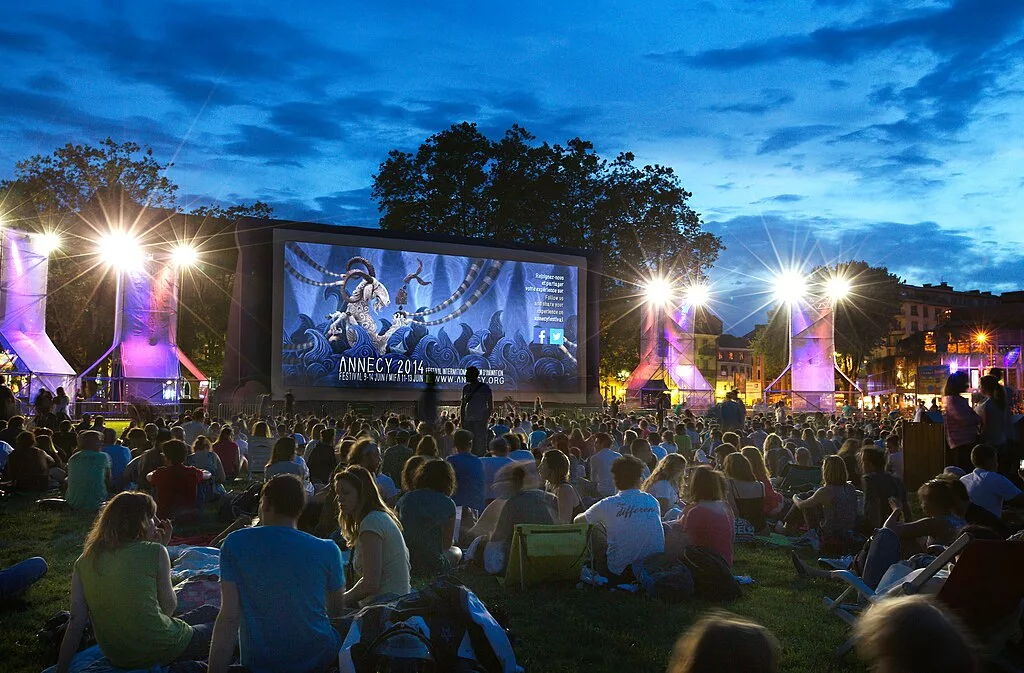
The Annecy International Animated Film Festival, often shortened to the Annecy Festival, is one of the city’s major events and one of the most prestigious animation festivals in the world. It was created in 1960, initiated by professionals and enthusiasts passionate about animation.
The festival takes place every year in June and attracts directors, producers, students, and enthusiasts from around the world. It features short and feature film competitions, television films, commissioned films, and student projects, and awards prestigious prizes such as the Annecy Cristal.
In addition to screenings, the festival offers professional meetings, workshops, conferences, and masterclasses, making Annecy a true global centre for animation. Since 2004, the festival has been accompanied by the International Animation Film Market (MIFA), which has become the world’s leading market for the sale and promotion of animated films.
2. Lake Festival
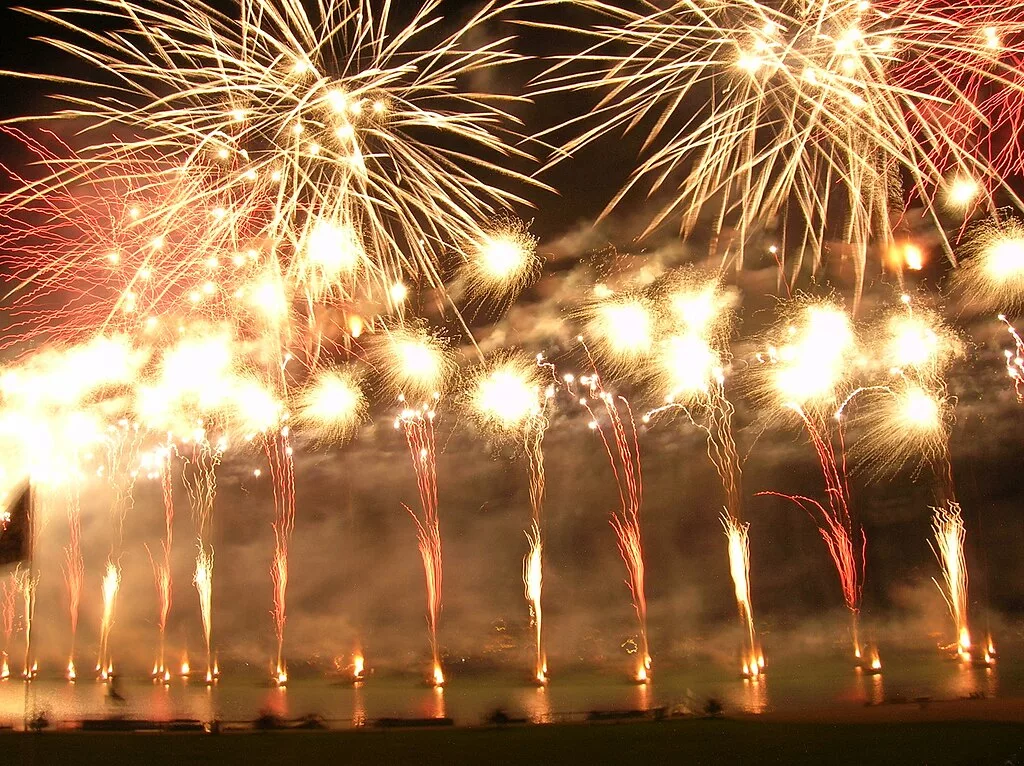
The Lake Festival is one of Annecy’s most iconic summer events. It takes place every year in August, usually on the first Saturday, on the shores of Lake Annecy, and attracts tens of thousands of spectators.
The highlight of the festival is the fireworks show, synchronized with music and launched from barges on the lake, offering a spectacular panorama over the city and the surrounding mountains. The festival also features concerts, entertainment, markets, and family activities, creating a festive and friendly atmosphere.
Excursions / Expeditions around Annecy
1. Mont Veyrier and Semnoz
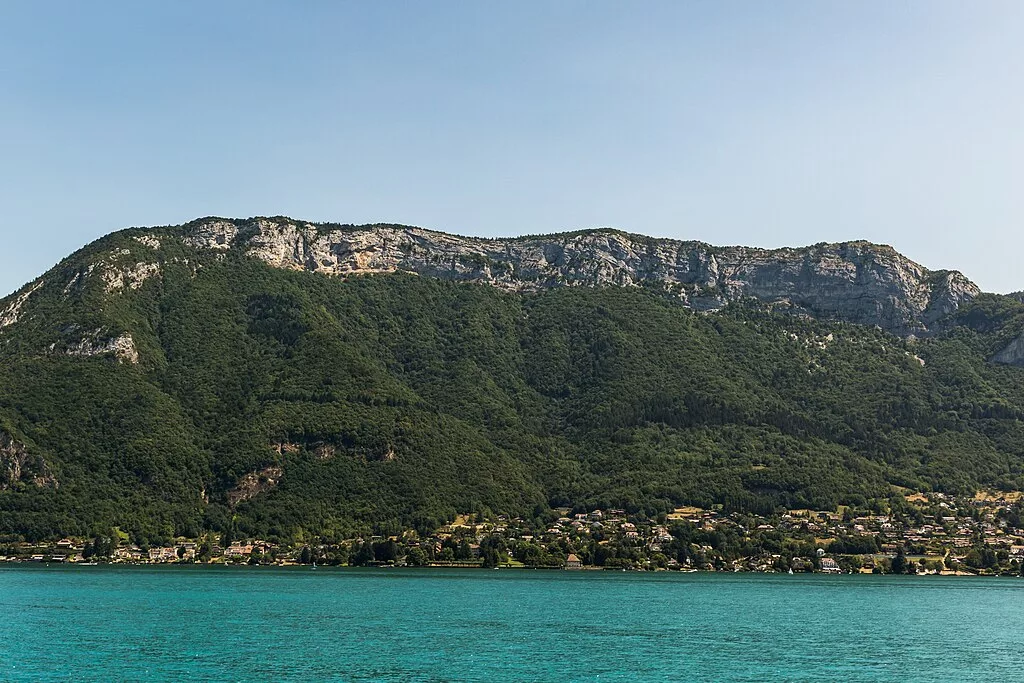
The Mont Veyrier and the Semnoz are two iconic mountain ranges overlooking Annecy and offering spectacular panoramas of the lake and surrounding mountains.
Mont Veyrier rises to 1,291 m and, together with Mont Baron, forms the mountain barrier bordering the eastern shore of the lake. It can be reached via several hiking trails of varying difficulty and offers unique viewpoints over the old town and Lake Annecy.
The Semnoz, often called “the balcony of the lake,” reaches 1,699 m and stretches across a plateau accessible by car, bicycle, or on foot. Semnoz is very popular for its outdoor activities: cross-country skiing and snowshoeing in winter, hiking, mountain biking, paragliding, and cycle touring in summer.
3. Gorges du Fier
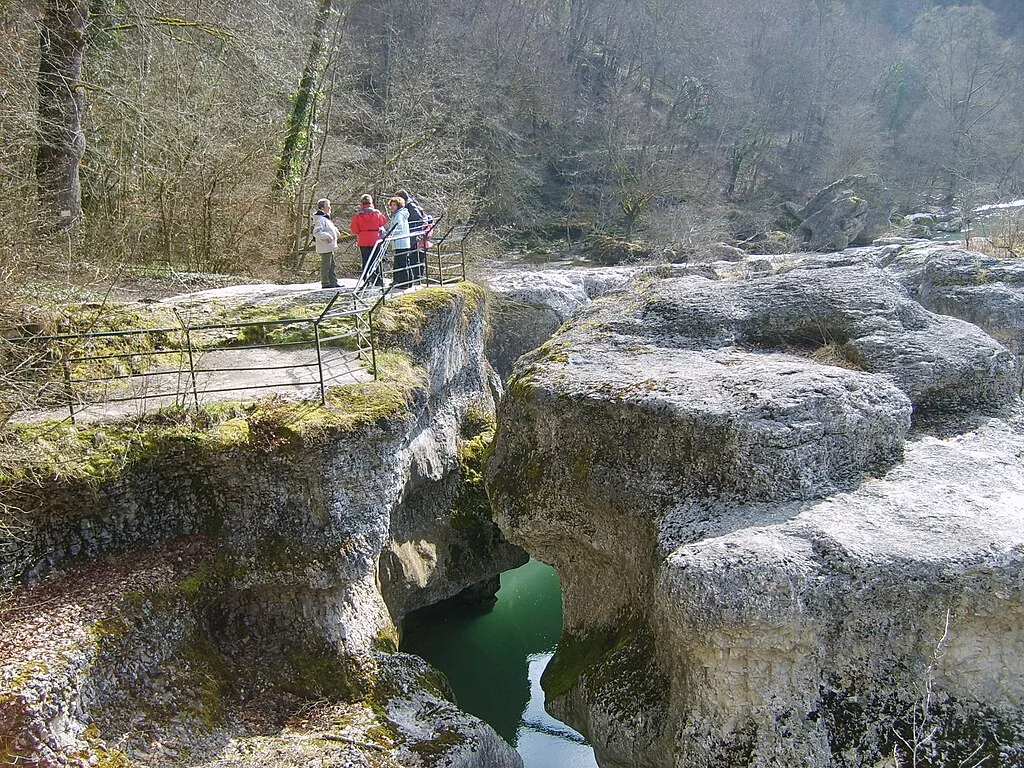
The Gorges du Fier are a spectacular natural formation located about 10 km from Annecy, in the commune of Lovagny. This impressive canyon, about 300 meters long and 25 meters deep, was carved by the Fier River into the limestone rock, forming dizzying walls sometimes only 3 meters apart.
A suspended footbridge allows visitors to cross the site and admire the waterfalls and shapes sculpted by the water over the centuries. The fauna and flora are also remarkable, with aquatic and forest species characteristic of the Savoyard Alps.
Discovered in 1869 by Baron Roussy and later developed for public visits, the gorge is now an unmissable tourist site, offering a striking natural spectacle accessible to the whole family.
4. Col de la Forclaz and Paragliding
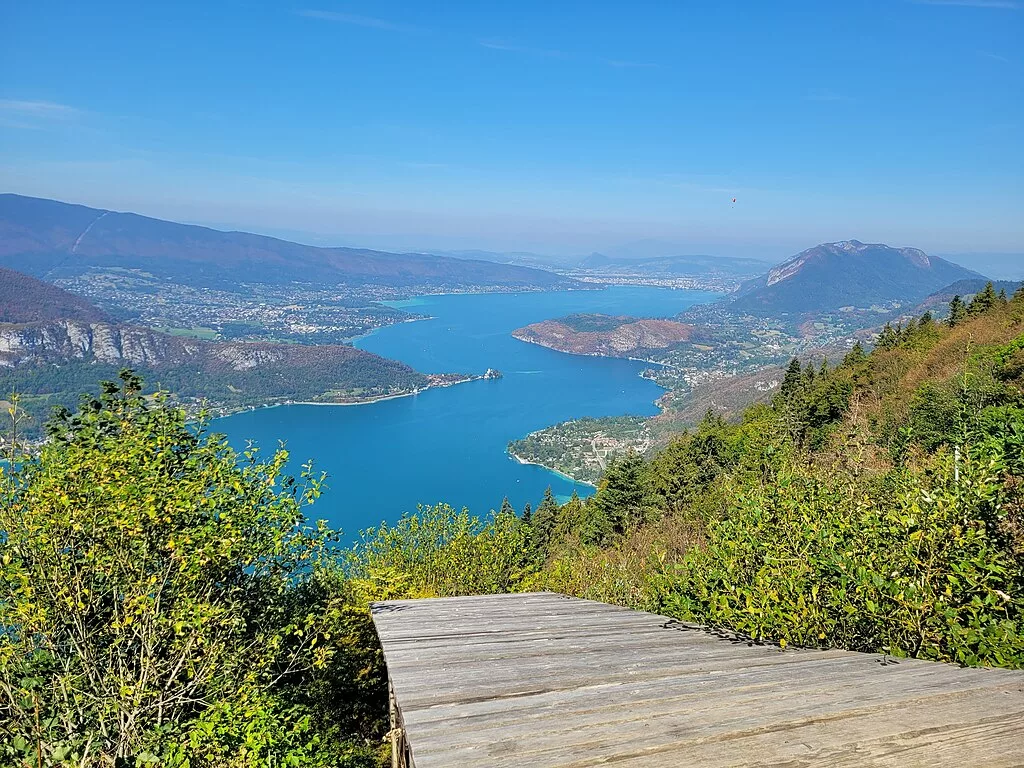
The Col de la Forclaz is a mountain pass located about 12 km from Annecy, at an altitude of 1,156 m, offering an exceptional panorama over Lake Annecy and the surrounding mountains. It is a popular spot for hikers, cyclists, and paragliding enthusiasts, as the wind conditions and thermal currents make it an ideal site for free flight.
The pass marks the starting point for many hiking trails, notably toward Mont Veyrier, and provides access to the plateaus and ridges of the Bauges massif. Several viewpoints offer spectacular views over the lake and the town of Annecy, making it a very popular place for tourists and photographers.
Conclusion
Visiting Annecy means combining natural beauty, historical heritage, and cultural richness. From picturesque canals and medieval streets to the castle and Alpine panoramas, every corner tells the story of the city.
Museums, parks, and lake walks offer moments of relaxation, while Savoyard specialties delight food lovers. Festivals, events, and water activities make the Annecy experience unforgettable.
Discover Annecy from a different perspective with our treasure hunt covering the must-sees of Annecy.